
Mapa mental
neurocutaneous syndromes
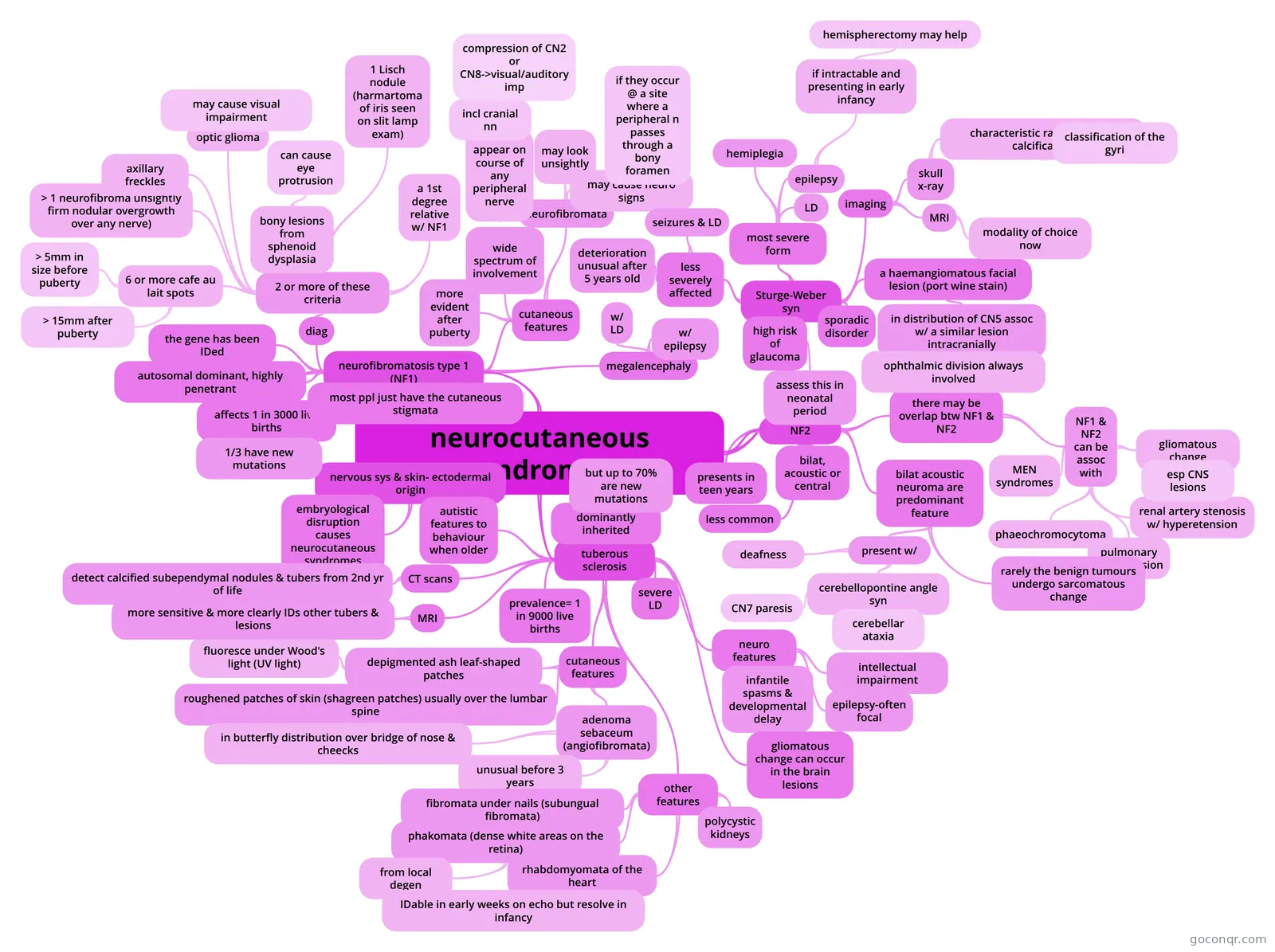
Mind map: neurocutaneous syndromes
Contenido del mapa
neurocutaneous syndromes
nervous sys & skin- ectodermal origin
- embryological disruption causes neurocutaneous syndromes
neurofibromatosis type 1 (NF1)
- affects 1 in 3000 live births
- 1/3 have new mutations
- autosomal dominant, highly penetrant
- the gene has been IDed
- diag
- 2 or more of these criteria
- 6 or more cafe au lait spots
- > 5mm in size before puberty
- > 15mm after puberty
- > 1 neurofibroma unsightly firm nodular overgrowth over any nerve)
- axillary freckles
- optic glioma
- may cause visual impairment
- 1 Lisch nodule (harmartoma of iris seen on slit lamp exam)
- bony lesions from sphenoid dysplasia
- can cause eye protrusion
- a 1st degree relative w/ NF1
- 6 or more cafe au lait spots
- 2 or more of these criteria
- cutaneous features
- more evident after puberty
- wide spectrum of involvement
- neurofibromata
- appear on course of any peripheral nerve
- incl cranial nn
- compression of CN2 or CN8->visual/auditory imp
- incl cranial nn
- may look unsightly
- may cause neuro signs
- if they occur @ a site where a peripheral n passes through a bony foramen
- appear on course of any peripheral nerve
- megalencephaly
- w/ LD
- w/ epilepsy
- most ppl just have the cutaneous stigmata
- affects 1 in 3000 live births
NF2
- bilat, acoustic or central
- less common
- presents in teen years
- bilat acoustic neuroma are predominant feature
- present w/
- deafness
- cerebellopontine angle syn
- CN7 paresis
- cerebellar ataxia
- rarely the benign tumours undergo sarcomatous change
- present w/
- there may be overlap btw NF1 & NF2
- NF1 & NF2 can be assoc with
- MEN syndromes
- phaeochromocytoma
- pulmonary hypertension
- renal artery stenosis w/ hyperetension
- gliomatous change
- esp CNS lesions
- NF1 & NF2 can be assoc with
tuberous sclerosis
- dominantly inherited
- but up to 70% are new mutations
- prevalence= 1 in 9000 live births
- cutaneous features
- depigmented ash leaf-shaped patches
- fluoresce under Wood's light (UV light)
- roughened patches of skin (shagreen patches) usually over the lumbar spine
- adenoma sebaceum (angiofibromata)
- in butterfly distribution over bridge of nose & cheecks
- unusual before 3 years
- depigmented ash leaf-shaped patches
- neuro features
- infantile spasms & developmental delay
- epilepsy-often focal
- intellectual impairment
- severe LD
- other features
- fibromata under nails (subungual fibromata)
- phakomata (dense white areas on the retina)
- from local degen
- rhabdomyomata of the heart
- IDable in early weeks on echo but resolve in infancy
- polycystic kidneys
- gliomatous change can occur in the brain lesions
- autistic features to behaviour when older
- CT scans
- detect calcified subependymal nodules & tubers from 2nd yr of life
- MRI
- more sensitive & more clearly IDs other tubers & lesions
- dominantly inherited
Sturge-Weber syn
- sporadic disorder
- a haemangiomatous facial lesion (port wine stain)
- in distribution of CN5 assoc w/ a similar lesion intracranially
- ophthalmic division always involved
- in distribution of CN5 assoc w/ a similar lesion intracranially
- imaging
- MRI
- modality of choice now
- skull x-ray
- characteristic rail-road track calcification
- classification of the gyri
- characteristic rail-road track calcification
- MRI
- most severe form
- epilepsy
- if intractable and presenting in early infancy
- hemispherectomy may help
- if intractable and presenting in early infancy
- LD
- hemiplegia
- epilepsy
- less severely affected
- seizures & LD
- deterioration unusual after 5 years old
- high risk of glaucoma
- assess this in neonatal period
Información
- Descripción
- paeds-neurology Mapa Mental sobre neurocutaneous syndromes, creado por v.djabatey el 12/01/2014.
- Creado por
- v.djabatey
- Visitas
- 173
- Etiquetas
- Valoración