
Mapa mental
Thermoregulation
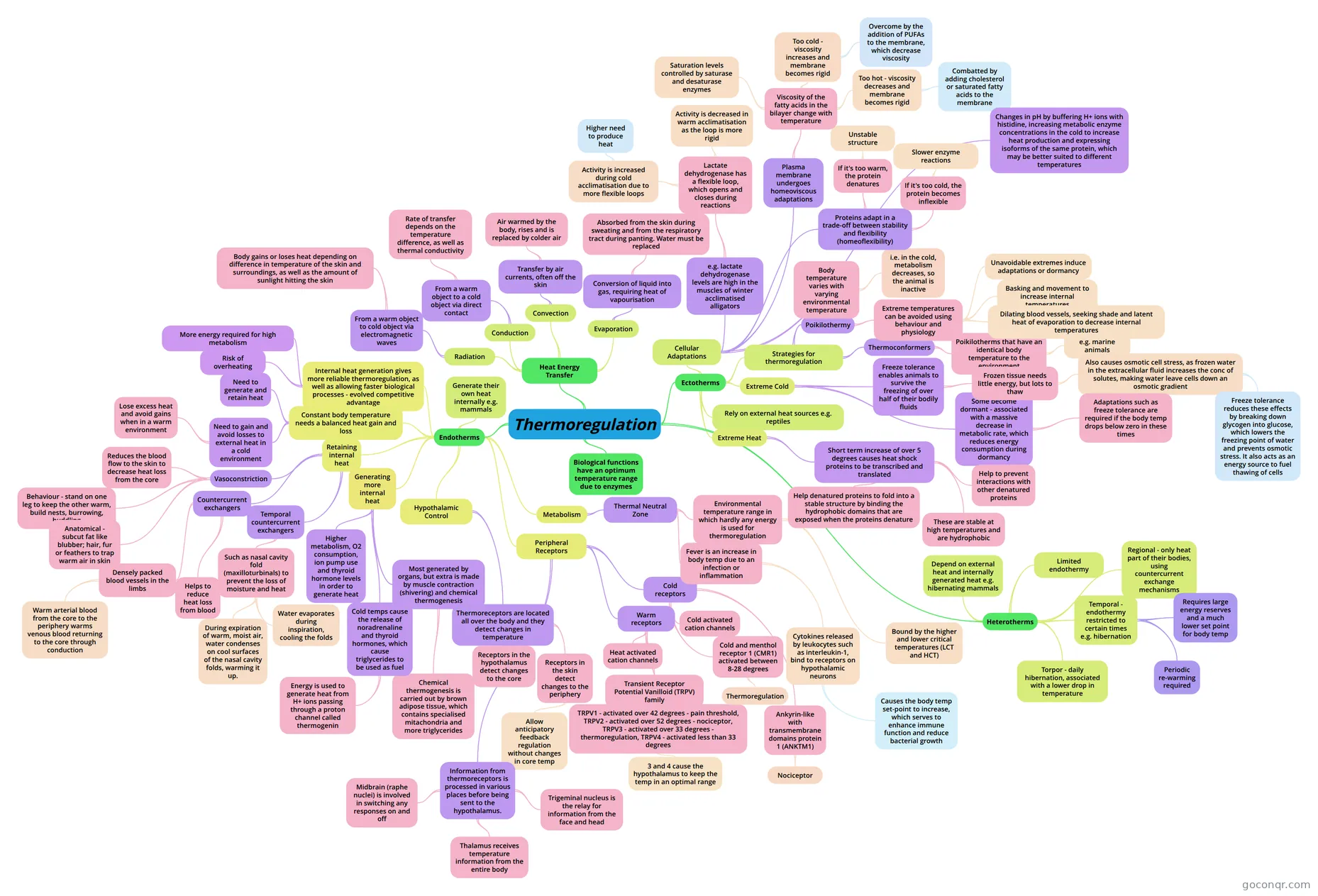
Mind map: thermoregulation
Contenido del mapa
Thermoregulation
Endotherms
- Generate their own heat internally e.g. mammals
- Internal heat generation gives more reliable thermoregulation, as well as allowing faster biological processes - evolved competitive advantage
- More energy required for high metabolism
- Risk of overheating
- Constant body temperature needs a balanced heat gain and loss
- Need to generate and retain heat
- Need to gain and avoid losses to external heat in a cold environment
- Lose excess heat and avoid gains when in a warm environment
- Retaining internal heat
- Vasoconstriction
- Reduces the blood flow to the skin to decrease heat loss from the core
- Behaviour - stand on one leg to keep the other warm, build nests, burrowing, huddling
- Anatomical - subcut fat like blubber; hair, fur or feathers to trap warm air in skin
- Countercurrent exchangers
- Densely packed blood vessels in the limbs
- Warm arterial blood from the core to the periphery warms venous blood returning to the core through conduction
- Helps to reduce heat loss from blood
- Densely packed blood vessels in the limbs
- Temporal countercurrent exchangers
- Such as nasal cavity fold (maxilloturbinals) to prevent the loss of moisture and heat
- During expiration of warm, moist air, water condenses on cool surfaces of the nasal cavity folds, warming it up.
- Water evaporates during inspiration, cooling the folds
- Such as nasal cavity fold (maxilloturbinals) to prevent the loss of moisture and heat
- Vasoconstriction
- Generating more internal heat
- Higher metabolism, O2 consumption, ion pump use and thyroid hormone levels in order to generate heat
- Most generated by organs, but extra is made by muscle contraction (shivering) and chemical thermogenesis
- Chemical thermogenesis is carried out by brown adipose tissue, which contains specialised mitachondria and more triglycerides
- Cold temps cause the release of noradrenaline and thyroid hormones, which cause triglycerides to be used as fuel
- Energy is used to generate heat from H+ ions passing through a proton channel called thermogenin
- Hypothalamic Control
- Thermoreceptors are located all over the body and they detect changes in temperature
- Receptors in the hypothalamus detect changes to the core
- Receptors in the skin detect changes to the periphery
- Allow anticipatory feedback regulation without changes in core temp
- Thermoreceptors are located all over the body and they detect changes in temperature
- Peripheral Receptors
- Warm receptors
- Heat activated cation channels
- Transient Receptor Potential Vanilloid (TRPV) family
- TRPV1 - activated over 42 degrees - pain threshold, TRPV2 - activated over 52 degrees - nociceptor, TRPV3 - activated over 33 degrees - thermoregulation, TRPV4 - activated less than 33 degrees
- 3 and 4 cause the hypothalamus to keep the temp in an optimal range
- Cold receptors
- Cold activated cation channels
- Cold and menthol receptor 1 (CMR1) activated between 8-28 degrees
- Thermoregulation
- Ankyrin-like with transmembrane domains protein 1 (ANKTM1)
- Nociceptor
- Information from thermoreceptors is processed in various places before being sent to the hypothalamus.
- Trigeminal nucleus is the relay for information from the face and head
- Thalamus receives temperature information from the entire body
- Midbrain (raphe nuclei) is involved in switching any responses on and off
- Warm receptors
- Metabolism
- Thermal Neutral Zone
- Environmental temperature range in which hardly any energy is used for thermoregulation
- Bound by the higher and lower critical temperatures (LCT and HCT)
- Fever is an increase in body temp due to an infection or inflammation
- Cytokines released by leukocytes such as interleukin-1, bind to receptors on hypothalamic neurons
- Causes the body temp set-point to increase, which serves to enhance immune function and reduce bacterial growth
- Cytokines released by leukocytes such as interleukin-1, bind to receptors on hypothalamic neurons
- Environmental temperature range in which hardly any energy is used for thermoregulation
- Thermal Neutral Zone
Ectotherms
- Cellular Adaptations
- e.g. lactate dehydrogenase levels are high in the muscles of winter acclimatised alligators
- Lactate dehydrogenase has a flexible loop, which opens and closes during reactions
- Activity is increased during cold acclimatisation due to more flexible loops
- Higher need to produce heat
- Activity is decreased in warm acclimatisation as the loop is more rigid
- Activity is increased during cold acclimatisation due to more flexible loops
- Lactate dehydrogenase has a flexible loop, which opens and closes during reactions
- Proteins adapt in a trade-off between stability and flexibility (homeoflexibility)
- If it's too warm, the protein denatures
- Unstable structure
- If it's too cold, the protein becomes inflexible
- Slower enzyme reactions
- If it's too warm, the protein denatures
- Plasma membrane undergoes homeoviscous adaptations
- Viscosity of the fatty acids in the bilayer change with temperature
- Too hot - viscosity decreases and membrane becomes rigid
- Combatted by adding cholesterol or saturated fatty acids to the membrane
- Too cold - viscosity increases and membrane becomes rigid
- Overcome by the addition of PUFAs to the membrane, which decrease viscosity
- Saturation levels controlled by saturase and desaturase enzymes
- Too hot - viscosity decreases and membrane becomes rigid
- Viscosity of the fatty acids in the bilayer change with temperature
- Changes in pH by buffering H+ ions with histidine, increasing metabolic enzyme concentrations in the cold to increase heat production and expressing isoforms of the same protein, which may be better suited to different temperatures
- e.g. lactate dehydrogenase levels are high in the muscles of winter acclimatised alligators
- Rely on external heat sources e.g. reptiles
- Strategies for thermoregulation
- Poikilothermy
- Body temperature varies with varying environmental temperature
- i.e. in the cold, metabolism decreases, so the animal is inactive
- Extreme temperatures can be avoided using behaviour and physiology
- Unavoidable extremes induce adaptations or dormancy
- Basking and movement to increase internal temperatures
- Dilating blood vessels, seeking shade and latent heat of evaporation to decrease internal temperatures
- Body temperature varies with varying environmental temperature
- Thermoconformers
- Poikilotherms that have an identical body temperature to the environment
- e.g. marine animals
- Poikilotherms that have an identical body temperature to the environment
- Poikilothermy
- Extreme Cold
- Some become dormant - associated with a massive decrease in metabolic rate, which reduces energy consumption during dormancy
- Adaptations such as freeze tolerance are required if the body temp drops below zero in these times
- Freeze tolerance enables animals to survive the freezing of over half of their bodily fluids
- Frozen tissue needs little energy, but lots to thaw
- Also causes osmotic cell stress, as frozen water in the extracellular fluid increases the conc of solutes, making water leave cells down an osmotic gradient
- Freeze tolerance reduces these effects by breaking down glycogen into glucose, which lowers the freezing point of water and prevents osmotic stress. It also acts as an energy source to fuel thawing of cells
- Also causes osmotic cell stress, as frozen water in the extracellular fluid increases the conc of solutes, making water leave cells down an osmotic gradient
- Frozen tissue needs little energy, but lots to thaw
- Some become dormant - associated with a massive decrease in metabolic rate, which reduces energy consumption during dormancy
- Extreme Heat
- Short term increase of over 5 degrees causes heat shock proteins to be transcribed and translated
- These are stable at high temperatures and are hydrophobic
- Help denatured proteins to fold into a stable structure by binding the hydrophobic domains that are exposed when the proteins denature
- Help to prevent interactions with other denatured proteins
- Short term increase of over 5 degrees causes heat shock proteins to be transcribed and translated
- Cellular Adaptations
Heterotherms
- Depend on external heat and internally generated heat e.g. hibernating mammals
- Limited endothermy
- Regional - only heat part of their bodies, using countercurrent exchange mechanisms
- Temporal - endothermy restricted to certain times e.g. hibernation
- Requires large energy reserves and a much lower set point for body temp
- Periodic re-warming required
- Torpor - daily hibernation, associated with a lower drop in temperature
Biological functions have an optimum temperature range due to enzymes
Heat Energy Transfer
- Conduction
- From a warm object to a cold object via direct contact
- Rate of transfer depends on the temperature difference, as well as thermal conductivity
- From a warm object to a cold object via direct contact
- Convection
- Transfer by air currents, often off the skin
- Air warmed by the body, rises and is replaced by colder air
- Transfer by air currents, often off the skin
- Evaporation
- Conversion of liquid into gas, requiring heat of vapourisation
- Absorbed from the skin during sweating and from the respiratory tract during panting. Water must be replaced
- Conversion of liquid into gas, requiring heat of vapourisation
- Radiation
- From a warm object to cold object via electromagnetic waves
- Body gains or loses heat depending on difference in temperature of the skin and surroundings, as well as the amount of sunlight hitting the skin
- From a warm object to cold object via electromagnetic waves
- Conduction
Información
- Descripción
- Undergraduate Coordinated Physiological Functions Mapa Mental sobre Thermoregulation, creado por Lydia Buckmaster el 13/01/2014.
- Creado por
- Lydia Buckmaster
- Visitas
- 453
- Etiquetas
- Valoración