
Mapa mental
1.8 Factors Effecting Enzyme Action
Contenido del mapa
1.8 Factors Effecting Enzyme Action
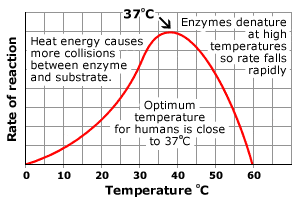
Temperature
- A higher temperature means the substrate and enzyme molecules have more kinetic energy and move around more
- More collisions
- MORE ENZYME-SUBSTRATE COMPLEXES FORMED
- The way this speeds up the reaction, is because the enzyme and substrate molecules come together to produce MORE enzyme-substrate complexes in a given time.
- Faster Rate of Reaction
- MORE ENZYME-SUBSTRATE COMPLEXES FORMED
- More collisions
- There is an optimum temperature
- Any temperature higher than the enzymes optimum will have enough energy to break the bonds that hold the enzyme in shape
- So therefore past the optimum, the enzyme becomes DENATURED
- It is no longer functional
- So therefore past the optimum, the enzyme becomes DENATURED
- Any temperature higher than the enzymes optimum will have enough energy to break the bonds that hold the enzyme in shape
- A higher temperature means the substrate and enzyme molecules have more kinetic energy and move around more
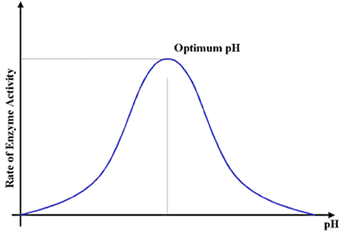
pH
- All enzymes have a maximum pH value
- They also have a minimum
- The pH of a solution is also a measure of its hydrogen ion concentration
- Above and below the optimum (maximum) pH, the H+ ions and OH- Ions ound in acids and alkali's can mess up the ionic and hydrogen bonds holding the enzymes tertiary structure in place
- So on either side of the optimum, the enzyme can be DENATURED!
- A change in pH alters the charges on the amino acids that make up the active site of the enzyme.
- As a result, the substrate can no longer attach to active site = NO ENZYME-SUBSTRATE COMPLEXES FORMED
- The phrase "ENZYME-SUBSTRATE COMPLEXES" is in capitals because in your exam, that phrase, is key. In most enzyme questions there will be one mark just for that small phrase - easy marks!
- As a result, the substrate can no longer attach to active site = NO ENZYME-SUBSTRATE COMPLEXES FORMED
- All enzymes have a maximum pH value
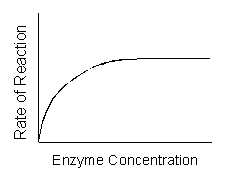
Enzyme Concentration
- Once an active site of an enzyme has acted on its substrate, it is free to repeat the procedure on another substrate molecule
- More enzyme molecules in a solution
- more likely substrate is to collide with one and form an ENZYME-SUBSTRATE COMPLEX
- therefore: Increasing the concentration of enzyme increases the rate of reaction
- more likely substrate is to collide with one and form an ENZYME-SUBSTRATE COMPLEX
- However, if the amount of substrate is limited
- Increase in enzyme concentrate eventually has no further effect
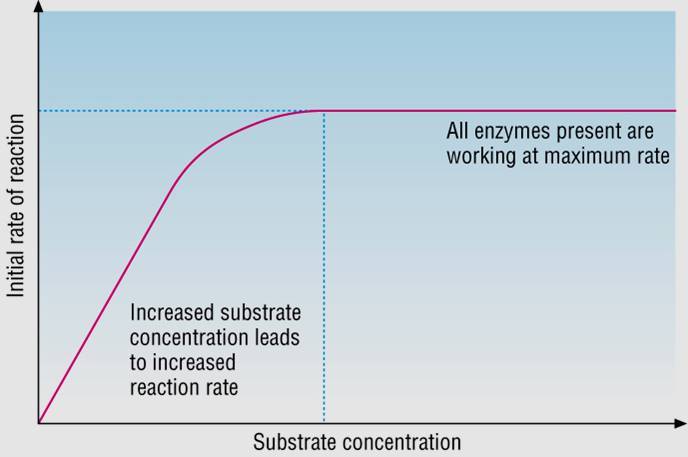
Substrate Concentration
- Higher the substrate concentration, the faster the reaction
- this is because collisions become more likely and more active sites will be used
- More ENZYME-SUBSTRATE COMPLEXES
- this is because collisions become more likely and more active sites will be used
- Saturation Point
- All active sites are full/in use
- Substrate concentration makes no difference
- All active sites are full/in use
- Substrate conc. decreases with time during a reaction (unless more is added to reaction mixture)
- If no other variables changed, rate of reaction will decrease over time too
- This means initial rate of reaction = highest rate of reaction
- If no other variables changed, rate of reaction will decrease over time too
- Higher the substrate concentration, the faster the reaction
Imágenes y archivos del mapa
Información
- Descripción
- AS - Level (1 - Biological Molecules) Biology Mapa Mental sobre 1.8 Factors Effecting Enzyme Action, creado por Bee Brittain el 29/03/2016.
- Creado por
- Bee Brittain
- Visitas
- 202
- Etiquetas
- Valoración