
Mapa mental
Topic 4) Gas exchange and transport
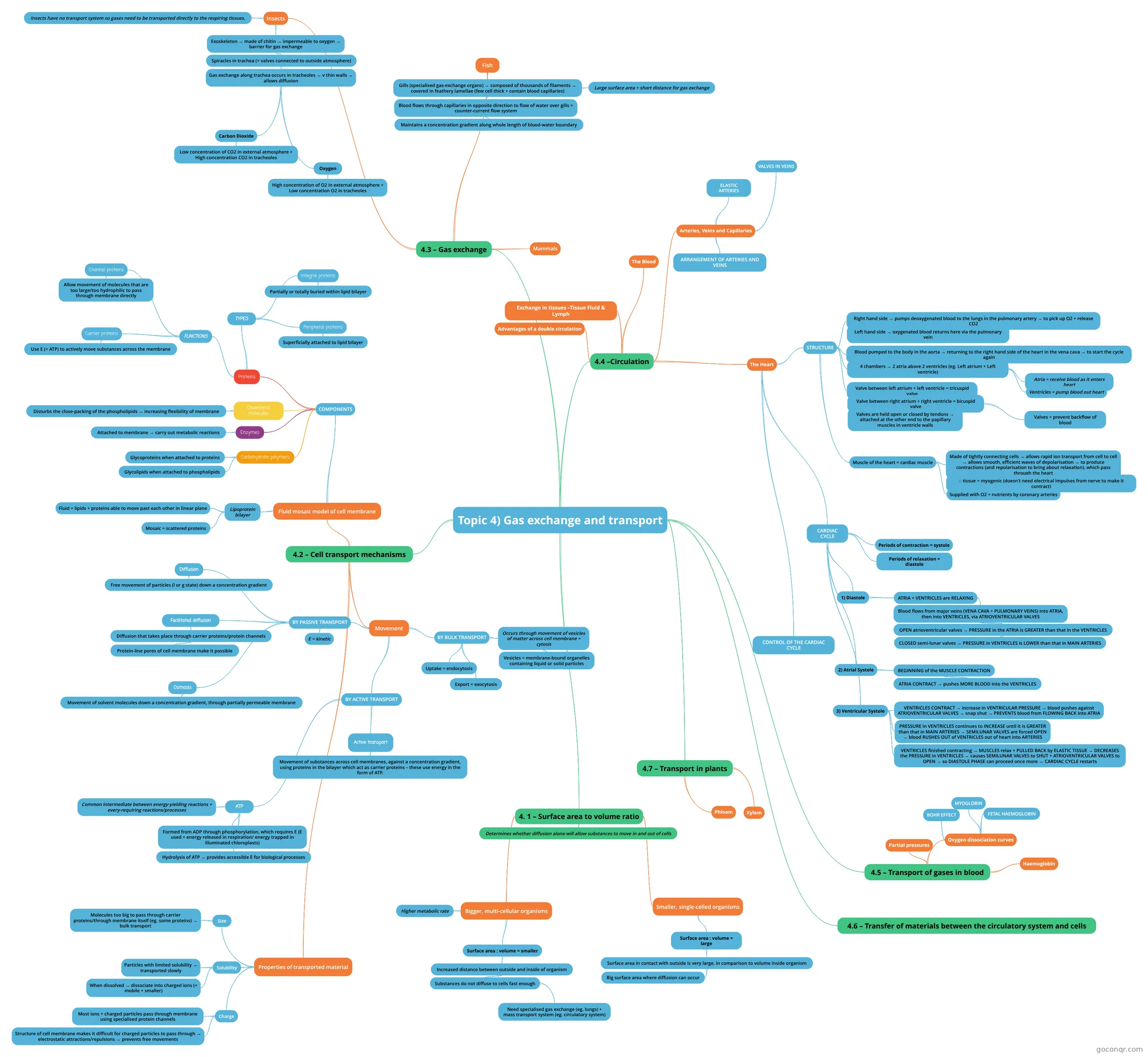
Mind map: gas exchange and transport biology
Contenido del mapa
Topic 4) Gas exchange and transport
4. 1 – Surface area to volume ratio
- Smaller, single-celled organisms
- Surface area : volume = large
- Surface area in contact with outside is very large, in comparison to volume inside organism
- Big surface area where diffusion can occur
- Surface area in contact with outside is very large, in comparison to volume inside organism
- Surface area : volume = large
- Bigger, multi-cellular organisms
- Surface area : volume = smaller
- Increased distance between outside and inside of organism
- Substances do not diffuse to cells fast enough
- Need specialised gas exchange (eg. lungs) + mass transport system (eg. circulatory system)
- Substances do not diffuse to cells fast enough
- Increased distance between outside and inside of organism
- Higher metabolic rate
- Surface area : volume = smaller
- Determines whether diffusion alone will allow substances to move in and out of cells
- Smaller, single-celled organisms
4.2 – Cell transport mechanisms
- Fluid mosaic model of cell membrane
- Lipoprotein bilayer
- Mosaic = scattered proteins
- Fluid = lipids + proteins able to move past each other in linear plane
- COMPONENTS
- Carbohydrate polymers
- Glycolipids when attached to phospholipids
- Glycoproteins when attached to proteins
- Enzymes
- Attached to membrane → carry out metabolic reactions
- Cholesterol molecules
- Disturbs the close-packing of the phospholipids → increasing flexibility of membrane
- Proteins
- TYPES
- Integral proteins
- Partially or totally buried within lipid bilayer
- Peripheral proteins
- Superficially attached to lipid bilayer
- Integral proteins
- FUNCTIONS
- Channel proteins
- Allow movement of molecules that are too large/too hydrophilic to pass through membrane directly
- Carrier proteins
- Use E (= ATP) to actively move substances across the membrane
- Channel proteins
- TYPES
- Carbohydrate polymers
- Lipoprotein bilayer
- Movement
- BY PASSIVE TRANSPORT
- Diffusion
- Free movement of particles (l or g state) down a concentration gradient
- Facilitated diffusion
- Diffusion that takes place through carrier proteins/protein channels
- Protein-line pores of cell membrane make it possible
- Diffusion that takes place through carrier proteins/protein channels
- Osmosis
- Movement of solvent molecules down a concentration gradient, through partially permeable membrane
- E = kinetic
- Diffusion
- BY ACTIVE TRANSPORT
- Active transport
- Movement of substances across cell membranes, against a concentration gradient, using proteins in the bilayer which act as carrier proteins – these use energy in the form of ATP.
- ATP
- Common intermediate between energy-yielding reactions + every-requiring reactions/processes
- Formed from ADP through phosphorylation, which requires E (E used = energy released in respiration/ energy trapped in illuminated chloroplasts)
- Hydrolysis of ATP → provides accessible E for biological processes
- Active transport
- BY BULK TRANSPORT
- Occurs through movement of vesicles of matter across cell membrane = cytosis
- Vesicles = membrane-bound organelles containing liquid or solid particles
- Uptake = endocytosis
- Export = exocytosis
- Occurs through movement of vesicles of matter across cell membrane = cytosis
- BY PASSIVE TRANSPORT
- Properties of transported material
- Size
- Molecules too big to pass through carrier proteins/through membrane itself (eg. some proteins) → bulk transport
- Solubility
- Particles with limited solubility → transported slowly
- When dissolved → dissociate into charged ions (= mobile + smaller)
- Charge
- Structure of cell membrane makes it difficult for charged particles to pass through → electrostatic attractions/repulsions → prevents free movements
- Most ions + charged particles pass through membrane using specialised protein channels
- Size
- Fluid mosaic model of cell membrane
4.3 – Gas exchange
- Insects
- Insects have no transport system so gases need to be transported directly to the respiring tissues.
- Exoskeleton → made of chitin → impermeable to oxygen → barrier for gas exchange
- Spiracles in trachea (= valves connected to outside atmosphere)
- Gas exchange along trachea occurs in tracheoles → v thin walls → allows diffusion
- Oxygen
- High concentration of O2 in external atmosphere ≠ Low concentration O2 in tracheoles
- Carbon Dioxide
- Low concentration of CO2 in external atmosphere ≠ High concentration CO2 in tracheoles
- Oxygen
- Gas exchange along trachea occurs in tracheoles → v thin walls → allows diffusion
- Spiracles in trachea (= valves connected to outside atmosphere)
- Fish
- Gills (specialised gas-exchange organs) → composed of thousands of filaments → covered in feathery lamellae (few cell thick + contain blood capillaries)
- Large surface area + short distance for gas exchange
- Blood flows through capillaries in opposite direction to flow of water over gills = counter-current flow system
- Maintains a concentration gradient along whole length of blood-water boundary
- Gills (specialised gas-exchange organs) → composed of thousands of filaments → covered in feathery lamellae (few cell thick + contain blood capillaries)
- Mammals
- Insects
4.4 –Circulation
- Advantages of a double circulation
- The Blood
- Arteries, Veins and Capillaries
- ELASTIC ARTERIES
- VALVES IN VEINS
- ARRANGEMENT OF ARTERIES AND VEINS
- The Heart
- CARDIAC CYCLE
- Periods of contraction = systole
- Periods of relaxation = diastole
- 1) Diastole
- ATRIA + VENTRICLES are RELAXING
- Blood flows from major veins (VENA CAVA + PULMONARY VEINS) into ATRIA, then into VENTRICLES, via ATRIOVENTRICULAR VALVES
- OPEN atrioventricular valves → PRESSURE in the ATRIA is GREATER than that in the VENTRICLES
- CLOSED semi-lunar valves → PRESSURE in VENTRICLES is LOWER than that in MAIN ARTERIES
- OPEN atrioventricular valves → PRESSURE in the ATRIA is GREATER than that in the VENTRICLES
- Blood flows from major veins (VENA CAVA + PULMONARY VEINS) into ATRIA, then into VENTRICLES, via ATRIOVENTRICULAR VALVES
- ATRIA + VENTRICLES are RELAXING
- 2) Atrial Systole
- BEGINNING of the MUSCLE CONTRACTION
- ATRIA CONTRACT → pushes MORE BLOOD into the VENTRICLES
- BEGINNING of the MUSCLE CONTRACTION
- 3) Ventricular Systole
- VENTRICLES CONTRACT → increase in VENTRICULAR PRESSURE → blood pushes against ATRIOVENTRICULAR VALVES → snap shut → PREVENTS blood from FLOWING BACK into ATRIA
- PRESSURE in VENTRICLES continues to INCREASE until it is GREATER than that in MAIN ARTERIES → SEMILUNAR VALVES are forced OPEN → blood RUSHES OUT of VENTRICLES out of heart into ARTERIES
- VENTRICLES finished contracting → MUSCLES relax + PULLED BACK by ELASTIC TISSUE → DECREASES the PRESSURE in VENTRICLES → causes SEMILUNAR VALVES to SHUT + ATRIOVENTRICULAR VALVES to OPEN → so DIASTOLE PHASE can proceed once more → CARDIAC CYCLE restarts
- CONTROL OF THE CARDIAC CYCLE
- STRUCTURE
- Right hand side → pumps deoxygenated blood to the lungs in the pulmonary artery → to pick up O2 + release CO2
- Left hand side → oxygenated blood returns here via the pulmonary vein
- Blood pumped to the body in the aorta → returning to the right hand side of the heart in the vena cava → to start the cycle again
- 4 chambers → 2 atria above 2 ventricles (eg. Left atrium + Left ventricle)
- Atria = receive blood as it enters heart
- Ventricles = pump blood out heart
- Valve between left atrium + left ventricle = tricuspid valve
- Valve between right atrium + right ventricle = bicuspid valve
- Valves = prevent backflow of blood
- Valves are held open or closed by tendons → attached at the other end to the papillary muscles in ventricle walls
- Valve between right atrium + right ventricle = bicuspid valve
- Muscle of the heart = cardiac muscle
- Made of tightly connecting cells → allows rapid ion transport from cell to cell → allows smooth, efficient waves of depolarisation → to produce contractions (and repolarisation to bring about relaxation), which pass through the heart
- ∴ tissue = myogenic (doesn't need electrical impulses from nerve to make it contract)
- Supplied with O2 + nutrients by coronary arteries
- Made of tightly connecting cells → allows rapid ion transport from cell to cell → allows smooth, efficient waves of depolarisation → to produce contractions (and repolarisation to bring about relaxation), which pass through the heart
- Right hand side → pumps deoxygenated blood to the lungs in the pulmonary artery → to pick up O2 + release CO2
- CARDIAC CYCLE
- Exchange in tissues –Tissue Fluid & Lymph
4.5 – Transport of gases in blood
- Haemoglobin
- Partial pressures
- Oxygen dissociation curves
- BOHR EFFECT
- MYOGLOBIN
- FETAL HAEMOGLOBIN
4.6 – Transfer of materials between the circulatory system and cells
4.7 – Transport in plants
- Xylem
- Phloem
Información
- Descripción
- AS - Level A Level – Biology Mapa Mental sobre Topic 4) Gas exchange and transport, creado por E A el 05/04/2016.
- Creado por
- E A
- Visitas
- 83
- Etiquetas
- Valoración