
Mapa mental
Attachment 2
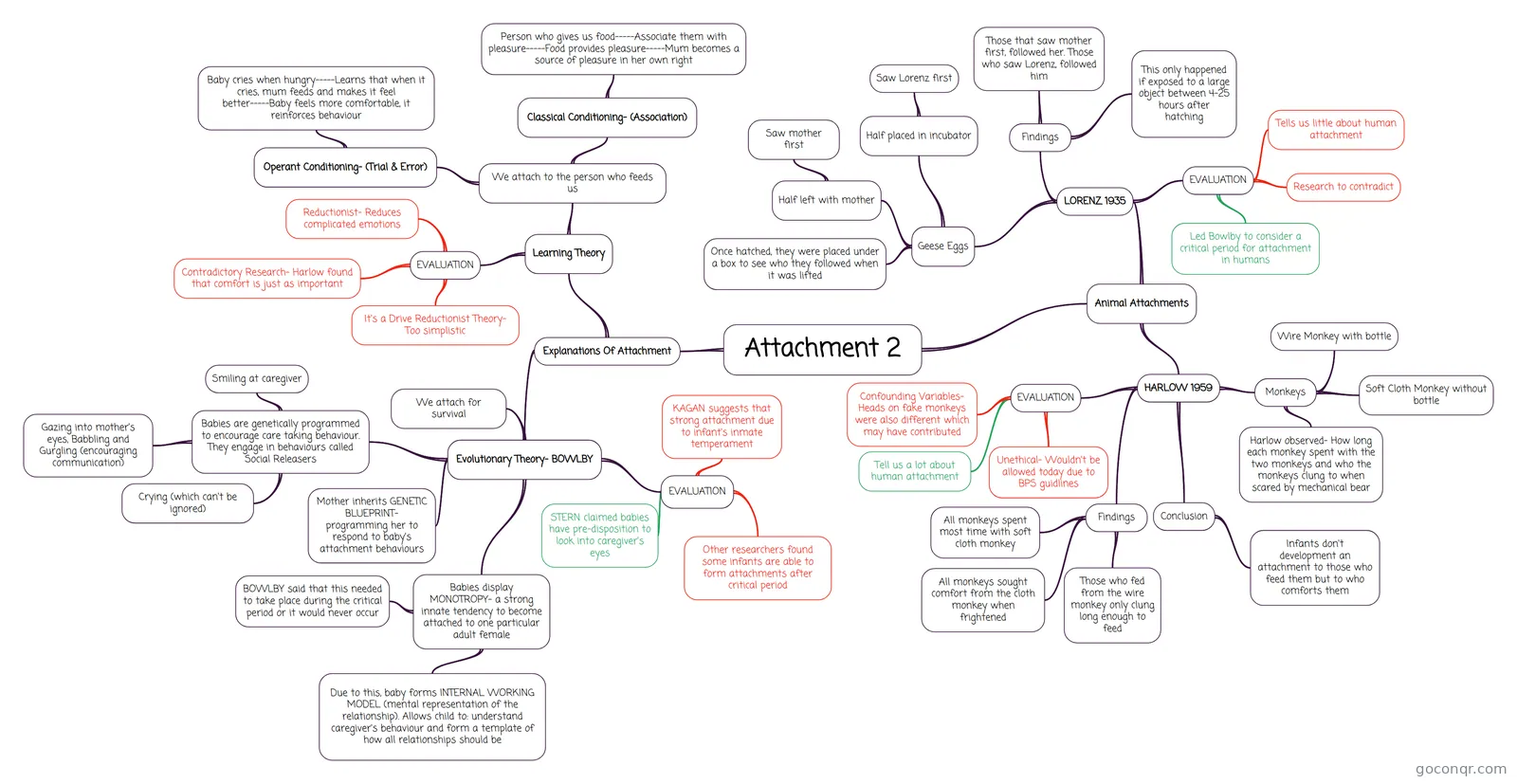
Mind map: Animal Attachments and Explanations
Contenido del mapa
Attachment 2
Animal Attachments
- LORENZ 1935
- Geese Eggs
- Half left with mother
- Saw mother first
- Half placed in incubator
- Saw Lorenz first
- Once hatched, they were placed under a box to see who they followed when it was lifted
- Half left with mother
- Findings
- Those that saw mother first, followed her. Those who saw Lorenz, followed him
- This only happened if exposed to a large object between 4-25 hours after hatching
- EVALUATION
- Tells us little about human attachment
- Research to contradict
- Led Bowlby to consider a critical period for attachment in humans
- Geese Eggs
- HARLOW 1959
- Monkeys
- Wire Monkey with bottle
- Soft Cloth Monkey without bottle
- Harlow observed- How long each monkey spent with the two monkeys and who the monkeys clung to when scared by mechanical bear
- Findings
- All monkeys spent most time with soft cloth monkey
- Those who fed from the wire monkey only clung long enough to feed
- All monkeys sought comfort from the cloth monkey when frightened
- Conclusion
- Infants don't development an attachment to those who feed them but to who comforts them
- EVALUATION
- Unethical- Wouldn't be allowed today due to BPS guidlines
- Confounding Variables- Heads on fake monkeys were also different which may have contributed
- Tell us a lot about human attachment
- Monkeys
- LORENZ 1935
Explanations Of Attachment
- Learning Theory
- We attach to the person who feeds us
- Classical Conditioning- (Association)
- Person who gives us food-----Associate them with pleasure-----Food provides pleasure-----Mum becomes a source of pleasure in her own right
- Operant Conditioning- (Trial & Error)
- Baby cries when hungry-----Learns that when it cries, mum feeds and makes it feel better-----Baby feels more comfortable, it reinforces behaviour
- Classical Conditioning- (Association)
- EVALUATION
- Reductionist- Reduces complicated emotions
- Contradictory Research- Harlow found that comfort is just as important
- It's a Drive Reductionist Theory- Too simplistic
- We attach to the person who feeds us
- Evolutionary Theory- BOWLBY
- We attach for survival
- Babies are genetically programmed to encourage care taking behaviour. They engage in behaviours called Social Releasers
- Crying (which can't be ignored)
- Gazing into mother's eyes, Babbling and Gurgling (encouraging communication)
- Smiling at caregiver
- Mother inherits GENETIC BLUEPRINT- programming her to respond to baby's attachment behaviours
- Babies display MONOTROPY- a strong innate tendency to become attached to one particular adult female
- BOWLBY said that this needed to take place during the critical period or it would never occur
- Due to this, baby forms INTERNAL WORKING MODEL (mental representation of the relationship). Allows child to: understand caregiver's behaviour and form a template of how all relationships should be
- EVALUATION
- KAGAN suggests that strong attachment due to infant's inmate temperament
- STERN claimed babies have pre-disposition to look into caregiver's eyes
- Other researchers found some infants are able to form attachments after critical period
- Learning Theory
Información
- Descripción
- Animal Attachments Explanations Of Attachment
- Creado por
- laurenjaynewalte
- Visitas
- 13
- Valoración
Más sobre Animal studies of attachment