
Mapa mental
CONTEXT - SHAKESPEARE
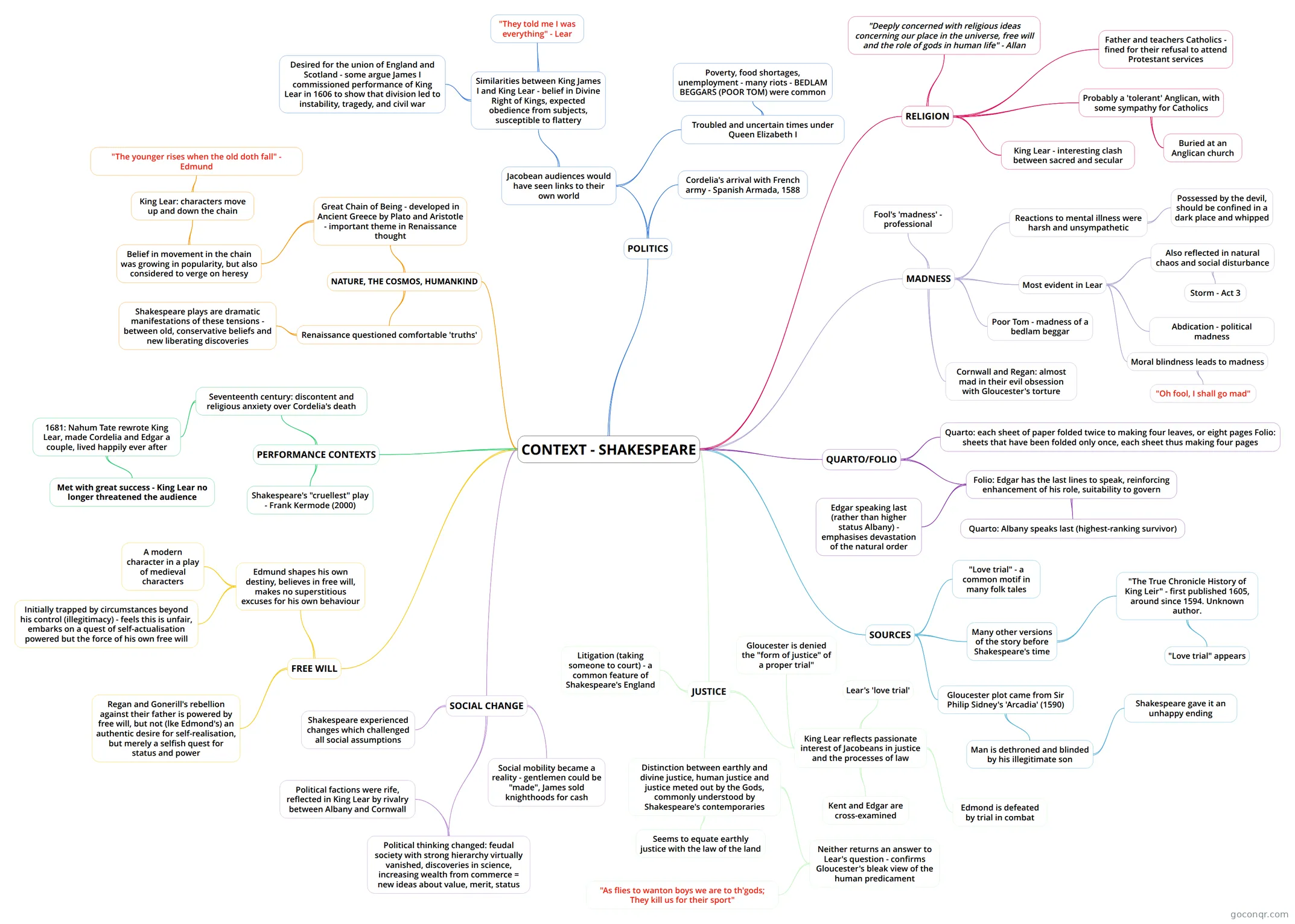
Mind map: Shakespeare Context
Contenido del mapa
CONTEXT - SHAKESPEARE
RELIGION
- "Deeply concerned with religious ideas concerning our place in the universe, free will and the role of gods in human life" - Allan
- Father and teachers Catholics - fined for their refusal to attend Protestant services
- Probably a 'tolerant' Anglican, with some sympathy for Catholics
- Buried at an Anglican church
- King Lear - interesting clash between sacred and secular
QUARTO/FOLIO
- Quarto: each sheet of paper folded twice to making four leaves, or eight pages Folio: sheets that have been folded only once, each sheet thus making four pages
- Folio: Edgar has the last lines to speak, reinforcing enhancement of his role, suitability to govern
- Quarto: Albany speaks last (highest-ranking survivor)
- Edgar speaking last (rather than higher status Albany) - emphasises devastation of the natural order
SOURCES
- Many other versions of the story before Shakespeare's time
- "The True Chronicle History of King Leir" - first published 1605, around since 1594. Unknown author.
- "Love trial" appears
- "The True Chronicle History of King Leir" - first published 1605, around since 1594. Unknown author.
- "Love trial" - a common motif in many folk tales
- Gloucester plot came from Sir Philip Sidney's 'Arcadia' (1590)
- Man is dethroned and blinded by his illegitimate son
- Shakespeare gave it an unhappy ending
- Man is dethroned and blinded by his illegitimate son
- Many other versions of the story before Shakespeare's time
PERFORMANCE CONTEXTS
- Seventeenth century: discontent and religious anxiety over Cordelia's death
- 1681: Nahum Tate rewrote King Lear, made Cordelia and Edgar a couple, lived happily ever after
- Met with great success - King Lear no longer threatened the audience
- 1681: Nahum Tate rewrote King Lear, made Cordelia and Edgar a couple, lived happily ever after
- Shakespeare's "cruellest" play - Frank Kermode (2000)
- Seventeenth century: discontent and religious anxiety over Cordelia's death
NATURE, THE COSMOS, HUMANKIND
- Great Chain of Being - developed in Ancient Greece by Plato and Aristotle - important theme in Renaissance thought
- Belief in movement in the chain was growing in popularity, but also considered to verge on heresy
- King Lear: characters move up and down the chain
- "The younger rises when the old doth fall" - Edmund
- King Lear: characters move up and down the chain
- Belief in movement in the chain was growing in popularity, but also considered to verge on heresy
- Renaissance questioned comfortable 'truths'
- Shakespeare plays are dramatic manifestations of these tensions - between old, conservative beliefs and new liberating discoveries
- Great Chain of Being - developed in Ancient Greece by Plato and Aristotle - important theme in Renaissance thought
FREE WILL
- Edmund shapes his own destiny, believes in free will, makes no superstitious excuses for his own behaviour
- A modern character in a play of medieval characters
- Initially trapped by circumstances beyond his control (illegitimacy) - feels this is unfair, embarks on a quest of self-actualisation powered but the force of his own free will
- Regan and Gonerill's rebellion against their father is powered by free will, but not (lke Edmond's) an authentic desire for self-realisation, but merely a selfish quest for status and power
- Edmund shapes his own destiny, believes in free will, makes no superstitious excuses for his own behaviour
POLITICS
- Jacobean audiences would have seen links to their own world
- Troubled and uncertain times under Queen Elizabeth I
- Poverty, food shortages, unemployment - many riots - BEDLAM BEGGARS (POOR TOM) were common
- Similarities between King James I and King Lear - belief in Divine Right of Kings, expected obedience from subjects, susceptible to flattery
- "They told me I was everything" - Lear
- Desired for the union of England and Scotland - some argue James I commissioned performance of King Lear in 1606 to show that division led to instability, tragedy, and civil war
- Troubled and uncertain times under Queen Elizabeth I
- Cordelia's arrival with French army - Spanish Armada, 1588
- Jacobean audiences would have seen links to their own world
SOCIAL CHANGE
- Shakespeare experienced changes which challenged all social assumptions
- Political thinking changed: feudal society with strong hierarchy virtually vanished, discoveries in science, increasing wealth from commerce = new ideas about value, merit, status
- Political factions were rife, reflected in King Lear by rivalry between Albany and Cornwall
- Social mobility became a reality - gentlemen could be "made", James sold knighthoods for cash
JUSTICE
- King Lear reflects passionate interest of Jacobeans in justice and the processes of law
- Lear's 'love trial'
- Gloucester is denied the "form of justice" of a proper trial"
- Kent and Edgar are cross-examined
- Edmond is defeated by trial in combat
- Litigation (taking someone to court) - a common feature of Shakespeare's England
- Distinction between earthly and divine justice, human justice and justice meted out by the Gods, commonly understood by Shakespeare's contemporaries
- Seems to equate earthly justice with the law of the land
- Neither returns an answer to Lear's question - confirms Gloucester's bleak view of the human predicament
- "As flies to wanton boys we are to th'gods; They kill us for their sport"
- King Lear reflects passionate interest of Jacobeans in justice and the processes of law
MADNESS
- Reactions to mental illness were harsh and unsympathetic
- Possessed by the devil, should be confined in a dark place and whipped
- Most evident in Lear
- Also reflected in natural chaos and social disturbance
- Storm - Act 3
- Abdication - political madness
- Moral blindness leads to madness
- "Oh fool, I shall go mad"
- Also reflected in natural chaos and social disturbance
- Poor Tom - madness of a bedlam beggar
- Fool's 'madness' - professional
- Cornwall and Regan: almost mad in their evil obsession with Gloucester's torture
- Reactions to mental illness were harsh and unsympathetic