
Mapa mental
Acute Inflammation
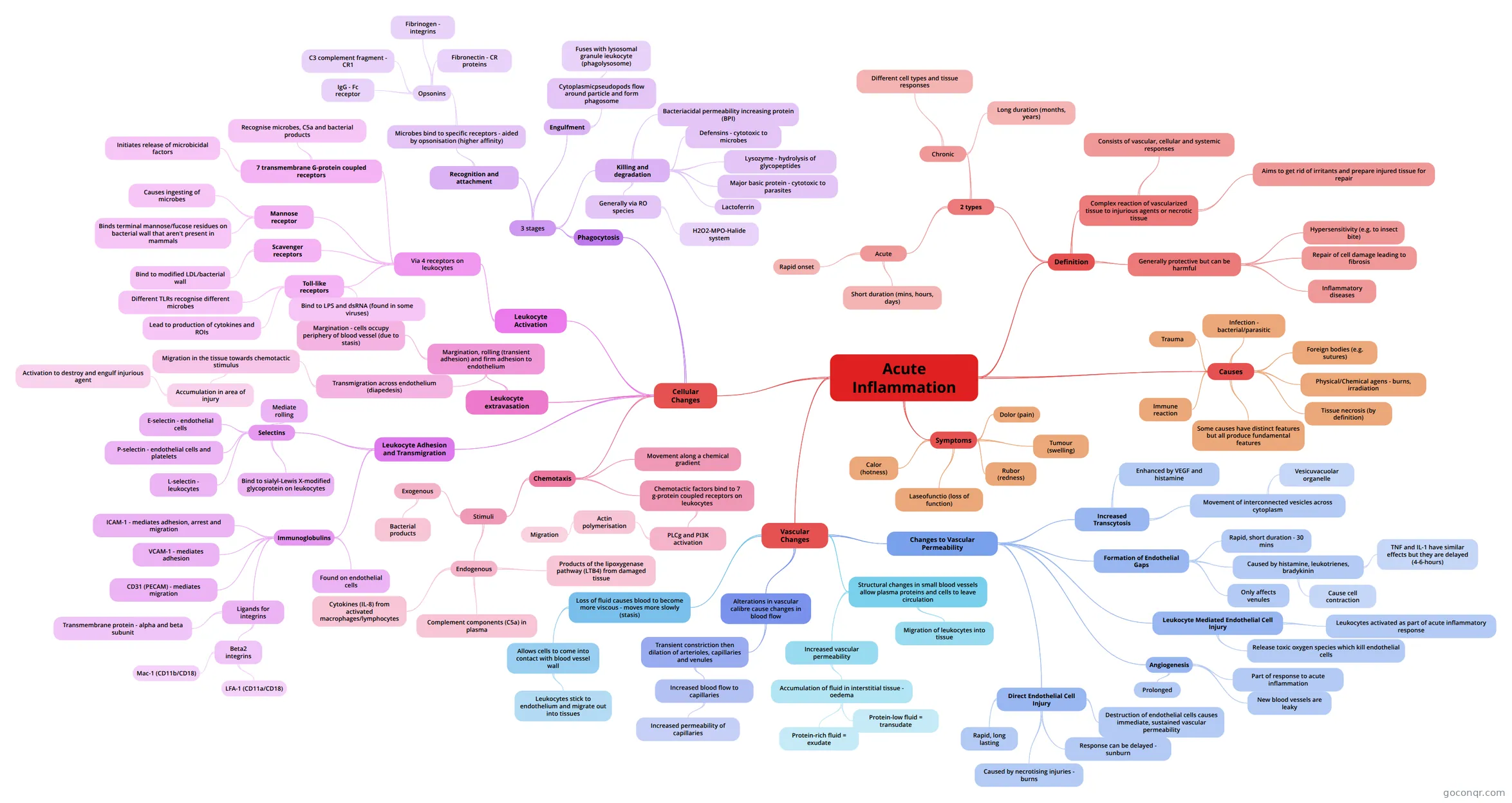
Mind map: acute inflammation
Contenido del mapa
Acute Inflammation
Definition
- Complex reaction of vascularized tissue to injurious agents or necrotic tissue
- Aims to get rid of irritants and prepare injured tissue for repair
- Consists of vascular, cellular and systemic responses
- Generally protective but can be harmful
- Hypersensitivity (e.g. to insect bite)
- Inflammatory diseases
- Repair of cell damage leading to fibrosis
- 2 types
- Acute
- Rapid onset
- Short duration (mins, hours, days)
- Chronic
- Long duration (months, years)
- Different cell types and tissue responses
- Acute
- Complex reaction of vascularized tissue to injurious agents or necrotic tissue
Causes
- Infection - bacterial/parasitic
- Trauma
- Physical/Chemical agens - burns, irradiation
- Tissue necrosis (by definition)
- Foreign bodies (e.g. sutures)
- Immune reaction
- Some causes have distinct features but all produce fundamental features
Symptoms
- Calor (hotness)
- Rubor (redness)
- Tumour (swelling)
- Dolor (pain)
- Laseofunctio (loss of function)
Vascular Changes
- Alterations in vascular calibre cause changes in blood flow
- Transient constriction then dilation of arterioles, capillaries and venules
- Increased blood flow to capillaries
- Increased permeability of capillaries
- Increased blood flow to capillaries
- Transient constriction then dilation of arterioles, capillaries and venules
- Structural changes in small blood vessels allow plasma proteins and cells to leave circulation
- Increased vascular permeability
- Accumulation of fluid in interstitial tissue - oedema
- Protein-rich fluid = exudate
- Protein-low fluid = transudate
- Accumulation of fluid in interstitial tissue - oedema
- Migration of leukocytes into tissue
- Increased vascular permeability
- Loss of fluid causes blood to become more viscous - moves more slowly (stasis)
- Allows cells to come into contact with blood vessel wall
- Leukocytes stick to endothelium and migrate out into tissues
- Allows cells to come into contact with blood vessel wall
- Changes to Vascular Permeability
- Formation of Endothelial Gaps
- Rapid, short duration - 30 mins
- Caused by histamine, leukotrienes, bradykinin
- Cause cell contraction
- TNF and IL-1 have similar effects but they are delayed (4-6-hours)
- Only affects venules
- Direct Endothelial Cell Injury
- Rapid, long lasting
- Caused by necrotising injuries - burns
- Destruction of endothelial cells causes immediate, sustained vascular permeability
- Response can be delayed - sunburn
- Leukocyte Mediated Endothelial Cell Injury
- Leukocytes activated as part of acute inflammatory response
- Release toxic oxygen species which kill endothelial cells
- Increased Transcytosis
- Enhanced by VEGF and histamine
- Movement of interconnected vesicles across cytoplasm
- Vesicuvacuolar organelle
- Angiogenesis
- Part of response to acute inflammation
- New blood vessels are leaky
- Prolonged
- Formation of Endothelial Gaps
- Alterations in vascular calibre cause changes in blood flow
Cellular Changes
- Leukocyte extravasation
- Margination, rolling (transient adhesion) and firm adhesion to endothelium
- Transmigration across endothelium (diapedesis)
- Migration in the tissue towards chemotactic stimulus
- Accumulation in area of injury
- Activation to destroy and engulf injurious agent
- Accumulation in area of injury
- Migration in the tissue towards chemotactic stimulus
- Margination - cells occupy periphery of blood vessel (due to stasis)
- Transmigration across endothelium (diapedesis)
- Margination, rolling (transient adhesion) and firm adhesion to endothelium
- Leukocyte Adhesion and Transmigration
- Selectins
- E-selectin - endothelial cells
- P-selectin - endothelial cells and platelets
- L-selectin - leukocytes
- Bind to sialyl-Lewis X-modified glycoprotein on leukocytes
- Mediate rolling
- Immunoglobulins
- ICAM-1 - mediates adhesion, arrest and migration
- VCAM-1 - mediates adhesion
- Found on endothelial cells
- CD31 (PECAM) - mediates migration
- Ligands for integrins
- Transmembrane protein - alpha and beta subunit
- Beta2 integrins
- LFA-1 (CD11a/CD18)
- Mac-1 (CD11b/CD18)
- Selectins
- Chemotaxis
- Movement along a chemical gradient
- Stimuli
- Endogenous
- Complement components (C5a) in plasma
- Products of the lipoxygenase pathway (LTB4) from damaged tissue
- Cytokines (IL-8) from activated macrophages/lymphocytes
- Exogenous
- Bacterial products
- Endogenous
- Chemotactic factors bind to 7 g-protein coupled receptors on leukocytes
- PLCg and PI3K activation
- Actin polymerisation
- Migration
- Actin polymerisation
- PLCg and PI3K activation
- Leukocyte Activation
- Via 4 receptors on leukocytes
- 7 transmembrane G-protein coupled receptors
- Recognise microbes, C5a and bacterial products
- Initiates release of microbicidal factors
- Toll-like receptors
- Different TLRs recognise different microbes
- Bind to LPS and dsRNA (found in some viruses)
- Lead to production of cytokines and ROIs
- Mannose receptor
- Causes ingesting of microbes
- Binds terminal mannose/fucose residues on bacterial wall that aren't present in mammals
- Scavenger receptors
- Bind to modified LDL/bacterial wall
- 7 transmembrane G-protein coupled receptors
- Via 4 receptors on leukocytes
- Phagocytosis
- 3 stages
- Recognition and attachment
- Microbes bind to specific receptors - aided by opsonisation (higher affinity)
- Opsonins
- IgG - Fc receptor
- C3 complement fragment - CR1
- Fibrinogen - integrins
- Fibronectin - CR proteins
- Opsonins
- Microbes bind to specific receptors - aided by opsonisation (higher affinity)
- Engulfment
- Cytoplasmicpseudopods flow around particle and form phagosome
- Fuses with lysosomal granule ieukocyte (phagolysosome)
- Cytoplasmicpseudopods flow around particle and form phagosome
- Killing and degradation
- Generally via RO species
- H2O2-MPO-Halide system
- Bacteriacidal permeability increasing protein (BPI)
- Lysozyme - hydrolysis of glycopeptides
- Lactoferrin
- Major basic protein - cytotoxic to parasites
- Defensins - cytotoxic to microbes
- Generally via RO species
- Recognition and attachment
- 3 stages
- Leukocyte extravasation
Información
- Descripción
- Blood Science Mapa Mental sobre Acute Inflammation, creado por maisie_oj el 29/04/2013.
- Creado por
- maisie_oj
- Visitas
- 809
- Etiquetas
- Valoración