
Mapa mental
Chapter 7
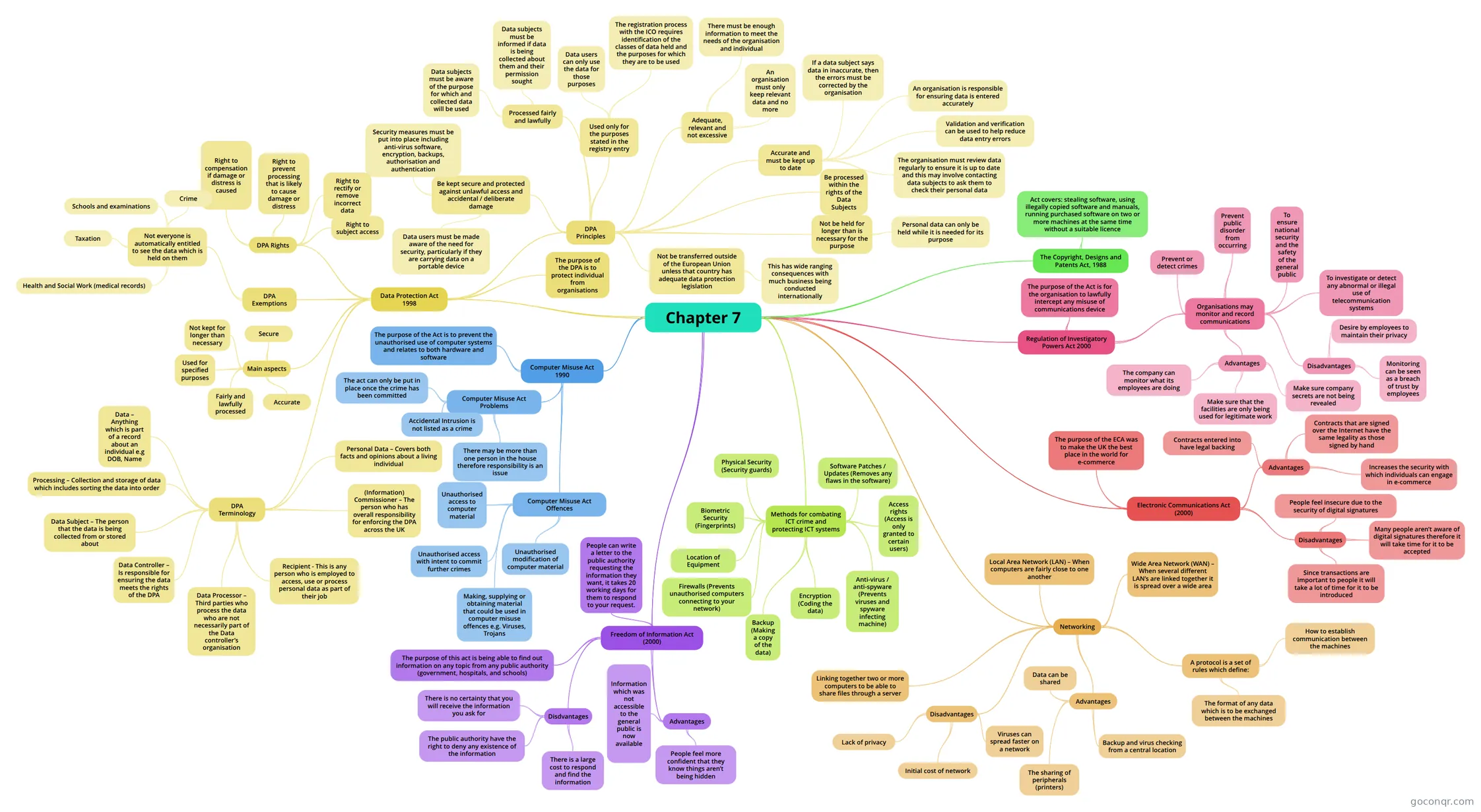
Mind map: UK ICT laws
Contenido del mapa
Chapter 7
Data Protection Act 1998
- DPA Principles
- Processed fairly and lawfully
- Data subjects must be informed if data is being collected about them and their permission sought
- Data subjects must be aware of the purpose for which and collected data will be used
- Used only for the purposes stated in the registry entry
- Data users can only use the data for those purposes
- The registration process with the ICO requires identification of the classes of data held and the purposes for which they are to be used
- Adequate, relevant and not excessive
- There must be enough information to meet the needs of the organisation and individual
- An organisation must only keep relevant data and no more
- Accurate and must be kept up to date
- An organisation is responsible for ensuring data is entered accurately
- Validation and verification can be used to help reduce data entry errors
- The organisation must review data regularly to ensure it is up to date and this may involve contacting data subjects to ask them to check their personal data
- If a data subject says data in inaccurate, then the errors must be corrected by the organisation
- Not be held for longer than is necessary for the purpose
- Personal data can only be held while it is needed for its purpose
- Be processed within the rights of the Data Subjects
- Be kept secure and protected against unlawful access and accidental / deliberate damage
- Security measures must be put into place including anti-virus software, encryption, backups, authorisation and authentication
- Data users must be made aware of the need for security, particularly if they are carrying data on a portable device
- Not be transferred outside of the European Union unless that country has adequate data protection legislation
- This has wide ranging consequences with much business being conducted internationally
- Processed fairly and lawfully
- The purpose of the DPA is to protect individual from organisations
- Main aspects
- Accurate
- Secure
- Used for specified purposes
- Not kept for longer than necessary
- Fairly and lawfully processed
- DPA Terminology
- Personal Data – Covers both facts and opinions about a living individual
- Data – Anything which is part of a record about an individual e.g DOB, Name
- Processing – Collection and storage of data which includes sorting the data into order
- Data Subject – The person that the data is being collected from or stored about
- Data Controller – Is responsible for ensuring the data meets the rights of the DPA
- Data Processor – Third parties who process the data who are not necessarily part of the Data controller’s organisation
- Recipient - This is any person who is employed to access, use or process personal data as part of their job
- (Information) Commissioner – The person who has overall responsibility for enforcing the DPA across the UK
- DPA Rights
- Right to subject access
- Right to rectify or remove incorrect data
- Right to prevent processing that is likely to cause damage or distress
- Right to compensation if damage or distress is caused
- DPA Exemptions
- Not everyone is automatically entitled to see the data which is held on them
- Crime
- Schools and examinations
- Taxation
- Health and Social Work (medical records)
- Not everyone is automatically entitled to see the data which is held on them
- DPA Principles
Computer Misuse Act 1990
- The purpose of the Act is to prevent the unauthorised use of computer systems and relates to both hardware and software
- Computer Misuse Act Offences
- Unauthorised access to computer material
- Unauthorised access with intent to commit further crimes
- Unauthorised modification of computer material
- Making, supplying or obtaining material that could be used in computer misuse offences e.g. Viruses, Trojans
- Computer Misuse Act Problems
- Accidental Intrusion is not listed as a crime
- There may be more than one person in the house therefore responsibility is an issue
- The act can only be put in place once the crime has been committed
The Copyright, Designs and Patents Act, 1988
- Act covers: stealing software, using illegally copied software and manuals, running purchased software on two or more machines at the same time without a suitable licence
Regulation of Investigatory Powers Act 2000
- The purpose of the Act is for the organisation to lawfully intercept any misuse of communications device
- Organisations may monitor and record communications
- Prevent or detect crimes
- Prevent public disorder from occurring
- To ensure national security and the safety of the general public
- To investigate or detect any abnormal or illegal use of telecommunication systems
- Advantages
- The company can monitor what its employees are doing
- Make sure that the facilities are only being used for legitimate work
- Make sure company secrets are not being revealed
- Disadvantages
- Monitoring can be seen as a breach of trust by employees
- Desire by employees to maintain their privacy
Electronic Communications Act (2000)
- The purpose of the ECA was to make the UK the best place in the world for e-commerce
- Advantages
- Contracts that are signed over the Internet have the same legality as those signed by hand
- Increases the security with which individuals can engage in e-commerce
- Contracts entered into have legal backing
- Disadvantages
- Many people aren’t aware of digital signatures therefore it will take time for it to be accepted
- Since transactions are important to people it will take a lot of time for it to be introduced
- People feel insecure due to the security of digital signatures
Freedom of Information Act (2000)
- The purpose of this act is being able to find out information on any topic from any public authority (government, hospitals, and schools)
- People can write a letter to the public authority requesting the information they want, it takes 20 working days for them to respond to your request.
- Advantages
- Information which was not accessible to the general public is now available
- People feel more confident that they know things aren’t being hidden
- Disdvantages
- There is no certainty that you will receive the information you ask for
- The public authority have the right to deny any existence of the information
- There is a large cost to respond and find the information
Methods for combating ICT crime and protecting ICT systems
- Physical Security (Security guards)
- Biometric Security (Fingerprints)
- Location of Equipment
- Firewalls (Prevents unauthorised computers connecting to your network)
- Backup (Making a copy of the data)
- Encryption (Coding the data)
- Software Patches / Updates (Removes any flaws in the software)
- Anti-virus / anti-spyware (Prevents viruses and spyware infecting machine)
- Access rights (Access is only granted to certain users)
Networking
- Linking together two or more computers to be able to share files through a server
- Advantages
- The sharing of peripherals (printers)
- Data can be shared
- Backup and virus checking from a central location
- Disadvantages
- Viruses can spread faster on a network
- Lack of privacy
- Initial cost of network
- Local Area Network (LAN) – When computers are fairly close to one another
- Wide Area Network (WAN) – When several different LAN’s are linked together it is spread over a wide area
- A protocol is a set of rules which define:
- How to establish communication between the machines
- The format of any data which is to be exchanged between the machines