
Mapa mental
Laertes
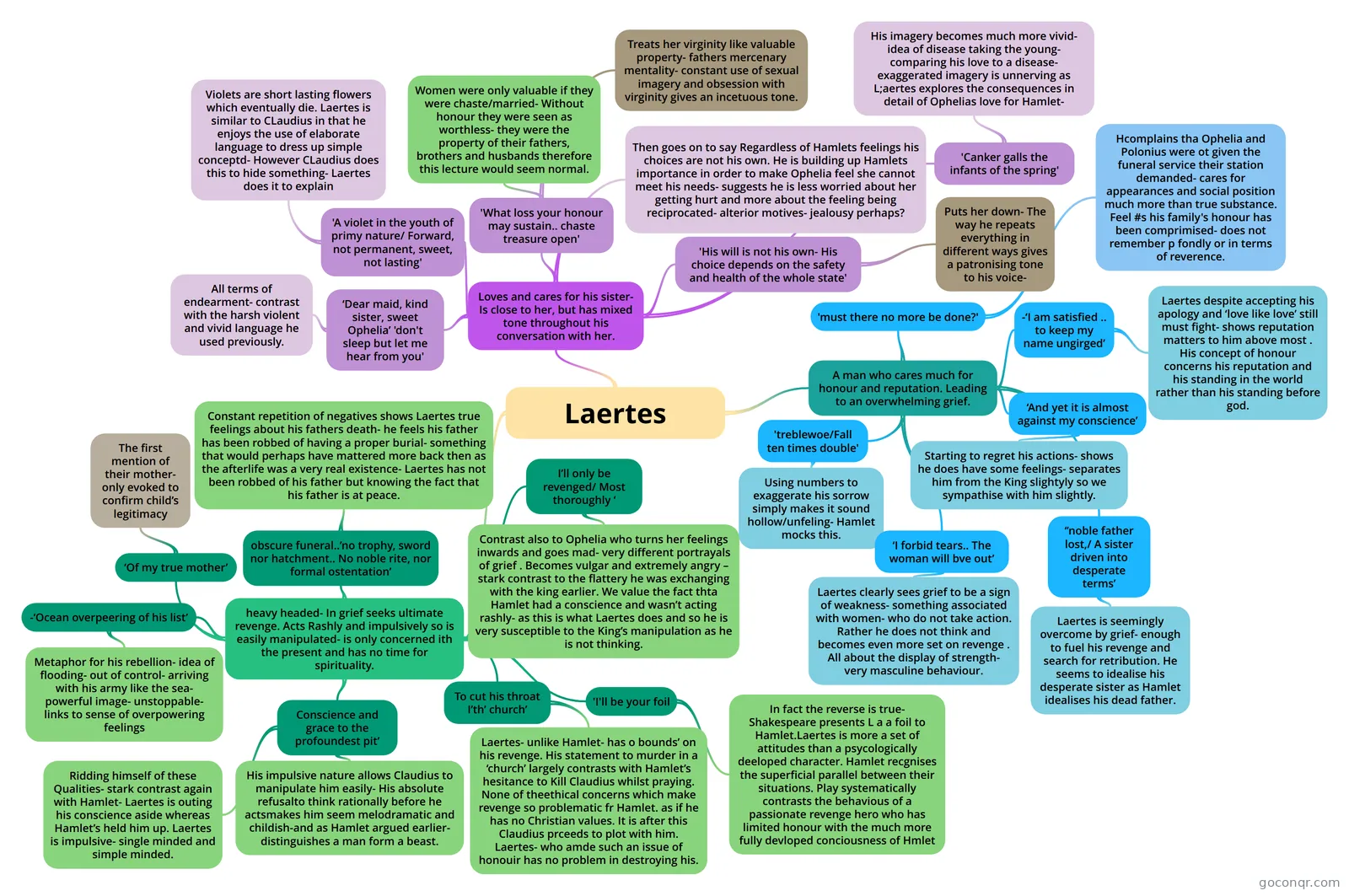
Mind map: Laertes in Hamlet
Contenido del mapa
Laertes
Loves and cares for his sister- Is close to her, but has mixed tone throughout his conversation with her.
- 'A violet in the youth of primy nature/ Forward, not permanent, sweet, not lasting'
- Violets are short lasting flowers which eventually die. Laertes is similar to CLaudius in that he enjoys the use of elaborate language to dress up simple conceptd- However CLaudius does this to hide something- Laertes does it to explain
- Then goes on to say Regardless of Hamlets feelings his choices are not his own. He is building up Hamlets importance in order to make Ophelia feel she cannot meet his needs- suggests he is less worried about her getting hurt and more about the feeling being reciprocated- alterior motives- jealousy perhaps?
- 'His will is not his own- His choice depends on the safety and health of the whole state'
- Puts her down- The way he repeats everything in different ways gives a patronising tone to his voice-
- 'What loss your honour may sustain.. chaste treasure open'
- Treats her virginity like valuable property- fathers mercenary mentality- constant use of sexual imagery and obsession with virginity gives an incetuous tone.
- Women were only valuable if they were chaste/married- Without honour they were seen as worthless- they were the property of their fathers, brothers and husbands therefore this lecture would seem normal.
- 'Canker galls the infants of the spring'
- His imagery becomes much more vivid- idea of disease taking the young- comparing his love to a disease- exaggerated imagery is unnerving as L;aertes explores the consequences in detail of Ophelias love for Hamlet-
- ‘Dear maid, kind sister, sweet Ophelia’ 'don't sleep but let me hear from you'
- All terms of endearment- contrast with the harsh violent and vivid language he used previously.
- 'A violet in the youth of primy nature/ Forward, not permanent, sweet, not lasting'
heavy headed- In grief seeks ultimate revenge. Acts Rashly and impulsively so is easily manipulated- is only concerned ith the present and has no time for spirituality.
- ‘Of my true mother’
- The first mention of their mother- only evoked to confirm child’s legitimacy
- -‘Ocean overpeering of his list’
- Metaphor for his rebellion- idea of flooding- out of control- arriving with his army like the sea- powerful image- unstoppable- links to sense of overpowering feelings
- Conscience and grace to the profoundest pit’
- Ridding himself of these Qualities- stark contrast again with Hamlet- Laertes is outing his conscience aside whereas Hamlet’s held him up. Laertes is impulsive- single minded and simple minded.
- His impulsive nature allows Claudius to manipulate him easily- His absolute refusalto think rationally before he actsmakes him seem melodramatic and childish-and as Hamlet argued earlier- distinguishes a man form a beast.
- I’ll only be revenged/ Most thoroughly ‘
- Contrast also to Ophelia who turns her feelings inwards and goes mad- very different portrayals of grief . Becomes vulgar and extremely angry – stark contrast to the flattery he was exchanging with the king earlier. We value the fact thta Hamlet had a conscience and wasn’t acting rashly- as this is what Laertes does and so he is very susceptible to the King’s manipulation as he is not thinking.
- obscure funeral..’no trophy, sword nor hatchment.. No noble rite, nor formal ostentation’
- Constant repetition of negatives shows Laertes true feelings about his fathers death- he feels his father has been robbed of having a proper burial- something that would perhaps have mattered more back then as the afterlife was a very real existence- Laertes has not been robbed of his father but knowing the fact that his father is at peace.
- To cut his throat I’th’ church’
- Laertes- unlike Hamlet- has o bounds’ on his revenge. His statement to murder in a ‘church’ largely contrasts with Hamlet’s hesitance to Kill Claudius whilst praying. None of theethical concerns which make revenge so problematic fr Hamlet. as if he has no Christian values. It is after this Claudius prceeds to plot with him. Laertes- who amde such an issue of honouir has no problem in destroying his.
- 'I'll be your foil
- In fact the reverse is true- Shakespeare presents L a a foil to Hamlet.Laertes is more a set of attitudes than a psycologically deeloped character. Hamlet recgnises the superficial parallel between their situations. Play systematically contrasts the behavious of a passionate revenge hero who has limited honour with the much more fully devloped conciousness of Hmlet
- ‘Of my true mother’
A man who cares much for honour and reputation. Leading to an overwhelming grief.
- -‘I am satisfied .. to keep my name ungirged’
- Laertes despite accepting his apology and ‘love like love’ still must fight- shows reputation matters to him above most . His concept of honour concerns his reputation and his standing in the world rather than his standing before god.
- ‘And yet it is almost against my conscience’
- Starting to regret his actions- shows he does have some feelings- separates him from the King slightyly so we sympathise with him slightly.
- 'treblewoe/Fall ten times double'
- Using numbers to exaggerate his sorrow simply makes it sound hollow/unfeling- Hamlet mocks this.
- 'must there no more be done?'
- Hcomplains tha Ophelia and Polonius were ot given the funeral service their station demanded- cares for appearances and social position much more than true substance. Feel #s his family's honour has been comprimised- does not remember p fondly or in terms of reverence.
- ‘’noble father lost,/ A sister driven into desperate terms’
- Laertes is seemingly overcome by grief- enough to fuel his revenge and search for retribution. He seems to idealise his desperate sister as Hamlet idealises his dead father.
- ‘I forbid tears.. The woman will bve out’
- Laertes clearly sees grief to be a sign of weakness- something associated with women- who do not take action. Rather he does not think and becomes even more set on revenge . All about the display of strength- very masculine behaviour.
- -‘I am satisfied .. to keep my name ungirged’
Información
- Descripción
- GCSE (Hamlet) English Literature- Texts Mapa Mental sobre Laertes, creado por Saheefa Ishaq el 01/01/2017.
- Creado por
- Saheefa Ishaq
- Visitas
- 20
- Valoración