
Mapa mental
Intrinsic Motivations for Learning
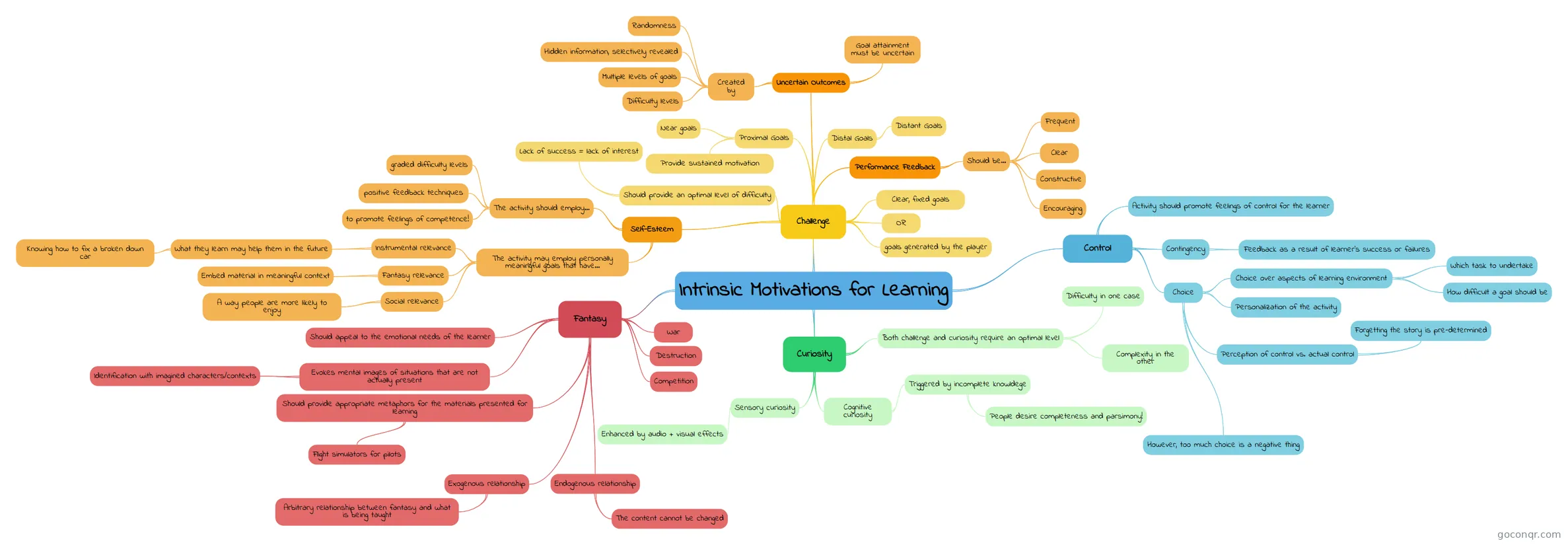
Mind map: intrinsic motivations for learning
Contenido del mapa
Intrinsic Motivations for Learning
Challenge
- Should provide an optimal level of difficulty
- Lack of success = lack of interest
- Clear, fixed goals
- OR
- goals generated by the player
- Proximal Goals
- Near goals
- Provide sustained motivation
- Distal Goals
- Distant Goals
- Uncertain Outcomes
- Goal attainment must be uncertain
- Created by
- Difficulty levels
- Multiple levels of goals
- Hidden information, selectively revealed
- Randomness
- Performance Feedback
- Should be...
- Frequent
- Clear
- Constructive
- Encouraging
- Should be...
- Self-Esteem
- The activity should employ...
- graded difficulty levels
- positive feedback techniques
- to promote feelings of competence!
- The activity may employ personally meaningful goals that have...
- Instrumental relevance
- What they learn may help them in the future
- Knowing how to fix a broken down car
- What they learn may help them in the future
- Fantasy relevance
- Embed material in meaningful context
- Social relevance
- A way people are more likely to enjoy
- Instrumental relevance
- The activity should employ...
- Should provide an optimal level of difficulty
Curiosity
- Sensory curiosity
- Enhanced by audio + visual effects
- Cognitive curiosity
- Triggered by incomplete knowldege
- People desire completeness and parsimony!
- Triggered by incomplete knowldege
- Both challenge and curiosity require an optimal level
- Difficulty in one case
- Complexity in the other
- Sensory curiosity
Fantasy
- Evokes mental images of situations that are not actually present
- Identification with imagined characters/contexts
- Should appeal to the emotional needs of the learner
- War
- Destruction
- Competition
- Should provide appropriate metaphors for the materials presented for learning
- Flight simulators for pilots
- Exogenous relationship
- Arbitrary relationship between fantasy and what is being taught
- Endogenous relationship
- The content cannot be changed
- Evokes mental images of situations that are not actually present
Control
- Activity should promote feelings of control for the learner
- Contingency
- Feedback as a result of learner's success or failures
- Choice
- Choice over aspects of learning environment
- Which task to undertake
- How difficult a goal should be
- Personalization of the activity
- Perception of control vs. actual control
- Forgetting the story is pre-determined
- However, too much choice is a negative thing
- Choice over aspects of learning environment
Información
- Descripción
- Details challenge, curiosity, fantasy and control.
- Creado por
- Kerrie Callaghan
- Visitas
- 9
- Valoración