
Motivation, Engagement and Learner Differences
238 resources created by 213 users
This Motivation, Engagement and Learner Differences page on GoConqr gathers community-made mind maps, flashcards, notes, flowcharts and a quiz, from intrinsic and extrinsic motivation to attribution theory, self-determination theory and wellbeing. It's built for university students and professional candidates, and for teachers after ready-made material. There are over 200 resources here, including more than 200 mind maps, made by over 200 contributors. Pick a map that suits your topic, then add your own notes and flashcards as you go.
Select topic
- Learner Characteristics and Individual Differences31
- Cognition, Intelligence and Language Aptitude12
- Learning Styles and Strategies8
- Motivation in Learning35
- Intrinsic and Extrinsic Motivation17
- Motivation Theories and Achievement16
- Motivation in Language Learning12
- Motivating Students22
- Lack of Motivation5
- Student Engagement11
- Emotions and Learning8
- Social-Emotional Learning and Emotional Intelligence24
- Student Wellbeing and Mental Health8
Top Motivation, Engagement and Learner Differences resources
Quizzes
Mind maps
See all 215 mind mapsFlashcards
See all 10 flashcards-
8 cardsEducational Psychology - Flashcards
-
2 cardsAdolescence literature 3 Motivation theories include
-
2 cardsIntrinsic and Extrinsic Motivation
-
15 cardsUntitled What do you do if a child kicks you? A. Kick them back or B. Ask them to stop and tell a trusted adult
-
10 cardsChapter 4: Stable Differences A number of factors that are relatively stable over time vary among individual learners. Aptitudes, styles,...
-
8 cardssocial emotional learning Social Emotional learning
-
4 cardslearning difficulties Difficulties on Learning Foreign Languages
-
3 cardsStudent engagement in 3 interactions Three kinds of interaction that have a big impact on student engagement rates.
Flowcharts
Notes
-
EI=EE - creado desde un Mapa Mental HISTORY PRINCIPLES PROGRESS
-
Motivation What is Motivation?- According to Simon, Ercikan, Rousseau (2013), the word motivation is referring to one’s enthusiasm to engage in daily action. In the educational environment, the notion of motivation is referred t...
-
Motivating students - creado desde un Mapa Mental How useful is English? Proper names Countries English around me English and my language Words I already know English and jobs Creating an English environment Posters of English-speaking countries Posters the students ...
Topics in Motivation, Engagement and Learner Differences
More Education and pedagogy (incl. teaching methods, curriculum, educational psychology) topics
About Motivation, Engagement and Learner Differences
GoConqr OriginalWhat this page covers
Most of the resources here are mind maps, so the page works best as a visual tour of motivation in education. Several maps share a title such as Motivation, each built by a different contributor. They draw on cognitive, behavioural and social cognitive views, and on ideas like expectancy ("Can I do this?"), learned helplessness and agency.
Where to start
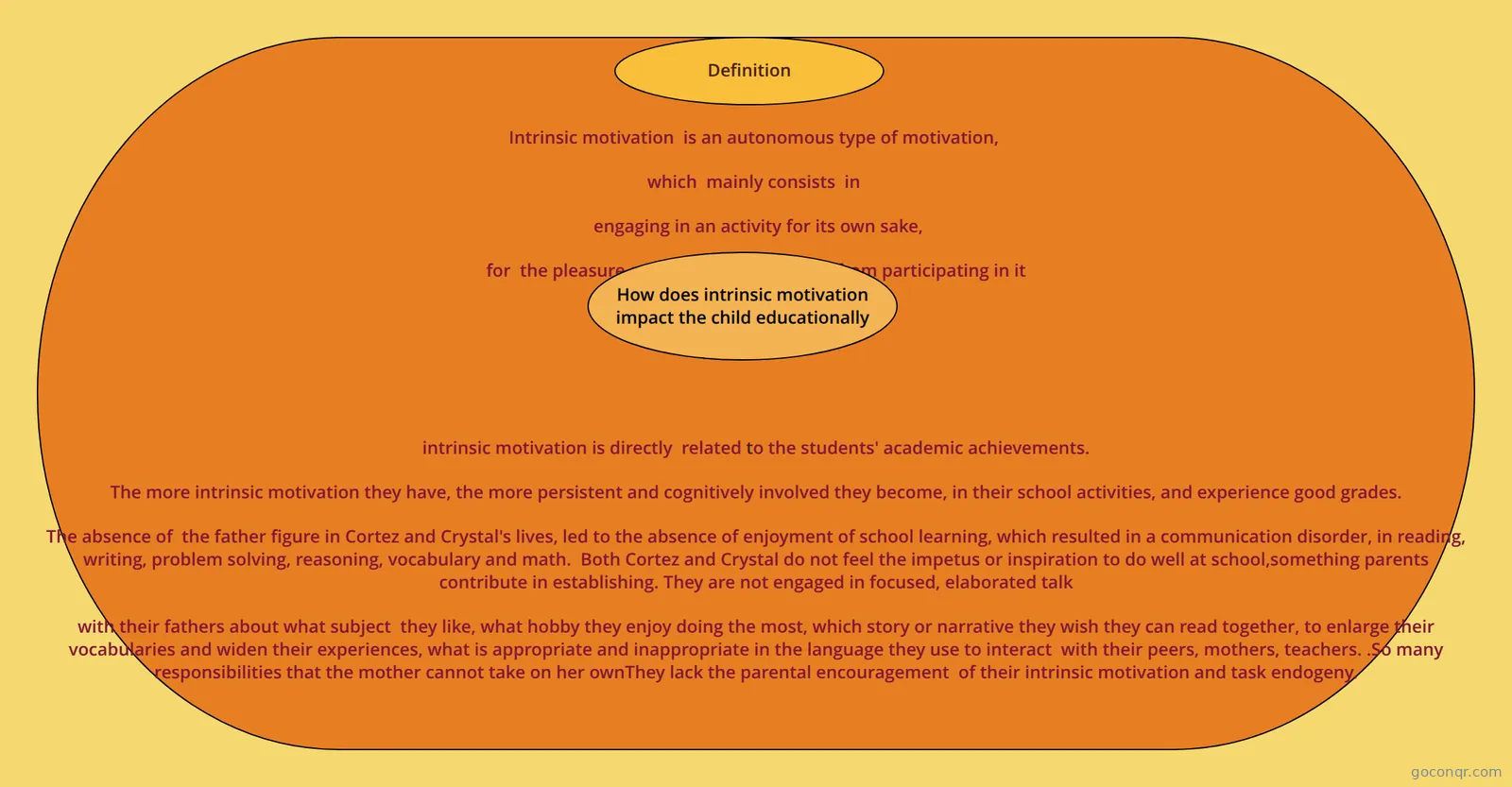
Begin with the flowchart on intrinsic motivation. It defines intrinsic motivation as an autonomous type of motivation, where you take part in an activity for its own sake. Then read the note Motivation, which explains the word through its educational meaning.
- Open Encouraging student motivation to compare intrinsic and extrinsic reasons for study.
- Move to Attribution Theory and SELF-DETERMINATION THEORY for the theory side.
- Try Achievement Processes and Negative emotions and learning (the map numbered 4) for emotion and goals.
Learner differences and wellbeing
The map called Characteristics. lists age, cognitive, personality and affective factors, multiple intelligences, the good language learner and Piaget's stages. Learning and Thinking Styles and Issues in Individual Variations add further angles. For classroom practice, Teacher looks at respecting how students learn, and Wellbeing covers five dimensions: cognitive, physical, spiritual, social and emotional. Some resources mention the TKT, so teaching candidates may find them useful.
Using maps with the quiz and flashcards
Read a map, then test yourself. The quiz Managing your Emotions is a short check, and decks such as Intrinsic and Extrinsic Motivation and Why student engagement matters help you rehearse key terms. Go back to the map for anything you miss.
Where it sits
This unit belongs to the Learning and Development strand of Education and pedagogy. Choose one map today and see how far it takes you.
Frequently asked questions
Which resource should I open first?
Start with the flowchart on intrinsic motivation, which gives a clear definition of motivation done for its own sake. After that, the note called Motivation and the map Encouraging student motivation build on it, comparing intrinsic and extrinsic reasons for study.
What do the mind maps cover?
They cover motivation from several angles: cognitive, behavioural and social cognitive views, attribution theory, self-determination theory, goals, negative emotions, learning styles and wellbeing. Some focus on teaching, such as the map called Teacher, while others look at individual differences between learners.
Are the resources free to use?
Yes. Every resource on this page is free to open, study and take, with no account needed. They were made by GoConqr users, not by GoConqr itself. A free account also saves your quiz scores and lets you make your own material.
Who are these resources for?
Mostly university students and professional candidates, plus teachers looking for ready-made material. A few resources suit school students in passing. One exam, the TKT, is mentioned in the listed resources, so teaching candidates may find parts of the page relevant.
Is there any practice, or only maps?
There is practice too. The quiz Managing your Emotions lets you check your understanding, and flashcard decks such as Social emotional learning and Student engagement in 3 interactions help you rehearse terms. Maps are the largest group, so use them for overview.
What if the topic I need is missing?
Look through the maps with similar titles, as contributors often cover the same theme differently. If you still cannot find what you need, you can build your own map, flashcards or notes on the topic with a free account.