
Mapa mental
3D Printed Designer Jewellery
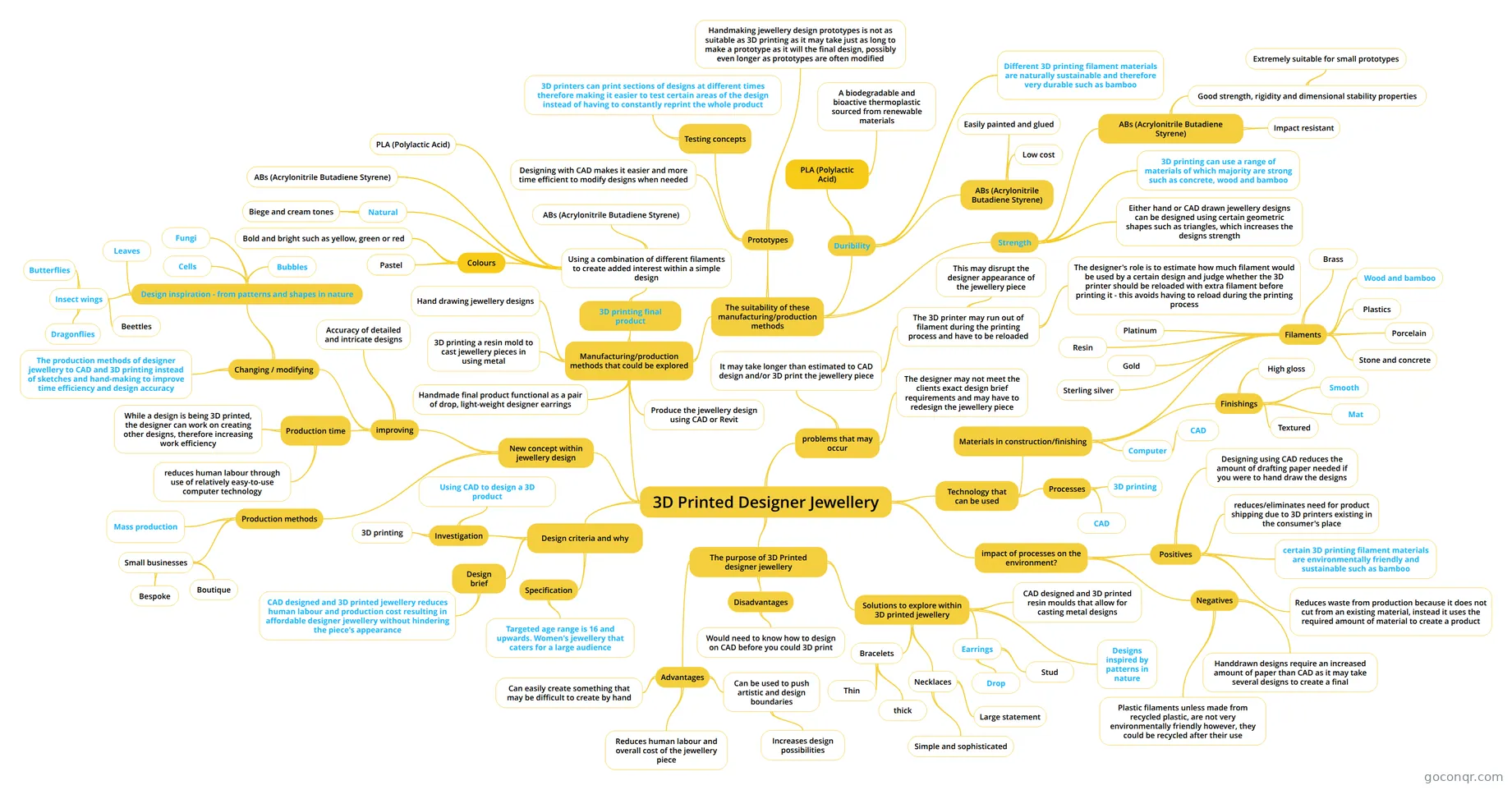
Mind map: 3D printed designer jewellery
Contenido del mapa
3D Printed Designer Jewellery
The purpose of 3D Printed designer jewellery
- Advantages
- Can be used to push artistic and design boundaries
- Increases design possibilities
- Can easily create something that may be difficult to create by hand
- Reduces human labour and overall cost of the jewellery piece
- Can be used to push artistic and design boundaries
- Disadvantages
- Would need to know how to design on CAD before you could 3D print
- Solutions to explore within 3D printed jewellery
- CAD designed and 3D printed resin moulds that allow for casting metal designs
- Earrings
- Drop
- Stud
- Necklaces
- Simple and sophisticated
- Large statement
- Bracelets
- Thin
- thick
- Designs inspired by patterns in nature
- Advantages
problems that may occur
- It may take longer than estimated to CAD design and/or 3D print the jewellery piece
- The 3D printer may run out of filament during the printing process and have to be reloaded
- The designer's role is to estimate how much filament would be used by a certain design and judge whether the 3D printer should be reloaded with extra filament before printing it - this avoids having to reload during the printing process
- This may disrupt the designer appearance of the jewellery piece
- The 3D printer may run out of filament during the printing process and have to be reloaded
- The designer may not meet the clients exact design brief requirements and may have to redesign the jewellery piece
- It may take longer than estimated to CAD design and/or 3D print the jewellery piece
Technology that can be used
- Materials in construction/finishing
- Filaments
- Sterling silver
- Gold
- Platinum
- Wood and bamboo
- Plastics
- Porcelain
- Stone and concrete
- Brass
- Resin
- Computer
- CAD
- Finishings
- Smooth
- Mat
- High gloss
- Textured
- Filaments
- Processes
- 3D printing
- CAD
- Materials in construction/finishing
impact of processes on the environment?
- Positives
- reduces/eliminates need for product shipping due to 3D printers existing in the consumer's place
- Reduces waste from production because it does not cut from an existing material, instead it uses the required amount of material to create a product
- Designing using CAD reduces the amount of drafting paper needed if you were to hand draw the designs
- certain 3D printing filament materials are environmentally friendly and sustainable such as bamboo
- Negatives
- Handdrawn designs require an increased amount of paper than CAD as it may take several designs to create a final
- Plastic filaments unless made from recycled plastic, are not very environmentally friendly however, they could be recycled after their use
- Positives
Design criteria and why
- Design brief
- CAD designed and 3D printed jewellery reduces human labour and production cost resulting in affordable designer jewellery without hindering the piece's appearance
- Specification
- Targeted age range is 16 and upwards. Women's jewellery that caters for a large audience
- Investigation
- 3D printing
- Using CAD to design a 3D product
- Design brief
New concept within jewellery design
- improving
- Accuracy of detailed and intricate designs
- Production time
- reduces human labour through use of relatively easy-to-use computer technology
- While a design is being 3D printed, the designer can work on creating other designs, therefore increasing work efficiency
- Changing / modifying
- The production methods of designer jewellery to CAD and 3D printing instead of sketches and hand-making to improve time efficiency and design accuracy
- Design inspiration - from patterns and shapes in nature
- Leaves
- Insect wings
- Butterflies
- Dragonflies
- Beettles
- Fungi
- Bubbles
- Cells
- Production methods
- Mass production
- Small businesses
- Boutique
- Bespoke
- improving
Manufacturing/production methods that could be explored
- The suitability of these manufacturing/production methods
- Prototypes
- Testing concepts
- 3D printers can print sections of designs at different times therefore making it easier to test certain areas of the design instead of having to constantly reprint the whole product
- Designing with CAD makes it easier and more time efficient to modify designs when needed
- Handmaking jewellery design prototypes is not as suitable as 3D printing as it may take just as long to make a prototype as it will the final design, possibly even longer as prototypes are often modified
- Testing concepts
- Strength
- 3D printing can use a range of materials of which majority are strong such as concrete, wood and bamboo
- Either hand or CAD drawn jewellery designs can be designed using certain geometric shapes such as triangles, which increases the designs strength
- ABs (Acrylonitrile Butadiene Styrene)
- Impact resistant
- Good strength, rigidity and dimensional stability properties
- Extremely suitable for small prototypes
- Duribility
- Different 3D printing filament materials are naturally sustainable and therefore very durable such as bamboo
- PLA (Polylactic Acid)
- A biodegradable and bioactive thermoplastic sourced from renewable materials
- ABs (Acrylonitrile Butadiene Styrene)
- Low cost
- Easily painted and glued
- Prototypes
- 3D printing final product
- Using a combination of different filaments to create added interest within a simple design
- Colours
- Pastel
- Bold and bright such as yellow, green or red
- Natural
- Biege and cream tones
- ABs (Acrylonitrile Butadiene Styrene)
- PLA (Polylactic Acid)
- ABs (Acrylonitrile Butadiene Styrene)
- Colours
- Using a combination of different filaments to create added interest within a simple design
- 3D printing a resin mold to cast jewellery pieces in using metal
- Produce the jewellery design using CAD or Revit
- Hand drawing jewellery designs
- Handmade final product functional as a pair of drop, light-weight designer earrings
- The suitability of these manufacturing/production methods
Información
- Descripción
- Mapa Mental sobre 3D Printed Designer Jewellery, creado por Chloe Gillespie el 05/02/2017.
- Creado por
- Chloe Gillespie
- Visitas
- 4
- Valoración