
Mapa mental
Nucleic Acids
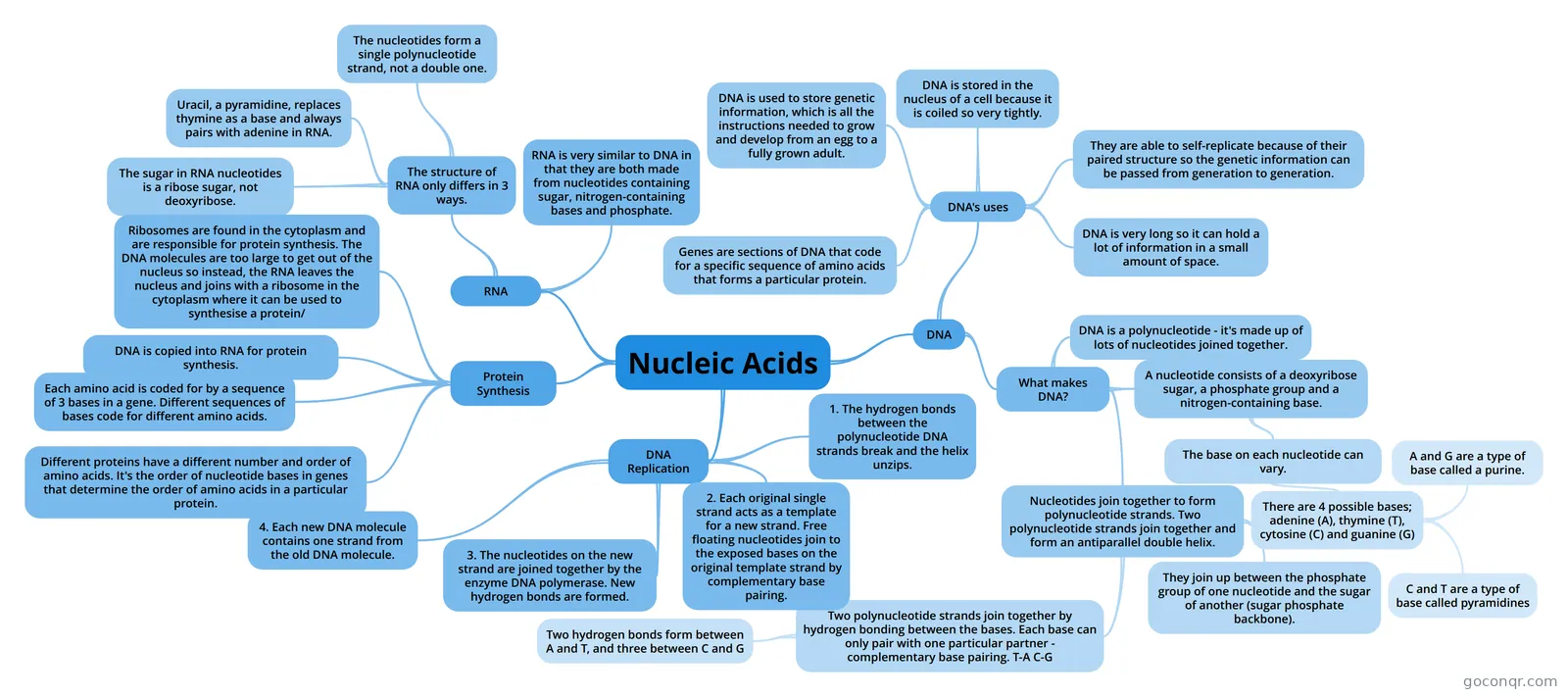
Mind map: nucleic acids
Contenido del mapa
Nucleic Acids
DNA
- DNA's uses
- DNA is used to store genetic information, which is all the instructions needed to grow and develop from an egg to a fully grown adult.
- DNA is stored in the nucleus of a cell because it is coiled so very tightly.
- They are able to self-replicate because of their paired structure so the genetic information can be passed from generation to generation.
- Genes are sections of DNA that code for a specific sequence of amino acids that forms a particular protein.
- DNA is very long so it can hold a lot of information in a small amount of space.
- What makes DNA?
- DNA is a polynucleotide - it's made up of lots of nucleotides joined together.
- A nucleotide consists of a deoxyribose sugar, a phosphate group and a nitrogen-containing base.
- The base on each nucleotide can vary.
- There are 4 possible bases; adenine (A), thymine (T), cytosine (C) and guanine (G)
- A and G are a type of base called a purine.
- C and T are a type of base called pyramidines
- There are 4 possible bases; adenine (A), thymine (T), cytosine (C) and guanine (G)
- The base on each nucleotide can vary.
- Nucleotides join together to form polynucleotide strands. Two polynucleotide strands join together and form an antiparallel double helix.
- They join up between the phosphate group of one nucleotide and the sugar of another (sugar phosphate backbone).
- Two polynucleotide strands join together by hydrogen bonding between the bases. Each base can only pair with one particular partner - complementary base pairing. T-A C-G
- Two hydrogen bonds form between A and T, and three between C and G
- DNA's uses
DNA Replication
- 1. The hydrogen bonds between the polynucleotide DNA strands break and the helix unzips.
- 2. Each original single strand acts as a template for a new strand. Free floating nucleotides join to the exposed bases on the original template strand by complementary base pairing.
- 3. The nucleotides on the new strand are joined together by the enzyme DNA polymerase. New hydrogen bonds are formed.
- 4. Each new DNA molecule contains one strand from the old DNA molecule.
Protein Synthesis
- Different proteins have a different number and order of amino acids. It's the order of nucleotide bases in genes that determine the order of amino acids in a particular protein.
- Each amino acid is coded for by a sequence of 3 bases in a gene. Different sequences of bases code for different amino acids.
- Ribosomes are found in the cytoplasm and are responsible for protein synthesis. The DNA molecules are too large to get out of the nucleus so instead, the RNA leaves the nucleus and joins with a ribosome in the cytoplasm where it can be used to synthesise a protein/
- DNA is copied into RNA for protein synthesis.
RNA
- RNA is very similar to DNA in that they are both made from nucleotides containing sugar, nitrogen-containing bases and phosphate.
- The structure of RNA only differs in 3 ways.
- The sugar in RNA nucleotides is a ribose sugar, not deoxyribose.
- The nucleotides form a single polynucleotide strand, not a double one.
- Uracil, a pyramidine, replaces thymine as a base and always pairs with adenine in RNA.
Información
- Descripción
- Nucleic Acids Mind Map for Unit 2 Section 2 Biology AS Level OCR
- Creado por
- gordonbrad
- Visitas
- 613
- Etiquetas
- Valoración