
Mapa mental
Macro-economics - How the economy works
Contenido del mapa
Macro-economics - How the economy works
Inflation
- Problems
- Hyperinflation
- Inflation rates increase by 1000+% per annum
- Hyperinflation
- Measured with the Consumer Price Index (CPI)
- Best inflation rate is about 2-3% per annum
- The rise in the general price level
- Problems
Unemployment
- Measured with
- Claimont Count
- Measures number of people claiming Job Seekers Allowance (JSA)
- Labour Force Survey
- Survey of a sample of households, counting people as unemployed if they are actively seeking work but don't have a job
- Claimont Count
- Types and causes of unemployment
- Voluntary
- People choose not to work
- Seasonal
- Types of workers not needed at certain times of the year
- Frictional
- Workers moving between jobs
- Structural
- Long-term changes in the structural industry. Workers will have wrong skills to do certain jobs
- Technological
- Capital takes the place of labour. Workers lose their jobs to robots
- Cyclical
- Fall in total (aggregate) demand in the economy
- Voluntary
- Problems
- Labour resources wasted
- Lower living standards
- Excluded workers
- Costs to taxpayers
- Budget defecit
- Regional problems
- Measured with
Government Objectives
- Economic Growth
- Growth of the country's output over time
- Value of output = Value of incomes for workers
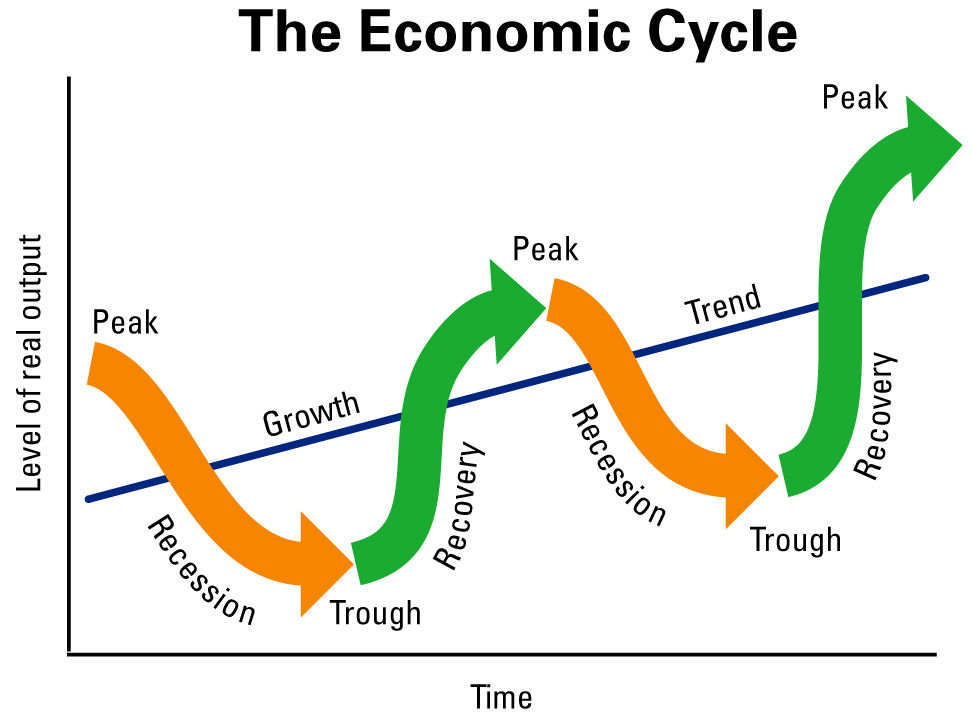
- Government want to achieve steady rate of growth
- Avoid cyclical changes in GDP
- Avoid cyclical changes in GDP
- Output measured as GDP
- The value of all goods and services produced within the country in a year
- GDP per Capita
- GDP Divided by the population
- Average output (income) which each person in the country has
- If GDP grows faster than the population growth, GDP per capita will rise
- Causes of economic growth
- Factors of production
- Investment
- Spending on capital goods eg. premises, machinery, equipment
- More investment means the economy has the capacity to produces more goods in the future
- Changes in technology
- Technical improvements means quality of capital goods increases
- Meaning a given quantity of capital can now produce more output than before
- Technical improvements means quality of capital goods increases
- A larger workforce
- Economy make produce more if there are more workers
- Maybe due to immigration or population increase
- Education and training
- The more educated, trained and skilled the workers are, the higher the output of the country's likely to be
- Natural Resources
- If a country discovers or develops natural resources, potential stimulus for economic growth eg. the middle east and their oil
- Government policies
- Government takes responsibility for macro-economic management for the economy
- Investment
- Factors of production
- Benefits of economic growth
- Rise in material living standards
- If GDP rises at a faster rate thanthe population, GDP per capita rises. Everyone on average has more output available to consume than before
- People are materially better off
- If GDP rises at a faster rate thanthe population, GDP per capita rises. Everyone on average has more output available to consume than before
- Rise in welfare of the population
- AS the capacity of the economy grows
- As the capacity of the economy to produce more grows, the government can devote more resources to health and education services.
- This can increase life expectancy and a higher rate of literacy
- Rise in employment and fall in unemployment
- As output rises, more workers are needed to produce it
- Reduction in poverty
- As output and incomes rise, government can take more in taxes from higher-income groups and use revenue to raise living standards for those with lower incomes
- Rise in material living standards
- Costs of economic growth
- Environmental costs
- More output and consumption can lead to more pollution
- Congestion
- Economic growth often concentrated in urban areas which may cause them to be overcrowded
- Loss of non-renewable sources
- Economic growth uses non-renewable sources eg. coal, oil, natural gas
- Lower quality of life
- People become materially better off but their, lifestyles may change in a bad way
- Inequalities of income and wealth
- Benefits of growth are unevenly spread, meaning some people get better off and others left behind
- The gap between rich and poor becomes wider
- Benefits of growth are unevenly spread, meaning some people get better off and others left behind
- Inflation
- Sometimes, the rate of economic growth is too fast for economy to respond without a rise in general price level
- Environmental costs
- Growth of the country's output over time
- Price Stability
- Keeping inflation low
- UK Government aims for inflation rate of 2% not 0%
- Balance imports and exports
- Does NOT mean value of imports = value of exports each year
- Government policies
- Fiscal Policy
- Aimed at changing the level of total (aggregate) demand in the economy
- Can be done by
- Changes in taxation
- Changes in government's own spending
- Can be done by
- Used if government objectives are
- Increase employment and economic growth
- In order to increase total (aggregate) demand
- Reduce imports and inflation
- In order to reduce total (aggregate) demand
- Increase employment and economic growth
- Aimed at changing the level of total (aggregate) demand in the economy
- Interest Rate Policy
- Aimed at changing the level of total (aggregate) demand in the economy
- Can be done by
- Changes in interest rates
- Not operated by the government but by the Bank of England
- Can be done by
- Decrease rates if government objectives are
- Increase employment and economic growth
- Total (aggregate) demand increases
- Increase employment and economic growth
- Increase rates if government objectives are
- Reduce inflation and reduce imports
- Total (aggregate) demand decreases
- Reduce inflation and reduce imports
- Aimed at changing the level of total (aggregate) demand in the economy
- Supply-side Policies
- Aim is to increase the economy's capacity to produce more goods and services
- Fiscal Policy
- Economic Growth
Imágenes y archivos del mapa
Información
- Descripción
- GCSE Economics Mapa Mental sobre Macro-economics - How the economy works, creado por Harnaam Jandoo el 01/05/2014.
- Creado por
- Harnaam Jandoo
- Visitas
- 40
- Valoración