
Mapa mental
IB Economics SL: Macroeconomics
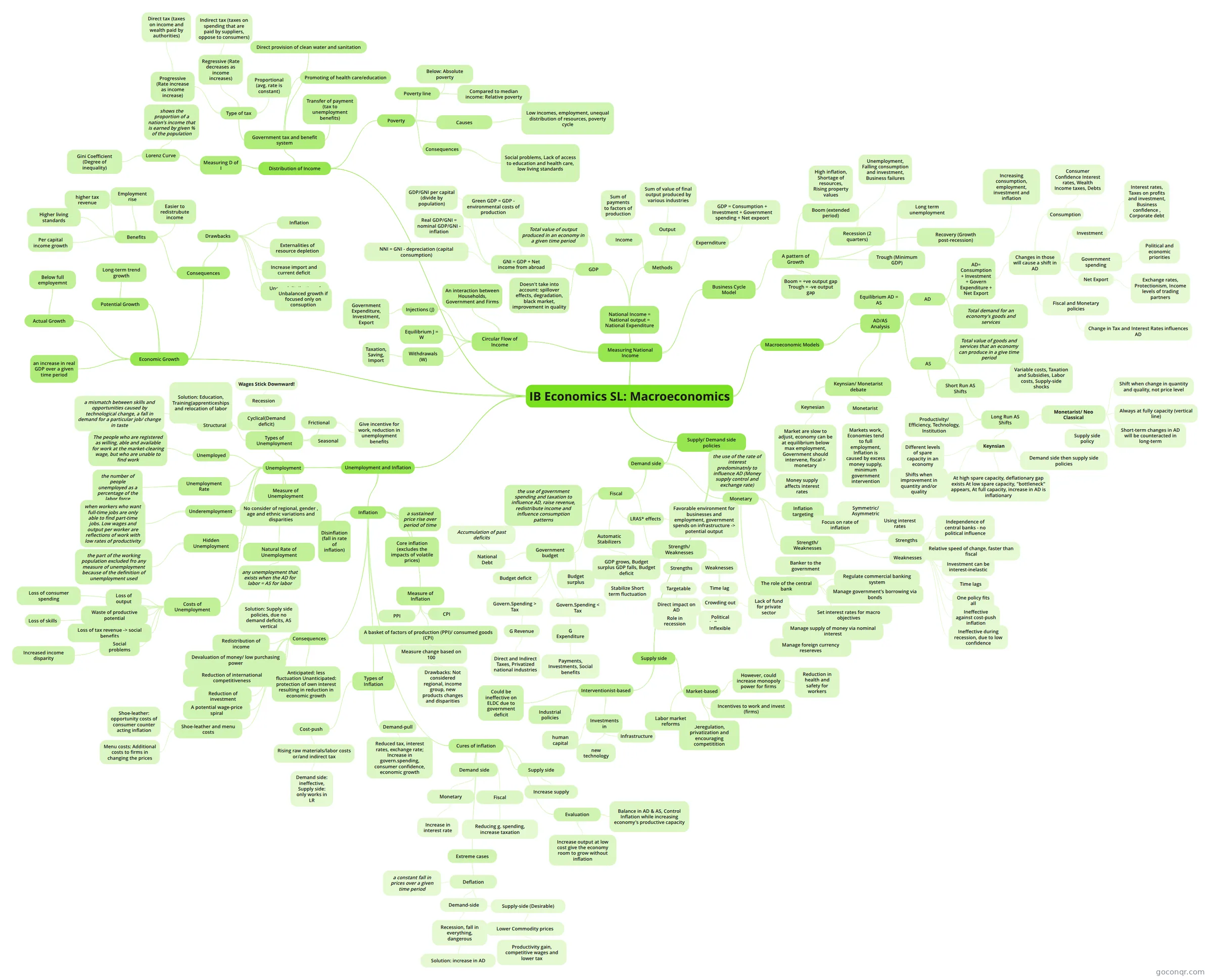
Mind map: IB Economics SL macroeconomics
Contenido del mapa
IB Economics SL: Macroeconomics
Measuring National Income
- National Income = National output = National Expenditure
- Methods
- Income
- Sum of payments to factors of production
- Output
- Sum of value of final output produced by various industries
- Expernditure
- GDP = Consumption + Investment + Government spending + Net expeort
- Income
- GDP
- Total value of output produced in an economy in a given time period
- GNI = GDP + Net income from abroad
- NNI = GNI - depreciation (capital consumption)
- Real GDP/GNI = nominal GDP/GNI - inflation
- GDP/GNI per capital (divide by population)
- Green GDP = GDP - environmental costs of production
- Doesn't take into account: spillover effects, degradation, black market, improvement in quality
- Methods
- Circular Flow of Income
- An interaction between Households, Government and Firms
- Injections (J)
- Government Expenditure, Investment, Export
- Withdrawals (W)
- Taxation, Saving, Import
- Equilibrium J = W
- Business Cycle Model
- A pattern of Growth
- Boom (extended period)
- High inflation, Shortage of resources, Rising property values
- Recession (2 quarters)
- Unemployment, Falling consumption and investment, Business failures
- Trough (Minimum GDP)
- Long term unemployment
- Recovery (Growth post-recession)
- Increasing consumption, employment, investment and inflation
- Boom = +ve output gap Trough = -ve output gap
- Boom (extended period)
- A pattern of Growth
- National Income = National output = National Expenditure
Macroeconomic Models
- AD/AS Analysis
- Equilibrium AD = AS
- AD
- Total demand for an economy's goods and services
- AD= Consumption + Investment + Govern Expenditure + Net Export
- Changes in those will cause a shift in AD
- Consumption
- Consumer Confidence Interest rates, Wealth Income taxes, Debts
- Investment
- Interest rates, Taxes on profits and investment, Business confidence , Corporate debt
- Government spending
- Political and economic priorities
- Net Export
- Exchange rates, Protectionism, Income levels of trading partners
- Fiscal and Monetary policies
- Change in Tax and Interest Rates influences AD
- Consumption
- Changes in those will cause a shift in AD
- AS
- Total value of goods and services that an economy can produce in a give time period
- Short Run AS Shifts
- Variable costs, Taxation and Subsidies, Labor costs, Supply-side shocks
- Long Run AS Shifts
- Productivity/ Efficiency, Technology, Institution
- Keynsian
- Different levels of spare capacity in an economy
- Shifts when improvement in quantity and/or quality
- At high spare capacity, deflationary gap exists At low spare capacity, "bottleneck" appears, At full capacity, increase in AD is inflationary
- Demand side then supply side policies
- Monetarist/ Neo Classical
- Always at fully capacity (vertical line)
- Shift when change in quantity and quality, not price level
- Short-term changes in AD will be counteracted in long-term
- Supply side policy
- Keynsian/ Monetarist debate
- Keynesian
- Market are slow to adjust, economy can be at equilibrium below max employment, Government should intervene, fiscal > monetary
- Monetarist
- Markets work, Economies tend to full employment, Inflation is caused by excess money supply, minimum government intervention
- Keynesian
- AD/AS Analysis
Supply/ Demand side policies
- Demand side
- Fiscal
- the use of government spending and taxation to influence AD, raise revenue, redistribute income and influence consumption patterns
- Government budget
- Budget deficit
- Govern.Spending > Tax
- Budget surplus
- Govern.Spending < Tax
- National Debt
- Accumulation of past deficits
- G Expenditure
- Payments, Investments, Social benefits
- G Revenue
- Direct and Indirect Taxes, Privatized national industries
- Budget deficit
- Automatic Stabilizers
- GDP grows, Budget surplus GDP falls, Budget deficit
- Stabilize Short term fluctuation
- GDP grows, Budget surplus GDP falls, Budget deficit
- Strength/ Weaknesses
- Strengths
- Targetable
- Direct impact on AD
- Role in recession
- Weaknesses
- Time lag
- Crowding out
- Lack of fund for private sector
- Political influence
- Inflexible
- Strengths
- LRAS* effects
- Favorable environment for businesses and employment, government spends on infrastructure -> potential output
- Monetary
- the use of the rate of interest predominatnly to influence AD (Money supply control and exchange rate)
- Money supply affects interest rates
- The role of the central bank
- Banker to the government
- Regulate commercial banking system
- Manage government's borrowing via bonds
- Set interest rates for macro objectives
- Manage supply of money via nominal interest
- Manage foreign currency resereves
- Inflation targeting
- Focus on rate of inflation
- Symmetric/ Asymmetric
- Using interest rates
- Symmetric/ Asymmetric
- Focus on rate of inflation
- Strength/ Weaknesses
- Strengths
- Independence of central banks - no political influence
- Relative speed of change, faster than fiscal
- Weaknesses
- Investment can be interest-inelastic
- Time lags
- One policy fits all
- Ineffective against cost-push inflation
- Ineffective during recession, due to low confidence
- Strengths
- the use of the rate of interest predominatnly to influence AD (Money supply control and exchange rate)
- Fiscal
- Supply side
- Interventionist-based
- Investments in
- human capital
- new technology
- Infrastructure
- Industrial policies
- Could be ineffective on ELDC due to government deficit
- Investments in
- Market-based
- Deregulation, privatization and encouraging competitition
- Labor market reforms
- Incentives to work and invest (firms)
- However, could increase monopoly power for firms
- Reduction in health and safety for workers
- Interventionist-based
- Demand side
Economic Growth
- an increase in real GDP over a given time period
- Actual Growth
- Below full employemnt
- Potential Growth
- Long-term trend growth
- Consequences
- Benefits
- Per capital income growth
- Higher living standards
- higher tax revenue
- Employment rise
- Easier to redistrubute income
- Drawbacks
- Inflation
- Externalities of resource depletion
- Increase import and current deficit
- Unequal ditribution of income
- Unbalanced growth if focused only on consuption
- Benefits
Unemployment and Inflation
- Unemployment
- Unemployed
- The people who are registered as willing, able and available for work at the market-clearing wage, but who are unable to find work
- Unemployment Rate
- the number of people unemployed as a percentage of the labor force
- Underemployment
- when workers who want full-time jobs are only able to find part-time jobs. Low wages and output per worker are reflections of work with low rates of productivity
- Hidden Unemployment
- the part of the working population excluded fro any measure of unemployment because of the definition of unemployment used
- Measure of Unemployment
- No consider of regional, gender , age and ethnic variations and disparities
- Costs of Unemployment
- Loss of output
- Waste of productive potential
- Loss of skills
- Loss of tax revenue -> social benefits
- Social problems
- Loss of consumer spending
- Increased income disparity
- Types of Unemployment
- Cyclical(Demand deficit)
- Recession
- Wages Stick Downward!
- Recession
- Frictional
- Give incentive for work, reduction in unemployment benefits
- Seasonal
- Structural
- a mismatch between skills and opportunities caused by technological change, a fall in demand for a particular job/ change in taste
- Solution: Education, Training(apprenticeships and relocation of labor
- Cyclical(Demand deficit)
- Natural Rate of Unemployment
- any unemployment that exists when the AD for labor = AS for labor
- Solution: Supply side policies, due no demand deficits, AS vertical
- any unemployment that exists when the AD for labor = AS for labor
- Unemployed
- Inflation
- a sustained price rise over period of time
- Types of Inflation
- Cost-push
- Rising raw materials/labor costs or/and indirect tax
- Demand side: ineffective, Supply side: only works in LR
- Rising raw materials/labor costs or/and indirect tax
- Demand-pull
- Reduced tax, interest rates, exchange rate; Increase in govern.spending, consumer confidence, economic growth
- Cost-push
- Measure of Inflation
- PPI
- CPI
- A basket of factors of production (PPI)/ consumed goods (CPI)
- Measure change based on 100
- Drawbacks: Not considered regional, income group, new products changes and disparities
- Measure change based on 100
- Disinflation (fall in rate of inflation)
- Core inflation (excludes the impacts of volatile prices)
- Consequences
- Redistribution of income
- Devaluation of money/ low purchasing power
- Reduction of investment
- Reduction of international competitiveness
- A potential wage-price spiral
- Shoe-leather and menu costs
- Shoe-leather: opportunity costs of consumer counter acting inflation
- Menu costs: Additional costs to firms in changing the prices
- Anticipated: less fluctuation Unanticipated: protection of own interest resulting in reduction in economic growth
- Cures of inflation
- Demand side
- Monetary
- Increase in interest rate
- Fiscal
- Reducing g. spending, increase taxation
- Monetary
- Supply side
- Increase supply
- Evaluation
- Balance in AD & AS, Control Inflation while increasing economy's productive capacity
- Increase output at low cost give the economy room to grow without inflation
- Extreme cases
- Deflation
- a constant fall in prices over a given time period
- Demand-side
- Recession, fall in everything, dangerous
- Solution: increase in AD
- Recession, fall in everything, dangerous
- Supply-side (Desirable)
- Lower Commodity prices
- Productivity gain, competitive wages and lower tax
- Lower Commodity prices
- Deflation
- Demand side
- Unemployment
Distribution of Income
- Measuring D of I
- Lorenz Curve
- Gini Coefficient (Degree of inequality)
- shows the proportion of a nation's income that is earned by given % of the population
- Lorenz Curve
- Government tax and benefit system
- Transfer of payment (tax to unemployment benefits)
- Type of tax
- Progressive (Rate increase as income increase)
- Direct tax (taxes on income and wealth paid by authorities)
- Regressive (Rate decreases as income increases)
- Indirect tax (taxes on spending that are paid by suppliers, oppose to consumers)
- Proportional (avg. rate is constant)
- Progressive (Rate increase as income increase)
- Promoting of health care/education
- Direct provision of clean water and sanitation
- Poverty
- Poverty line
- Below: Absolute poverty
- Compared to median income: Relative poverty
- Consequences
- Social problems, Lack of access to education and health care, low living standards
- Causes
- Low incomes, employment, unequal distribution of resources, poverty cycle
- Poverty line
- Measuring D of I
Información
- Descripción
- Some key points in macroeconomics
- Creado por
- Han Zhang
- Visitas
- 1.307
- Etiquetas
- Valoración