
Mapa mental
chapter 7 Memory
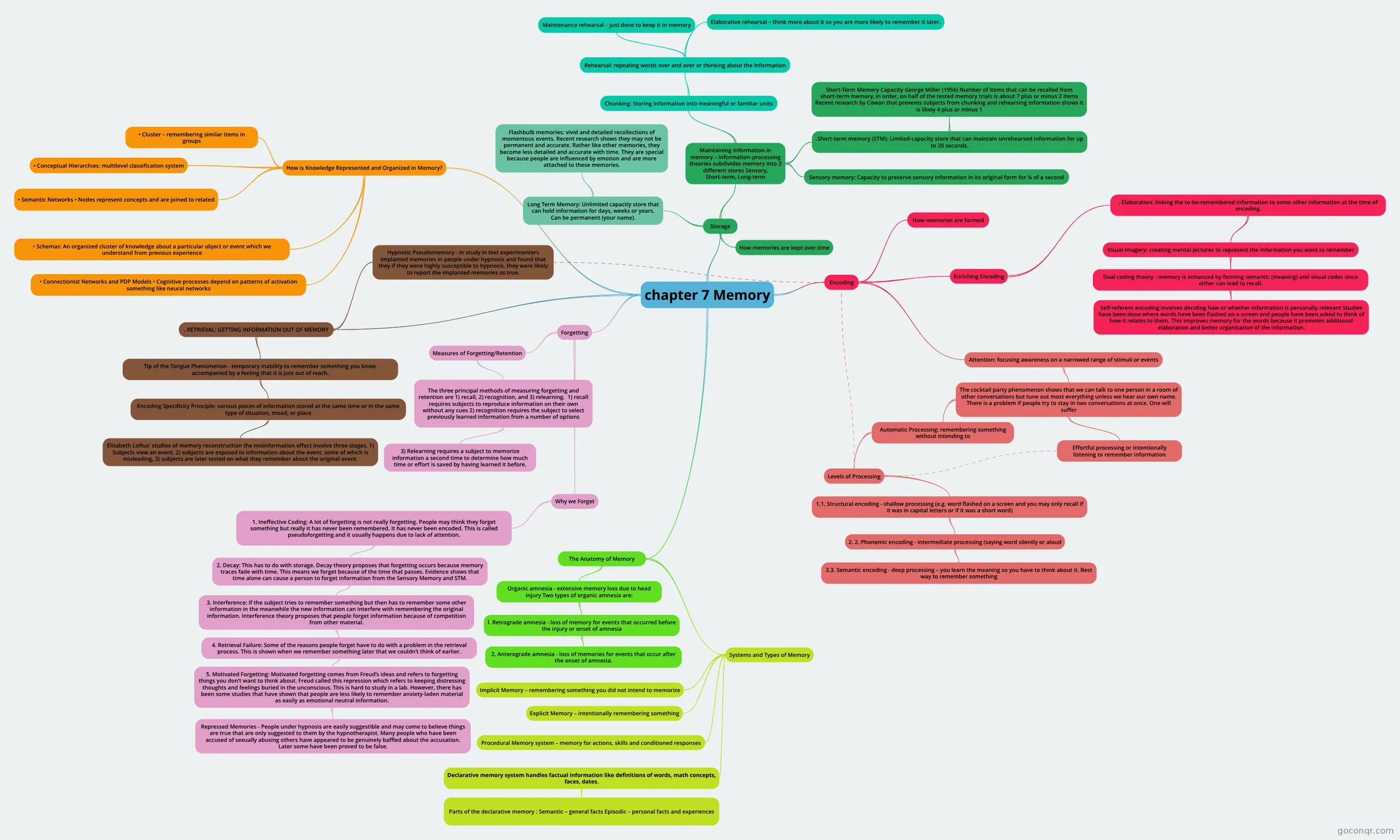
Mind map: chapter 7 Memory psychology
Contenido del mapa
chapter 7 Memory
Encoding
- How memories are formed
- Attention: focusing awareness on a narrowed range of stimuli or events
- The cocktail party phenomenon shows that we can talk to one person in a room of other conversations but tune out most everything unless we hear our own name. There is a problem if people try to stay in two conversations at once. One will suffer
- Effortful processing or intentionally listening to remember information
- Automatic Processing: remembering something without intending to
- Levels of Processing
- 1.1. Structural encoding - shallow processing (e.g. word flashed on a screen and you may only recall if it was in capital letters or if it was a short word)
- 2. 2. Phonemic encoding - intermediate processing (saying word silently or aloud
- 3.3. Semantic encoding - deep processing – you learn the meaning so you have to think about it. Best way to remember something
- 2. 2. Phonemic encoding - intermediate processing (saying word silently or aloud
- 1.1. Structural encoding - shallow processing (e.g. word flashed on a screen and you may only recall if it was in capital letters or if it was a short word)
- Levels of Processing
- The cocktail party phenomenon shows that we can talk to one person in a room of other conversations but tune out most everything unless we hear our own name. There is a problem if people try to stay in two conversations at once. One will suffer
- Enriching Encoding
- . Elaboration: linking the to-be-remembered information to some other information at the time of encoding.
- Visual Imagery: creating mental pictures to represent the information you want to remember
- Dual coding theory - memory is enhanced by forming semantic (meaning) and visual codes since either can lead to recall.
- Self-referent encoding involves deciding how or whether information is personally relevant Studies have been done where words have been flashed on a screen and people have been asked to think of how it relates to them. This improves memory for the words because it promotes additional elaboration and better organization of the information.
- Dual coding theory - memory is enhanced by forming semantic (meaning) and visual codes since either can lead to recall.
- Visual Imagery: creating mental pictures to represent the information you want to remember
- . Elaboration: linking the to-be-remembered information to some other information at the time of encoding.
Storage
- How memories are kept over time
- Maintaining information in memory – Information-processing theories subdivides memory into 3 different stores Sensory, Short-term, Long-term
- Sensory memory: Capacity to preserve sensory information in its original form for ¼ of a second
- .Short-term memory (STM): Limited-capacity store that can maintain unrehearsed information for up to 20 seconds.
- Short-Term Memory Capacity George Miller (1956) Number of items that can be recalled from short-term memory, in order, on half of the tested memory trials is about 7 plus or minus 2 items Recent research by Cowan that prevents subjects from chunking and rehearsing information shows it is likely 4 plus or minus 1
- Chunking: Storing information into meaningful or familiar units
- Rehearsal: repeating words over and over or thinking about the information
- Maintenance rehearsal – just done to keep it in memory
- Elaborative rehearsal – think more about it so you are more likely to remember it later.
- Rehearsal: repeating words over and over or thinking about the information
- Long Term Memory: Unlimited capacity store that can hold information for days, weeks or years. Can be permanent (your name).
- Flashbulb memories: vivid and detailed recollections of momentous events. Recent research shows they may not be permanent and accurate. Rather like other memories, they become less detailed and accurate with time. They are special because people are influenced by emotion and are more attached to these memories.
How is Knowledge Represented and Organized in Memory?
- • Cluster – remembering similar items in groups
- • Conceptual Hierarchies: multilevel classification system
- • Schemas: An organized cluster of knowledge about a particular object or event which we understand from previous experience
- • Semantic Networks • Nodes represent concepts and are joined to related
- • Connectionist Networks and PDP Models • Cognitive processes depend on patterns of activation something like neural networks
. RETRIEVAL: GETTING INFORMATION OUT OF MEMORY
- Tip of the Tongue Phenomenon - temporary inability to remember something you know, accompanied by a feeling that it is just out of reach.
- Encoding Specificity Principle: various pieces of information stored at the same time or in the same type of situation, mood, or place
- Elizabeth Loftus’ studies of memory reconstruction the misinformation effect involve three stages. 1) Subjects view an event, 2) subjects are exposed to information about the event, some of which is misleading, 3) subjects are later tested on what they remember about the original event.
- Encoding Specificity Principle: various pieces of information stored at the same time or in the same type of situation, mood, or place
- Hypnotic Pseudomemory - In study in text experimenters implanted memories in people under hypnosis and found that they if they were highly susceptible to hypnosis, they were likely to report the implanted memories as true.
- Tip of the Tongue Phenomenon - temporary inability to remember something you know, accompanied by a feeling that it is just out of reach.
Forgetting
- Measures of Forgetting/Retention
- The three principal methods of measuring forgetting and retention are 1) recall, 2) recognition, and 3) relearning. 1) recall requires subjects to reproduce information on their own without any cues 2) recognition requires the subject to select previously learned information from a number of options
- 3) Relearning requires a subject to memorize information a second time to determine how much time or effort is saved by having learned it before.
- The three principal methods of measuring forgetting and retention are 1) recall, 2) recognition, and 3) relearning. 1) recall requires subjects to reproduce information on their own without any cues 2) recognition requires the subject to select previously learned information from a number of options
- Why we Forget
- 1. Ineffective Coding: A lot of forgetting is not really forgetting. People may think they forget something but really it has never been remembered. It has never been encoded. This is called pseudoforgetting and it usually happens due to lack of attention.
- 2. Decay: This has to do with storage. Decay theory proposes that forgetting occurs because memory traces fade with time. This means we forget because of the time that passes. Evidence shows that time alone can cause a person to forget information from the Sensory Memory and STM.
- 3. Interference: If the subject tries to remember something but then has to remember some other information in the meanwhile the new information can interfere with remembering the original information. Interference theory proposes that people forget information because of competition from other material.
- 4. Retrieval Failure: Some of the reasons people forget have to do with a problem in the retrieval process. This is shown when we remember something later that we couldn’t think of earlier.
- 5. Motivated Forgetting: Motivated forgetting comes from Freud’s ideas and refers to forgetting things you don’t want to think about. Freud called this repression which refers to keeping distressing thoughts and feelings buried in the unconscious. This is hard to study in a lab. However, there has been some studies that have shown that people are less likely to remember anxiety-laden material as easily as emotional neutral information.
- Repressed Memories - People under hypnosis are easily suggestible and may come to believe things are true that are only suggested to them by the hypnotherapist. Many people who have been accused of sexually abusing others have appeared to be genuinely baffled about the accusation. Later some have been proved to be false.
- 5. Motivated Forgetting: Motivated forgetting comes from Freud’s ideas and refers to forgetting things you don’t want to think about. Freud called this repression which refers to keeping distressing thoughts and feelings buried in the unconscious. This is hard to study in a lab. However, there has been some studies that have shown that people are less likely to remember anxiety-laden material as easily as emotional neutral information.
- 4. Retrieval Failure: Some of the reasons people forget have to do with a problem in the retrieval process. This is shown when we remember something later that we couldn’t think of earlier.
- 3. Interference: If the subject tries to remember something but then has to remember some other information in the meanwhile the new information can interfere with remembering the original information. Interference theory proposes that people forget information because of competition from other material.
- 2. Decay: This has to do with storage. Decay theory proposes that forgetting occurs because memory traces fade with time. This means we forget because of the time that passes. Evidence shows that time alone can cause a person to forget information from the Sensory Memory and STM.
- 1. Ineffective Coding: A lot of forgetting is not really forgetting. People may think they forget something but really it has never been remembered. It has never been encoded. This is called pseudoforgetting and it usually happens due to lack of attention.
- Measures of Forgetting/Retention
The Anatomy of Memory
- Organic amnesia - extensive memory loss due to head injury Two types of organic amnesia are:
- l. Retrograde amnesia - loss of memory for events that occurred before the injury or onset of amnesia
- 2. Anterograde amnesia - loss of memories for events that occur after the onset of amnesia.
- l. Retrograde amnesia - loss of memory for events that occurred before the injury or onset of amnesia
- Systems and Types of Memory
- Implicit Memory – remembering something you did not intend to memorize
- Explicit Memory – intentionally remembering something
- Procedural Memory system – memory for actions, skills and conditioned responses
- Declarative memory system handles factual information like definitions of words, math concepts, faces, dates.
- Parts of the declarative memory : Semantic – general facts Episodic – personal facts and experiences
- Organic amnesia - extensive memory loss due to head injury Two types of organic amnesia are:
Información
- Descripción
- SEC I Physcology Mapa Mental sobre chapter 7 Memory, creado por Jacob Leveque el 01/04/2017.
- Creado por
- Jacob Leveque
- Visitas
- 1
- Valoración