
Mapa mental
Viruses
Contenido del mapa
Viruses
Structure
- Small
- 20nm (polio)
- 300nm (pox)
- Shape
- Genetic material enclosed in a capsid
- Nucleic Acid
- DNA
- Linear or circular
- ss DNA e.g Parvoviridae
- ds DNA e.g Herpesviridae
- Linear or circular
- RNA
- Linear
- ss RNA e.g Parvoviridae
- (+) ss RNA e.g Picornaviridae
- (-) ss RNA e.g Paramyxoviridae
- ds RNA e.g Reoviridae
- ss RNA e.g Parvoviridae
- Linear
- DNA
- Capsid
- Protein coat
- Made up of protein sub units called capsomeres
- Gives the virus it shape
- Helical
- Long rods flexible/rigid
- Nucleic acid is found in hollow cylindrical capsid that has a helical structure eg Ebola virus
- Icosahedral
- Capsid in shape of Icosahedral (polyhedron with 30 triangular faces 12 corners) e.g Adenovirus and Poliovirus
- Complex
- Complicated structures additional structures attached to capsid (bacteriophage) e,g T-even bacteriophage
- Helical
- Gives the virus it shape
- Nucleic Acid
- Envolope or Naked
- Envoloped
- Lipid bilayer surrounding capsid
- Made of host cell lipids
- Acquired during budding process
- Surface proteins called glycoproteins
- Used to attach to host cell
- Can cause hemagglutination e.g influenza
- Made of host cell lipids
- Lipid bilayer surrounding capsid
- Non-envoloped
- No lipid bilayer (naked)
- Envoloped
- Small
Replication
- Cant replicate outside a host cell
- Completly dependant on host cells for replication
- Replicate at a fast rate
- Completly dependant on host cells for replication
- Can mutate
- Don't grow or divide
- New viral components are synthesized and assembled within the infected host cell
- Cant replicate outside a host cell
Classification
- Family; Genus; Species
- Type of nucleic acid
- The sense (+ve/-ve) of ssRNA
- Nucleic acid strandedness
- Presence/absence of envelope
- Type of host
- e.g Family;Rhabdoviridae, Genus; Lysavirus, Species; Rabies virus
- e.g Family; Retroviridae, Genus; Lentivirus, Species; human immunodeficiency virus
- Family = ends with viridae subfamily = ends with virinae Genus and sp. = virus
- Family; Genus; Species
Infection
- Entry
- Across mucosa of respiratory, GI, genitourinary tract
- E.g influenza
- Infects upper respiratory tract of humans, birds, pigs, horses
- major pandemics 20-50 M people dead in 1918-1919
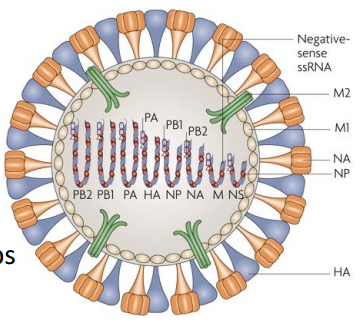
- Enveloped RNA virus: 8 single-strand RNAs (ssRNA) ->10 proteins
- Hemagglutinin (HA): binds to cell surface sialic acid (SA) groups
- M1: main capsid protein
- M2: ion channel important in unpacking
- Neuraminidase (NA): facilitate budding by cleaving N-acetlyneuraminic acid (SA)
- 3 basic types of influenza
- Type A
- Variations in HA and NA -> subtypes of type A virus
- 13 different HA subtypes 9 different NA subtypes H1N1 swine flu H5N1 bird flu
- Variations in HA and NA -> subtypes of type A virus
- Type B
- Humans and seals
- Type C
- Mild Illness
- Type A
- E.g influenza
- Broken skin
- Bites
- Across mucosa of respiratory, GI, genitourinary tract
- Infect target cells through binding to specific cellsurface receptors
- Host range
- Invertebrates, vertebrates, plants, protists, fungi or bacteria
- Narrow host range
- Determined by the receptors on the cell and avalibilty of host cellular factors for replication
- Can be very specific
- Determined by the receptors on the cell and avalibilty of host cellular factors for replication
- Narrow host range
- Invertebrates, vertebrates, plants, protists, fungi or bacteria
- Evasion
- Entry
Immune response
- Breach of protective barriers
- First infection (no virus specific anti-bodies)
- Humoral response
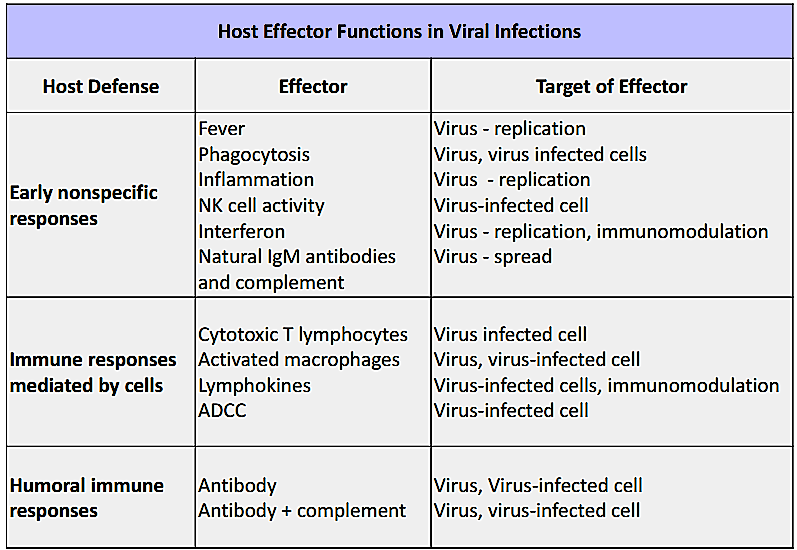
- Natural IgM + Complement
- Virus neutralisation/lysis
- Natural IgM antibodies: recognize specific markers on apoptotic cells
- enhance the phagocytic clearance of dead and dying cells
- recognise a wide range of viral antigens and bacterial toxins
- protect against a variety of pathogens not previously encountered
- recognise a wide range of viral antigens and bacterial toxins
- enhance the phagocytic clearance of dead and dying cells
- Natural IgM + Complement
- Cell response
- Infected non-immune cell
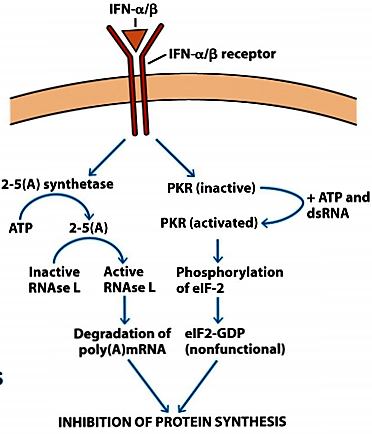
- Expression of type I IFNs (-a and –β) and IL-12 by infected cell
- IFN-a and –β bind IFN a/β receptor (autocrine / paracrine effect) Increased expression of specific genes Degradation of viral RNA (RNAse L) Inhibition of protein synthesis
- IFN types I + IL-12 -> stimulation of NK cells
- Apoptosis of infected cell
- IFN types I + IL-12 -> stimulation of NK cells
- IFN-a and –β bind IFN a/β receptor (autocrine / paracrine effect) Increased expression of specific genes Degradation of viral RNA (RNAse L) Inhibition of protein synthesis
- Expression of type I IFNs (-a and –β) and IL-12 by infected cell
- Cytotoxicity by NK and Tc
- Antigen-Presenting cells
- Infected non-immune cell
- Humoral response
- Subsequent infection
- Humoral Response
- Cell response
- First infection (no virus specific anti-bodies)
- Breach of protective barriers
Imágenes y archivos del mapa
Información
- Descripción
- Undergraduate Infection and Immunitiy Mapa Mental sobre Viruses, creado por Emma Bateson el 15/04/2017.
- Creado por
- Emma Bateson
- Visitas
- 1
- Historial
-
- Creado por Emma Bateson · 15 abr 2017
- Copiado por Emma Bateson · 15 abr 2017
- Valoración