
General Virology
683 resources created by 395 users
This General Virology page on GoConqr gathers community-made mind maps, quizzes, flashcards and notes, from bacteriophage lambda and herpes viruses to RNA viruses, HIV and AIDS, and prion disease. It's built for university students revising a topic and teachers after ready-made material. There are over 600 resources here, including more than 100 quizzes, over 290 mind maps and more than 220 flashcard sets, almost all at university level. Pick a topic, try a quiz to find your gaps, then make your own maps.
Top General Virology resources
Quizzes
See all 110 quizzes-
6 questionsGeneral virology Alexandria university year 2 2017
-
66 questionsVirology (week 5 and 6) What is the basic structure of Adenoviridae?
-
17 questionsQuiz CH9V1: Replication of DNA Genomes In productive infections a virus is very transcriptionally active and produces many progeny virions, wherea...
-
31 questionsIntro to virology The outer surface of the capsid mediates with host cells.
-
29 questionsMMI Module Exam Unit 3 and 4 Which of the following statements are not true about bacteriophages?
-
30 questionsHIV and AIDS HIV and AIDS has a natural reservoir in monkeys. This virus most likely made the jump from monkeys to human...
-
23 questionsViruses Quiz Virus Structure, Replication
-
25 questionsInfectious Diseases Viruses affect only humans.
Mind maps
See all 298 mind mapsFlashcards
See all 226 flashcards-
11 cardsBacteriophage Lambda What are functions of phages?
-
136 cardsMicro Exam 1 What is one of the smallest human viruses?
-
44 cardsCoronavirus From what order is the family Coronaviridae?
-
142 cardsMicrobiology Test 3 Researchers converted skin cells into embryonic stem cells. They first inserted RNA complimentary for four ...
-
81 cardsVirology
-
52 cardsVirology Concepts What is the definition of a virus?
-
61 cardsTreatment and Prevention: Virus What are the qualities of the viruses of public health importance? (4) Give examples
-
59 cardsViruses How does dsRNA/class three viruses infect its host cell?
Notes
See all 33 notes-
Enteric Viruses Enteric Viruses - General Background Structure of Intestinal Epithelium The intestinal epithelium is made up of small tower-like projections called villi. The space between these tower-like projections is called a cry...
-
Epstein Barr Virus in Health & Disease Epstein Barr Virus in Health & Disease General: EBV is a double stranded DNA virus or the Herpesviridae family It is also known as human herpesvirus 4 and is a gammaherpesvirus Genome is about 172kbp Primarily c...
-
TSEs Transmissible spongiform encephalopathies In humans Sporadic CJD Occurs worldwide at an incidence of 1 /1000000 Familial disease Familial CJG Gerstmann-Straussler-Scheinker syndrome 1/10000000 Fatal familial insomnia&...
-
BACTERIOPHAGE VIRUS Multiply within bacteria eg. E.Coli Isocohedral head and helical tail Contain DNA Phage rep time: 20-40 mins (50-200) Lytic Cycle: Virus goes inside, multiplys and releaseLysogenic Cycle: Virus DNA becomes p...
-
Virus glycoprotein
Slides
More Microbiology and immunology topics
About General Virology
GoConqr OriginalWhat the page covers
This unit sits in the Medically Important Microorganisms strand of Microbiology and immunology. It starts with what a virus is and moves on to individual virus families and diseases.
- Basics: the mind maps VIRUS and Virus Replication cover host preferences, taxonomy and how viruses multiply inside living cells.
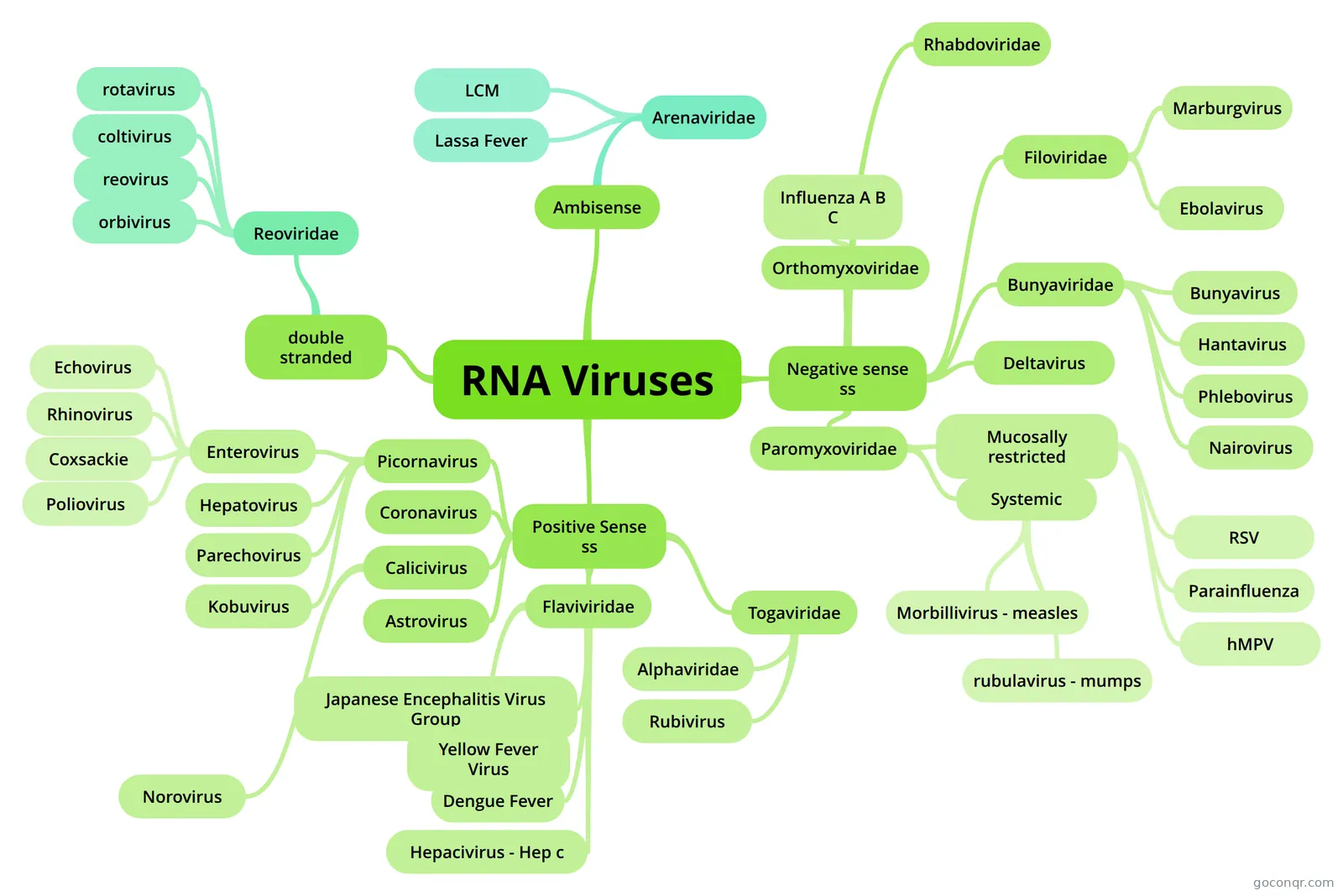
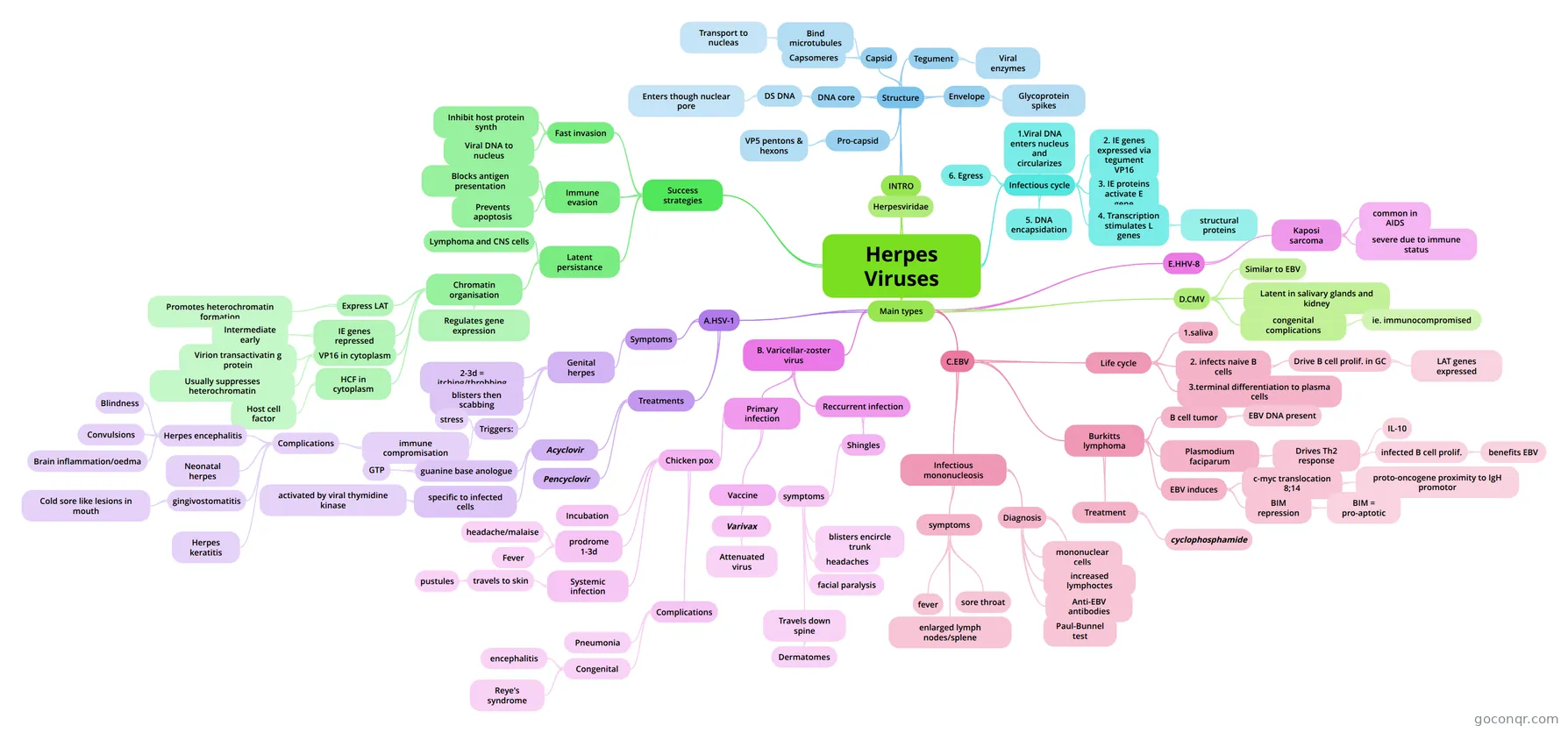
- Families: the Herpes Viruses map lists HSV-1, varicella-zoster, EBV, CMV and HHV-8, plus virion structure. The RNA Viruses map sorts positive sense, negative sense, ambisense and double stranded groups.
- Diseases: there are maps on CHIKUNGUNYA, Respiratory Viruses and HIV + AIDS, and notes on Ebola.
- Phages: the Bacteriophages map covers gene transfer, phage therapy and phage display.
Where to start
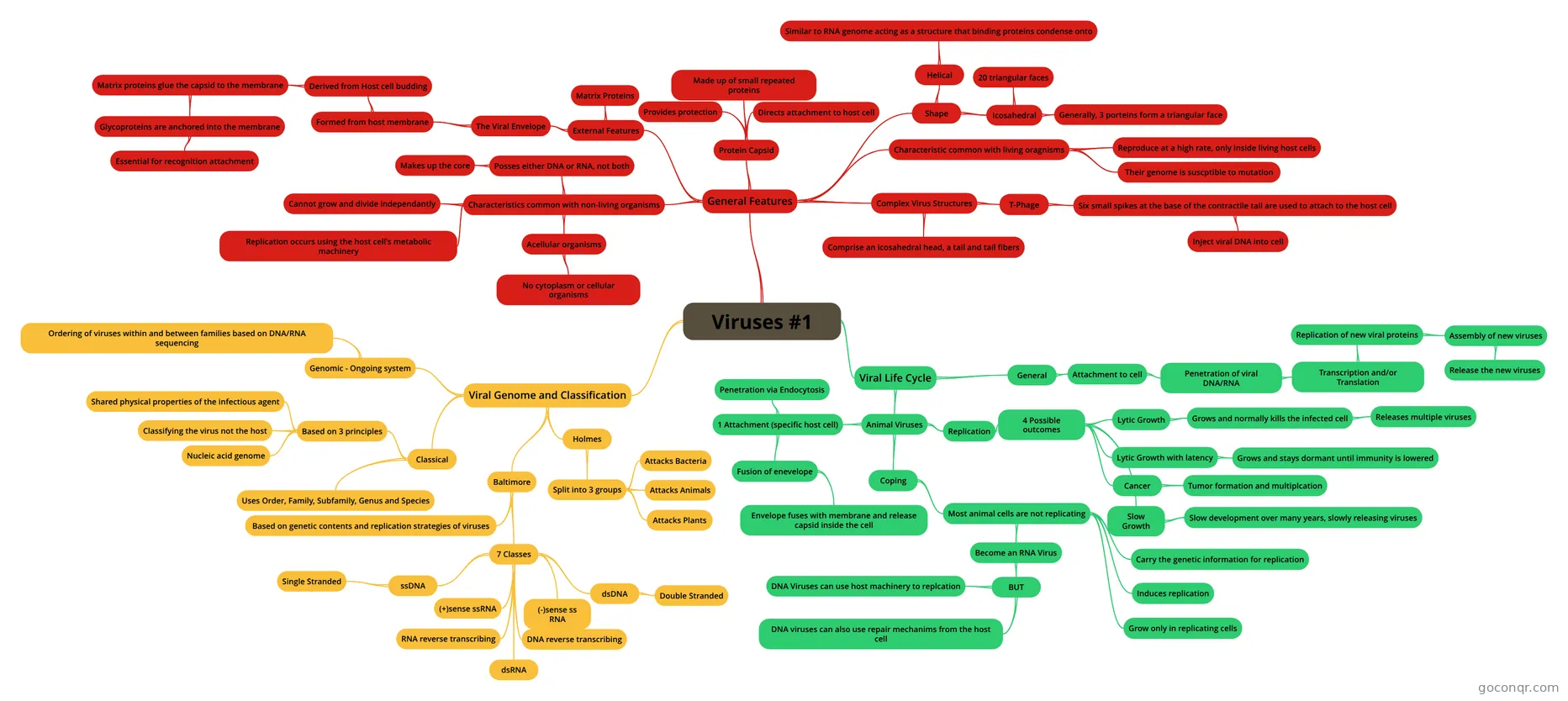
Begin with the Viruses mind maps for the general features of viruses. They set out what viruses share with living and non-living things. Then open the General virology quiz, which asks you to fill in blanks such as the metabolic pathways viruses cannot carry out.
Moving on to families
Next, pick one family at a time. Read the Herpes Viruses map, then check yourself with the Herpesvirus quiz. Do the same for RNA viruses, using the RNA virus replication quiz. The Bacteriophage Lambda flashcards ask you to describe the phases of lytic and lysogenic growth, which makes them a good test of recall.
Using maps and quizzes together
- Read a mind map and note the branches you could not explain.
- Take a quiz on the same topic, such as Stages of viral replication.
- Go back to the weak branches, then try a flashcard deck on the same subject.
Teachers can use the slide sets, such as Classification of viruses, as ready-made starting points for a lesson.
Make it your own
When you have worked through a topic, try building a mind map or a short quiz in your own words. Choose a virus family and see what you can recall.
Frequently asked questions
Which resource should I open first?
Start with the Viruses mind maps, which set out the general features of viruses, then try the General virology quiz. Together they give you the basic vocabulary before you move on to herpes viruses, RNA viruses, HIV or bacteriophages.
What do the mind maps cover?
They cover general virus features and replication, then particular groups. You will find maps on Herpes Viruses, RNA Viruses, Respiratory Viruses, Adenoviruses, Bacteriophages, HIV and AIDS, CHIKUNGUNYA, Polio and Emerging Infections, among others.
Are the resources free to use?
Yes. Every resource on this page is free to open, study and take, with no account needed. They were made by GoConqr users, not by GoConqr itself, so styles and depth vary from one resource to another.
Who are these resources for?
Nearly all of them are at university level, so they suit university students revising virology. Teachers can also use them, for example the slide sets on viral classification and transmission, as ready-made material.
Is there anything on phages and prions?
Yes. The Bacteriophage Lambda flashcards and the Bacteriophages mind map cover phages. For prions, there are flashcard decks on spongiform encephalopathies and human prion disease, plus notes on TSEs.
What if I cannot find my topic?
Try a broader search term, such as the virus family rather than the disease name. You can also make your own quiz, mind map, flashcards or notes on the topic with a free account, which also saves your quiz scores.