
Mapa mental
Climate Change
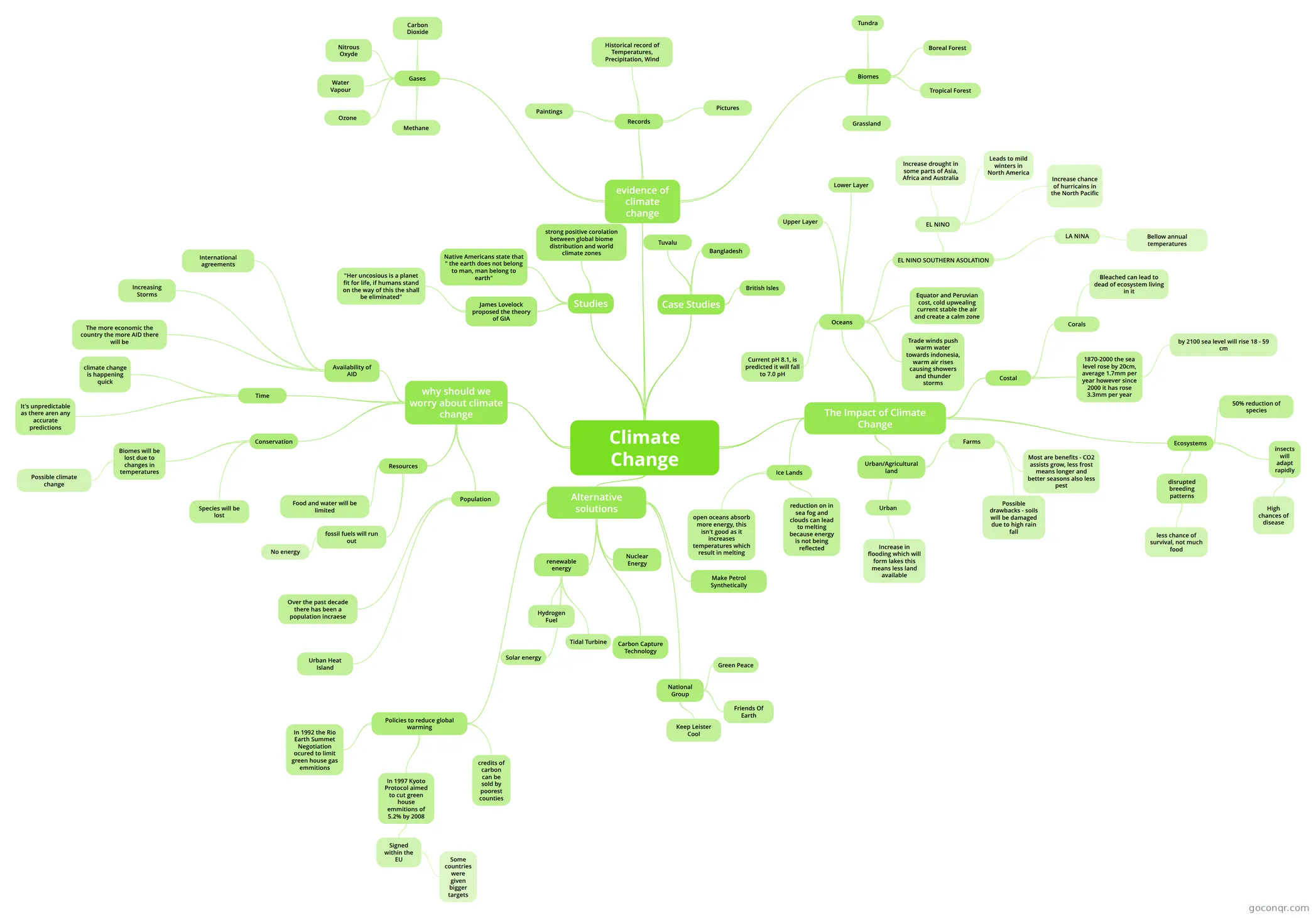
Mind map: Climate change
Contenido del mapa
Climate Change
- weather - overall state of the athmosphere of the time scale of minutes to months with reference to impact on man
- Climate - long term characteristics of an area. used to produce maps - Hazards
evidence of climate change
- Variations exist because, energy is reflected, absorbed and transmited
- Biomes
- Biomes - large ecosystem unit characterised by plant comunity, adaptation to the specific conditions
- Tundra
- Coldest biome, most fragile and young, very important because its a CARBON SINK.
- There is little precipitation of 125mm per year as its temperature is 3-12*C
- Located at high altitude within the northerns hemisphere eg. Alaska, Canada, Greenland and Eurasia. within the southern hemisphere eg chilean Andes
- There is little sun and warmth for many plants to grow so they need to have special adaptations for survival : waxy leafs - prevent transpiration shallow roots - due to freeze thaw photosynthesis at low temperatures most plant shapes are clustered to keep warmth
- The soil is acidic and most of the time it develops freeze thaw hence descomposition is slow
- most of the animals found in the Tundra are herbivores this is because of food availability, they hibernate or migrate, the majority are small built, have thick fur but with small hairs and a fat layer of fat which keeps them warm
- This biome will be eliminated completely, species will change and the snow will melt leading to increase in sea levels. Smog clouds will appear, its said that this will desapear by 2100 also the oceanic currents in the North Atlantic ocean will be affected this are the ones in charge of keeping the seas in Europe warm.
- Tropical Forest
- Its very humid and important because its a CARBON SINK, it also has the greatest biological diversity in the whole world. temperature is between 20-40*C and its precipitation its between 1000 - 7000 mm
- Its vegetation is found in layers and its continuos . Its adaptions involve: thin, smooth bark. waxy surfaces to protect from burning up and to stop transpiration because intense sunlight. shallow rooted, soil is moist leaves are able to turn to photosynthesise
- Animals feed on one type of food as they have adaptations which neutralise toxins, they usually live in an area. use camouflage to hide or hunt and animals which have bright colors use this to warn predators.
- The impact is that El NINO will endanger the ecosystem which endangers communities around it. the capasity to take in CO2 will decrease, deforestation will release CO2 however they wont be many sinks
- Grassland
- It has a low rain fall per year 500-1000 mm and its temperature is between 15-30*C. Its located 5-15* north and south Equator and cover 12% of the worlds land. Tanzania and South America.
- Its vegetation is well adapted to have long roots and a thick bark to resist fires. its leaves fall in winter and they are sharp and taster bitter to avoid being eaten
- Animals have long legs and wings for migration. eg big ears in an elephant to help it release heat and to make sure that body fluid isnt lost
- population increase will lead to using grassland for livestock and plants will release CO2. deforestation, open cast mining and most will be used for agriculture.
- Boreal Forest
- Precipitation varies from 500-1000 mm and its temperature are between 0-10*C. They are found in North America, Western and Central Europe, North East Asia, China and Japan.
- Its Vegetation is deciduous woodland, green leaves to photosynthesise. organic compounds are stored in roots and chlorophyl decomposes in winter. sucrose helps in winter.
- The animals in this area migrate and hibernate most of the time, they store food, and it cold temperatures it doesn't decompose. It soil is good for decomposition because it has worm and fungi and holds nutrients
- The impact will be that there will be a woodland decline, and the ecosytem will not be able to adapt fast enough, this area will eventually become stormy
- Gases
- Carbon Dioxide
- measured in parts per million by volume of air, there has been an increase of CO2 in the past 100 years
- Ozone
- gas which filters UV light and its beneficial and a low levels it produces photochemical smog
- Nitrous Oxyde
- given off by bacteria and one molecule of this is greater than one of CO2
- Water Vapour
- the more vapor the more hear there will be
- Methane
- 20 times more powerful than CO2 and it has increased dramatically as a result of burning fossil fuels
- Carbon Dioxide
- Records
- Paintings
- Pictures
- Historical record of Temperatures, Precipitation, Wind
why should we worry about climate change
- Population
- Over the past decade there has been a population incraese
- Urban Heat Island
- Resources
- fossil fuels will run out
- No energy
- Food and water will be limited
- fossil fuels will run out
- Availability of AID
- Increasing Storms
- International agreements
- The more economic the country the more AID there will be
- Time
- climate change is happening quick
- It's unpredictable as there aren any accurate predictions
- Conservation
- Biomes will be lost due to changes in temperatures
- Possible climate change
- Species will be lost
- Biomes will be lost due to changes in temperatures
- Population
Case Studies
- Tuvalu
- Bangladesh
- British Isles
Studies
- Native Americans state that " the earth does not belong to man, man belong to earth"
- James Lovelock proposed the theory of GIA
- "Her uncosious is a planet fit for life, if humans stand on the way of this the shall be eliminated"
- strong positive corolation between global biome distribution and world climate zones
The Impact of Climate Change
- Oceans
- if global temperature increases, wind speed will increase hence there will be rapid movement in the upper layer which will bring up decaying material.
- This will release methane and hydrogen sulphite than can turn the sea acidic. as CO2 levels increase which produces a weak carbonic acid which will have a long term effect on fishes.
- species will decline in this conditions in exeption of the squid because of low oxygen levels
- Upper Layer
- Lower Layer
- Current pH 8.1, is predicted it will fall to 7.0 pH
- EL NINO SOUTHERN ASOLATION
- EL NINO
- occurs around christmas time hence in translation is the child Jesus
- Increase drought in some parts of Asia, Africa and Australia
- Leads to mild winters in North America
- Increase chance of hurricains in the North Pacific
- LA NINA
- Bellow annual temperatures
- EL NINO
- Trade winds push warm water towards indonesia, warm air rises causing showers and thunder storms
- Equator and Peruvian cost, cold upwealing current stable the air and create a calm zone
- Costal
- corals will bleach as so will the plants that live within them
- Corals
- Bleached can lead to dead of ecosystem living in it
- 1870-2000 the sea level rose by 20cm, average 1.7mm per year however since 2000 it has rose 3.3mm per year
- by 2100 sea level will rise 18 - 59 cm
- Ice Lands
- Green Land will add 3 m to global sea level, this will wipe Florida, wipe the Mississipi delta and destroy a 3rd of New York and drown London
- open oceans absorb more energy, this isn't good as it increases temperatures which result in melting
- reduction on in sea fog and clouds can lead to melting because energy is not being reflected
- Ecosystems
- amphybians - golden toad found in COSTA RICA can catch a fungus that can happen due to climate change
- butterflies - if there are changes on temperatures can be highly impacted if drought and flood
- 50% reduction of species
- disrupted breeding patterns
- less chance of survival, not much food
- insects will adapt rapidly
- High chances of disease
- malaria mosquito - can lead to death dengue mosquito - can lead to severe damage
- High chances of disease
- Urban/Agricultural land
- Farms
- Most are benefits - CO2 assists grow, less frost means longer and better seasons also less pest
- Possible drawbacks - soils will be damaged due to high rain fall
- Urban
- Increase in flooding which will form lakes this means less land available
- Farms
- Oceans
Alternative solutions
- renewable energy
- Solar energy
- Hydrogen Fuel
- Tidal Turbine
- Nuclear Energy
- Make Petrol Synthetically
- Policies to reduce global warming
- In 1992 the Rio Earth Summet Negotiation ocured to limit green house gas emmitions
- In 1997 Kyoto Protocol aimed to cut green house emmitions of 5.2% by 2008
- Signed within the EU
- Some countries were given bigger targets
- Signed within the EU
- credits of carbon can be sold by poorest counties
- Carbon Capture Technology
- National Group
- Green Peace
- Friends Of Earth
- Keep Leister Cool
- renewable energy
Información
- Descripción
- A Levels (Physical) Geography Mapa Mental sobre Climate Change, creado por mccarl8 el 11/05/2014.
- Creado por
- mccarl8
- Visitas
- 37
- Valoración