
Mapa mental
Biological molecules
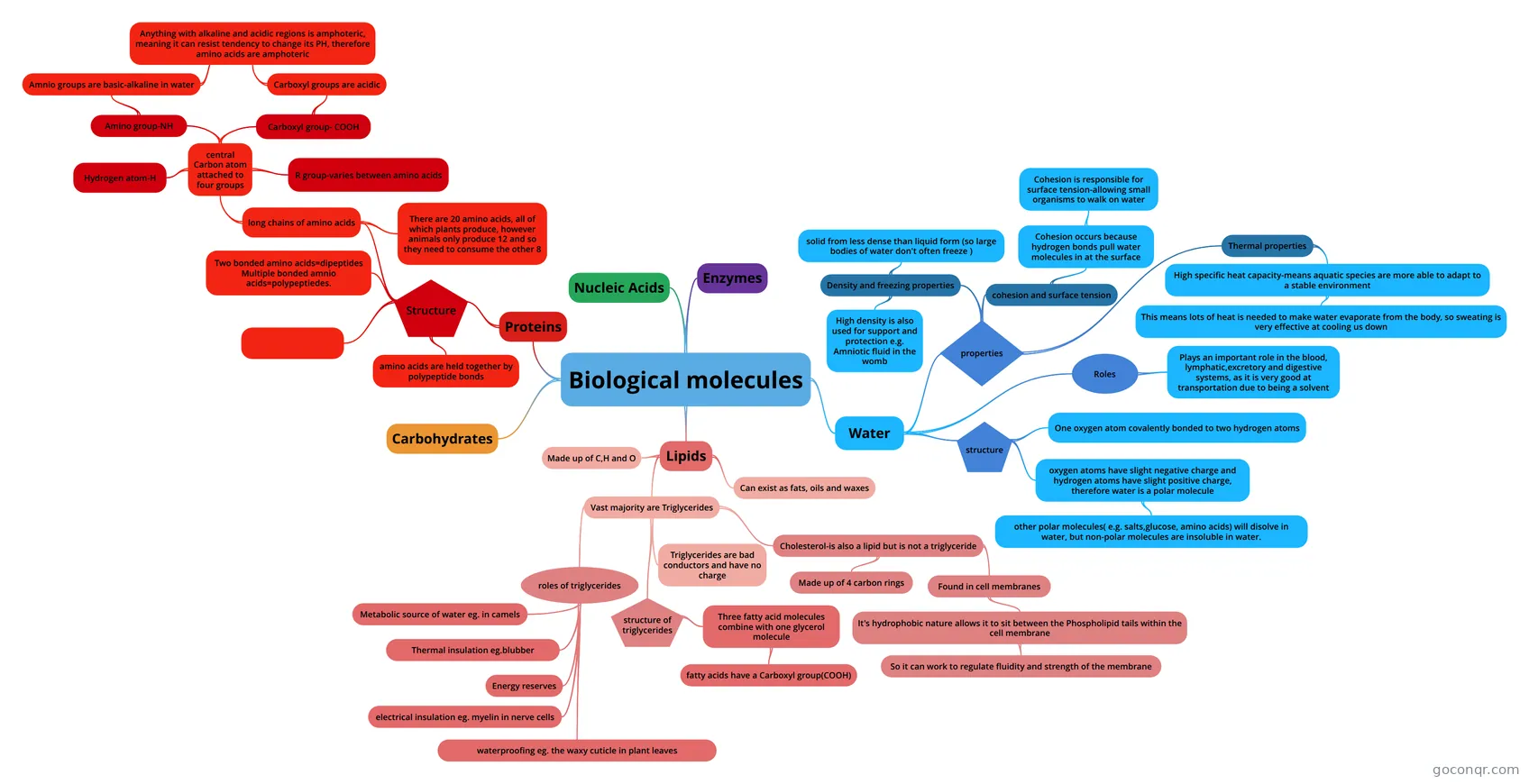
Mind map: Biological molecules
Contenido del mapa
Biological molecules
Carbohydrates
Lipids
- Can exist as fats, oils and waxes
- Made up of C,H and O
- Vast majority are Triglycerides
- roles of triglycerides
- Energy reserves
- electrical insulation eg. myelin in nerve cells
- Thermal insulation eg.blubber
- Metabolic source of water eg. in camels
- waterproofing eg. the waxy cuticle in plant leaves
- structure of triglycerides
- Three fatty acid molecules combine with one glycerol molecule
- fatty acids have a Carboxyl group(COOH)
- Three fatty acid molecules combine with one glycerol molecule
- Triglycerides are bad conductors and have no charge
- Cholesterol-is also a lipid but is not a triglyceride
- Made up of 4 carbon rings
- Found in cell membranes
- It's hydrophobic nature allows it to sit between the Phospholipid tails within the cell membrane
- So it can work to regulate fluidity and strength of the membrane
- It's hydrophobic nature allows it to sit between the Phospholipid tails within the cell membrane
- roles of triglycerides
Water
- structure
- One oxygen atom covalently bonded to two hydrogen atoms
- oxygen atoms have slight negative charge and hydrogen atoms have slight positive charge, therefore water is a polar molecule
- other polar molecules( e.g. salts,glucose, amino acids) will disolve in water, but non-polar molecules are insoluble in water.
- Roles
- Plays an important role in the blood, lymphatic,excretory and digestive systems, as it is very good at transportation due to being a solvent
- properties
- Thermal properties
- High specific heat capacity-means aquatic species are more able to adapt to a stable environment
- This means lots of heat is needed to make water evaporate from the body, so sweating is very effective at cooling us down
- High specific heat capacity-means aquatic species are more able to adapt to a stable environment
- Density and freezing properties
- solid from less dense than liquid form (so large bodies of water don't often freeze )
- High density is also used for support and protection e.g. Amniotic fluid in the womb
- cohesion and surface tension
- Cohesion occurs because hydrogen bonds pull water molecules in at the surface
- Cohesion is responsible for surface tension-allowing small organisms to walk on water
- Cohesion occurs because hydrogen bonds pull water molecules in at the surface
- Thermal properties
- structure
Proteins
- Structure
- long chains of amino acids
- central Carbon atom attached to four groups
- Amino group-NH
- Amnio groups are basic-alkaline in water
- Amnio groups are basic-alkaline in water
- Hydrogen atom-H
- R group-varies between amino acids
- Carboxyl group- COOH
- Carboxyl groups are acidic
- Anything with alkaline and acidic regions is amphoteric, meaning it can resist tendency to change its PH, therefore amino acids are amphoteric
- Carboxyl groups are acidic
- Amino group-NH
- There are 20 amino acids, all of which plants produce, however animals only produce 12 and so they need to consume the other 8
- central Carbon atom attached to four groups
- Two bonded amino acids=dipeptides Multiple bonded amnio acids=polypeptiedes.
- amino acids are held together by polypeptide bonds
- long chains of amino acids
- Structure
Nucleic Acids
Enzymes
Información
- Descripción
- Brief description of roles and structure of the 6 biological molecules (OCR A-level)
- Creado por
- megan hill
- Visitas
- 31
- Etiquetas
- Valoración