
Mapa mental
Covalent Bonding
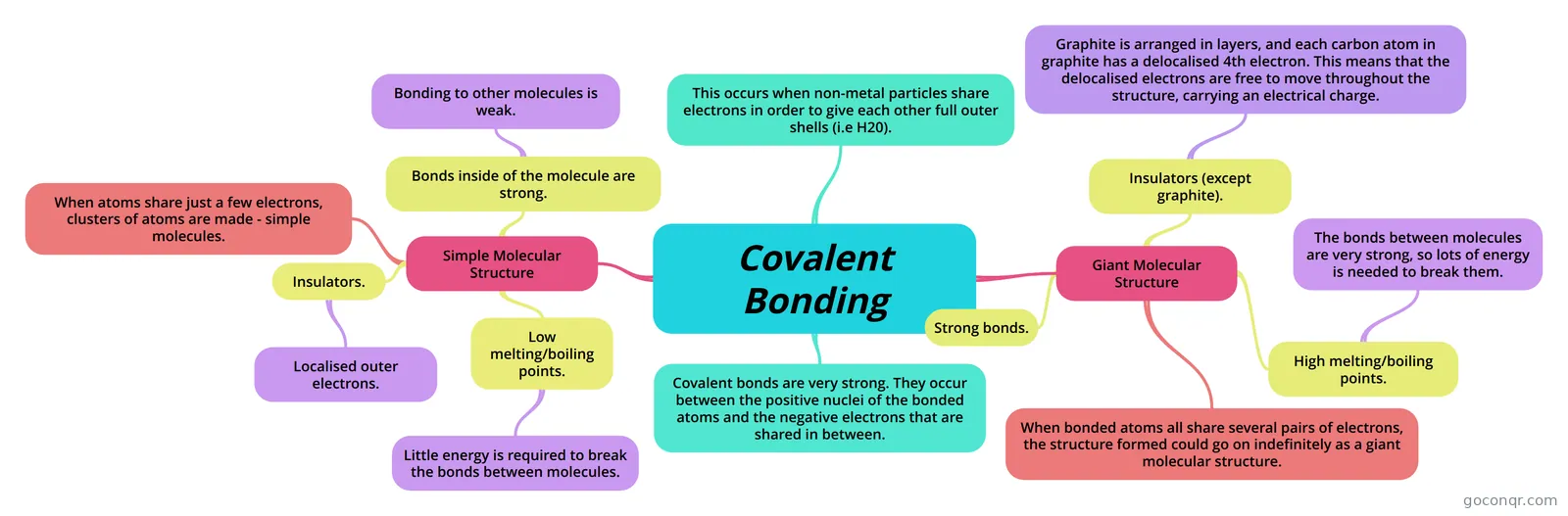
Mind map: covalent bonding
Contenido del mapa
Covalent Bonding
Giant Molecular Structure
- Strong bonds.
- High melting/boiling points.
- The bonds between molecules are very strong, so lots of energy is needed to break them.
- Insulators (except graphite).
- Graphite is arranged in layers, and each carbon atom in graphite has a delocalised 4th electron. This means that the delocalised electrons are free to move throughout the structure, carrying an electrical charge.
- When bonded atoms all share several pairs of electrons, the structure formed could go on indefinitely as a giant molecular structure.
Simple Molecular Structure
- Bonds inside of the molecule are strong.
- Bonding to other molecules is weak.
- Low melting/boiling points.
- Little energy is required to break the bonds between molecules.
- Insulators.
- Localised outer electrons.
- When atoms share just a few electrons, clusters of atoms are made - simple molecules.
- Bonds inside of the molecule are strong.
This occurs when non-metal particles share electrons in order to give each other full outer shells (i.e H20).
Covalent bonds are very strong. They occur between the positive nuclei of the bonded atoms and the negative electrons that are shared in between.
Información
- Descripción
- GCSE Chemistry Mapa Mental sobre Covalent Bonding, creado por katherinethewise el 28/05/2014.
- Creado por
- katherinethewise
- Visitas
- 598
- Etiquetas
- Valoración