
Mapa mental
UNIT 3 RELATIONSHIPS (PART C)
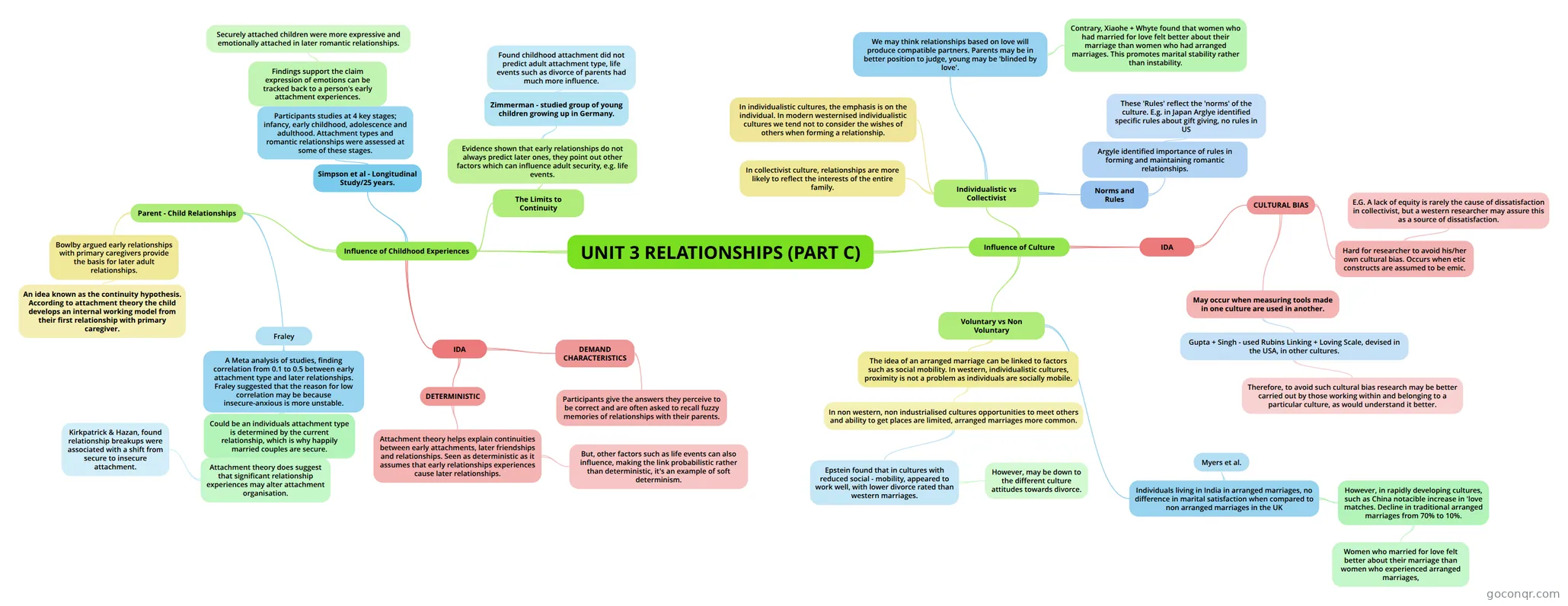
Mind map: relationships
Contenido del mapa
UNIT 3 RELATIONSHIPS (PART C)
Influence of Childhood Experiences
- Parent - Child Relationships
- Bowlby argued early relationships with primary caregivers provide the basis for later adult relationships.
- An idea known as the continuity hypothesis. According to attachment theory the child develops an internal working model from their first relationship with primary caregiver.
- A Meta analysis of studies, finding correlation from 0.1 to 0.5 between early attachment type and later relationships. Fraley suggested that the reason for low correlation may be because insecure-anxious is more unstable.
- Fraley
- Could be an individuals attachment type is determined by the current relationship, which is why happily married couples are secure.
- Attachment theory does suggest that significant relationship experiences may alter attachment organisation.
- Kirkpatrick & Hazan, found relationship breakups were associated with a shift from secure to insecure attachment.
- Attachment theory does suggest that significant relationship experiences may alter attachment organisation.
- Bowlby argued early relationships with primary caregivers provide the basis for later adult relationships.
- Simpson et al - Longitudinal Study/25 years.
- Participants studies at 4 key stages; infancy, early childhood, adolescence and adulthood. Attachment types and romantic relationships were assessed at some of these stages.
- Findings support the claim expression of emotions can be tracked back to a person's early attachment experiences.
- Securely attached children were more expressive and emotionally attached in later romantic relationships.
- Findings support the claim expression of emotions can be tracked back to a person's early attachment experiences.
- Participants studies at 4 key stages; infancy, early childhood, adolescence and adulthood. Attachment types and romantic relationships were assessed at some of these stages.
- The Limits to Continuity
- Evidence shown that early relationships do not always predict later ones, they point out other factors which can influence adult security, e.g. life events.
- Zimmerman - studied group of young children growing up in Germany.
- Found childhood attachment did not predict adult attachment type, life events such as divorce of parents had much more influence.
- Zimmerman - studied group of young children growing up in Germany.
- Evidence shown that early relationships do not always predict later ones, they point out other factors which can influence adult security, e.g. life events.
- IDA
- DETERMINISTIC
- Attachment theory helps explain continuities between early attachments, later friendships and relationships. Seen as deterministic as it assumes that early relationships experiences cause later relationships.
- But, other factors such as life events can also influence, making the link probabilistic rather than deterministic, it's an example of soft determinism.
- Attachment theory helps explain continuities between early attachments, later friendships and relationships. Seen as deterministic as it assumes that early relationships experiences cause later relationships.
- DEMAND CHARACTERISTICS
- Participants give the answers they perceive to be correct and are often asked to recall fuzzy memories of relationships with their parents.
- DETERMINISTIC
- Parent - Child Relationships
Influence of Culture
- Voluntary vs Non Voluntary
- The idea of an arranged marriage can be linked to factors such as social mobility. In western, individualistic cultures, proximity is not a problem as individuals are socially mobile.
- In non western, non industrialised cultures opportunities to meet others and ability to get places are limited, arranged marriages more common.
- Epstein found that in cultures with reduced social - mobility, appeared to work well, with lower divorce rated than western marriages.
- However, may be down to the different culture attitudes towards divorce.
- Epstein found that in cultures with reduced social - mobility, appeared to work well, with lower divorce rated than western marriages.
- In non western, non industrialised cultures opportunities to meet others and ability to get places are limited, arranged marriages more common.
- Individuals living in India in arranged marriages, no difference in marital satisfaction when compared to non arranged marriages in the UK
- Myers et al.
- However, in rapidly developing cultures, such as China notacible increase in 'love matches. Decline in traditional arranged marriages from 70% to 10%.
- Women who married for love felt better about their marriage than women who experienced arranged marriages,
- The idea of an arranged marriage can be linked to factors such as social mobility. In western, individualistic cultures, proximity is not a problem as individuals are socially mobile.
- Individualistic vs Collectivist
- In individualistic cultures, the emphasis is on the individual. In modern westernised individualistic cultures we tend not to consider the wishes of others when forming a relationship.
- In collectivist culture, relationships are more likely to reflect the interests of the entire family.
- Norms and Rules
- Argyle identified importance of rules in forming and maintaining romantic relationships.
- These 'Rules' reflect the 'norms' of the culture. E.g. in Japan Arglye identified specific rules about gift giving, no rules in US
- Argyle identified importance of rules in forming and maintaining romantic relationships.
- We may think relationships based on love will produce compatible partners. Parents may be in better position to judge, young may be 'blinded by love'.
- Contrary, Xiaohe + Whyte found that women who had married for love felt better about their marriage than women who had arranged marriages. This promotes marital stability rather than instability.
- IDA
- CULTURAL BIAS
- Hard for researcher to avoid his/her own cultural bias. Occurs when etic constructs are assumed to be emic.
- E.G. A lack of equity is rarely the cause of dissatisfaction in collectivist, but a western researcher may assure this as a source of dissatisfaction.
- May occur when measuring tools made in one culture are used in another.
- Gupta + Singh - used Rubins Linking + Loving Scale, devised in the USA, in other cultures.
- Therefore, to avoid such cultural bias research may be better carried out by those working within and belonging to a particular culture, as would understand it better.
- Gupta + Singh - used Rubins Linking + Loving Scale, devised in the USA, in other cultures.
- Hard for researcher to avoid his/her own cultural bias. Occurs when etic constructs are assumed to be emic.
- CULTURAL BIAS
- Voluntary vs Non Voluntary
Información
- Descripción
- Mapa Mental sobre UNIT 3 RELATIONSHIPS (PART C), creado por itsmenickylee el 28/05/2014.
- Creado por
- itsmenickylee
- Visitas
- 22
- Valoración
Más sobre Childhood experiences and adult relationships