
Mapa mental
Sex differences in parental investment
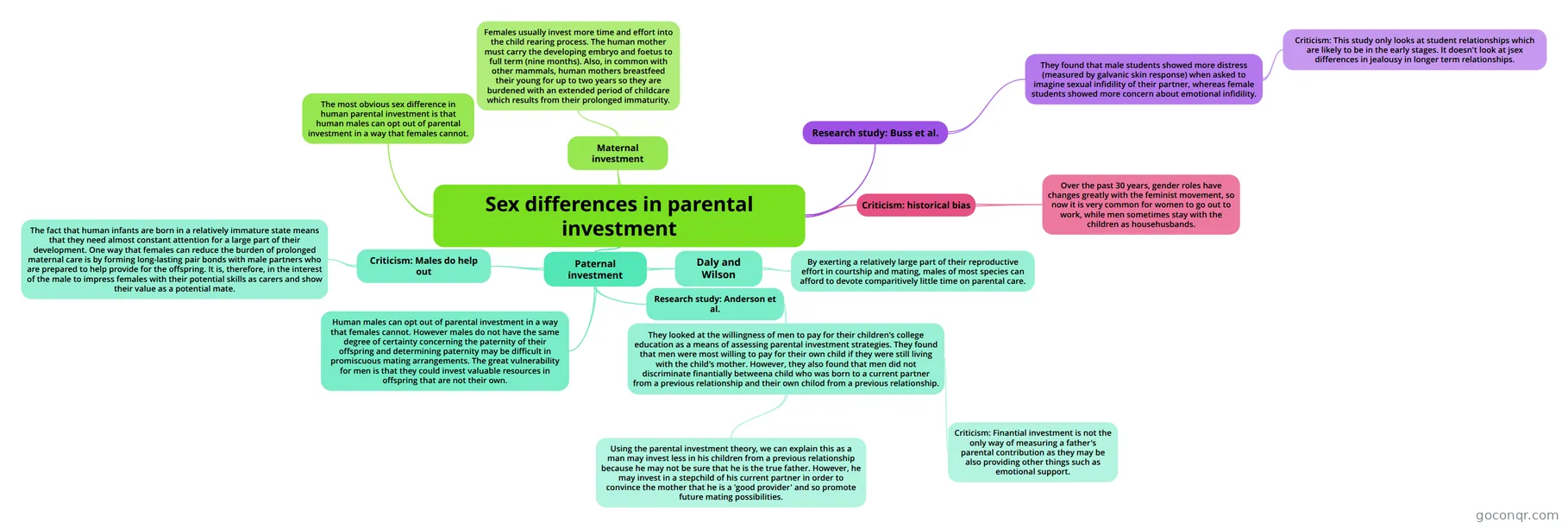
Mind map: Sex differences in parental investment
Contenido del mapa
Sex differences in parental investment
The most obvious sex difference in human parental investment is that human males can opt out of parental investment in a way that females cannot.
Maternal investment
- Females usually invest more time and effort into the child rearing process. The human mother must carry the developing embryo and foetus to full term (nine months). Also, in common with other mammals, human mothers breastfeed their young for up to two years so they are burdened with an extended period of childcare which results from their prolonged immaturity.
Paternal investment
- Human males can opt out of parental investment in a way that females cannot. However males do not have the same degree of certainty concerning the paternity of their offspring and determining paternity may be difficult in promiscuous mating arrangements. The great vulnerability for men is that they could invest valuable resources in offspring that are not their own.
- Research study: Anderson et al.
- They looked at the willingness of men to pay for their children's college education as a means of assessing parental investment strategies. They found that men were most willing to pay for their own child if they were still living with the child's mother. However, they also found that men did not discriminate finantially betweena child who was born to a current partner from a previous relationship and their own chilod from a previous relationship.
- Using the parental investment theory, we can explain this as a man may invest less in his children from a previous relationship because he may not be sure that he is the true father. However, he may invest in a stepchild of his current partner in order to convince the mother that he is a 'good provider' and so promote future mating possibilities.
- Criticism: Finantial investment is not the only way of measuring a father's parental contribution as they may be also providing other things such as emotional support.
- They looked at the willingness of men to pay for their children's college education as a means of assessing parental investment strategies. They found that men were most willing to pay for their own child if they were still living with the child's mother. However, they also found that men did not discriminate finantially betweena child who was born to a current partner from a previous relationship and their own chilod from a previous relationship.
- Criticism: Males do help out
- The fact that human infants are born in a relatively immature state means that they need almost constant attention for a large part of their development. One way that females can reduce the burden of prolonged maternal care is by forming long-lasting pair bonds with male partners who are prepared to help provide for the offspring. It is, therefore, in the interest of the male to impress females with their potential skills as carers and show their value as a potential mate.
- Daly and Wilson
- By exerting a relatively large part of their reproductive effort in courtship and mating, males of most species can afford to devote comparitively little time on parental care.
Research study: Buss et al.
- They found that male students showed more distress (measured by galvanic skin response) when asked to imagine sexual infidility of their partner, whereas female students showed more concern about emotional infidility.
- Criticism: This study only looks at student relationships which are likely to be in the early stages. It doesn't look at jsex differences in jealousy in longer term relationships.
- They found that male students showed more distress (measured by galvanic skin response) when asked to imagine sexual infidility of their partner, whereas female students showed more concern about emotional infidility.
Criticism: historical bias
- Over the past 30 years, gender roles have changes greatly with the feminist movement, so now it is very common for women to go out to work, while men sometimes stay with the children as househusbands.
Información
- Descripción
- Mapa Mental sobre Sin título, creado por hannahmcgrath199 el 03/06/2014.
- Creado por
- hannahmcgrath199
- Visitas
- 9
- Valoración
Más sobre Sexual selection and partner preferences