
Apuntes
DNA profiling
Contenido del apunte (1)
Página 1
DNA profiling
DNA profiling is also called DNA or genetic fingerprinting. It is a method of making a unique pattern of bands from the DNA of a person, which can then be used to distinguish that DNA from other DNA.
Introduction to the method of preparing a DNA profile
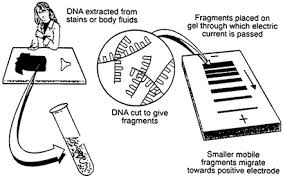
Preparing a DNA profile involves 4 steps. First, the DNA is released from cells. Second, the DNA is cut into fragments of different lengths. Then, the DNA fragments are separated according to their sizes. Finally, the patterns produced by the fragments are compared.
Step 1 - DNA is released
In order to produce a DNA profile, cells are broken down to release their DNA. If the amount of DNA available is too small to work with, it can be increased or amplified. A common technique used to amplify small quantities of DNA is a process called polymerase chain reaction, PCR.
Step 2 - DNA is cut into fragments
The isolated DNA is cut into fragments using special enzymes. These enzymes are called restriction enzymes. They were first isolated from bacteria where they are used to destroy the DNA of invading viruses. Different restriction enzymes cut DNA at specific base sequences. For example, one restriction enzyme will cut the DNA at the base sequence, GAATTC, while another only cuts at the sequence, GATC.
By using the GAATTC restriction enzyme, a long strand of DNA will be cut into sections. Each section starts with the base sequence AATTC - the enzyme cuts the DNA between the G and the A bases.
The sections of DNA that are cut out are called restriction fragments. The restriction fragments will be of different lengths because the base sequences being cut may be close together or far apart on the DNA strands. This means that if two GAATTC sequences are close together, then a short section of DNA results.
It two GAATTC sequences are very far apart, then the DNA section cut out will be much longer.
Step 3 - The fragments are separated
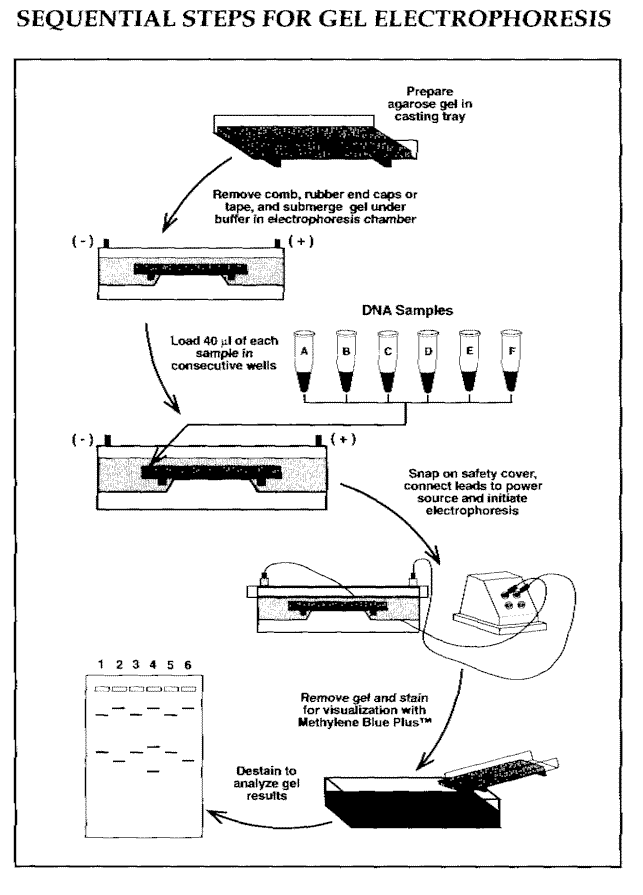
The restriction fragments are separated on the bases of their size. They are separated by a process called Gel Electrophoresis. This involves placing the invisible DNA fragments in a small glass tank containing a sugar-based gel. An electric current is applied along the gel. The current draws the negatively charged DNA to one end of the gel. Small DNA fragments move faster through the porous gel than do the larger fragments. In this way, bands of the small fragments are separated from bands of larger fragments.
When the electrophoresis is finished, a permanent record of the results in obtained. This may involve adding radioactive material, which combines with DNA fragments to produce a fluorescent image. A photographic copy of the final pattern of DNA bands is then obtained.
Step 4 - Patterns are compared
It is highly unlikely that two people will have the same DNA, unless they are identical twins. If the pattern of bands from two different DNA samples is the same, then the two samples must have come from the same person.
DNA profiling
Información
- Descripción
- DNA profiling is also known as DNA fingerprinting. It is a method of making a unique pattern of bands from the DNA of a person. This note focuses on DNA profiling and the method of preparing a DNA profile. It would appeal to anyone studying intermediate level biology.
- Creado por
- daniel.praecox · ene 2014
- Actualizado
- 11 dic 2016
- Visitas
- 158
- Etiquetas
- Historial
-
- Creado por jill.examtime · 31 ene 2014
- Copiado por daniel.praecox · 31 ene 2014
- Valoración