
Apuntes
Chapter 34
Contenido del apunte (1)
Página 1
Chapter 34: Vertebrates
A. Phylum- Chordata
i. All have the following characteristics at some time in their development:
a. Dorsal hollow nerve cord: only chordates have this structure
b. Notochord: a flexible rod between the nerve cord and the digestive system
c. Pharyngeal slits
d. Segmented muscles
ii. Most have a postanal tail
iii. Subphylum- Cephalochordata
a. Lancelets
b. Filter feeders
c. Look like small fish
d. No brain
iv. Subphylum- Urochordata
a. The tunicates
b. Include sea squirts and salps
c. The adults are filter feeding bags
d. The larvae look like mini tadpoles and have all the chordate characteristics
v. Subphylum- Vertebrata
a. The vertebrates have the chordate characteristics and characteristics of their own
1. Vertebral column
2. Cranium
3. Living endoskeleton of bone or cartilage
4. Closed circulatory system and a 2, 3 or 4 chambered heart
5. A variety of internal organs including paired kidneys for excretion and water balance
6. An advanced and adaptive immune system that remembers infections
7. Neural crest
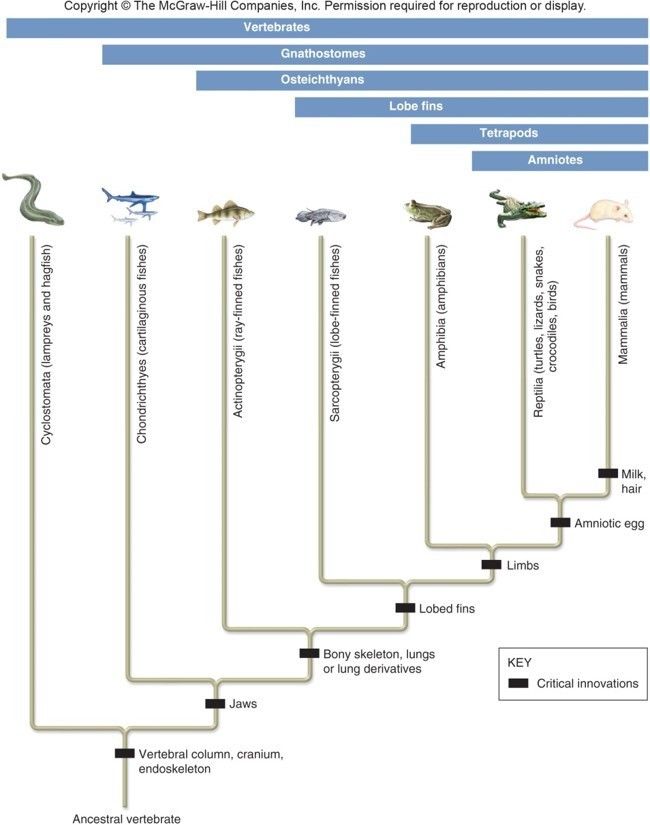
vi. The main classes and characteristics of living vertebrates
a. Class- Cyclostomata
1. Lampreys and hagfish (100 species)
2. Jawless fishes
3. No appendages
4. Sub class- Myxini
- “circle mouths”
- Hagfish/slime eels
- No jaws
- Marine scavengers and predators of invertebrates
- No vertebrates column- degenerate anatomy
- Secrete mucus (slime) for defense
5. Sub class- Petromyzontida
- Lampreys
- Live in marine and freshwater environments
- No jaws
- Some are predators/ parasites of fish
- Some do not feed as adults (non-parasitic)
- Larvae are filter feeders
b. Gnathostomes (all classes that follow)
1. Vertebrates with jaws and paired appendages
2. Jaws may have evolved from gill supports, the hard support for gill arches
c. Class- Chondrichthyes
1. Sharks, skates and rays (970)
2. Fishes with cartilaginous skeleton
3. Teeth not fused to jaw
4. No swim bladder
5. Well-developed fins
6. Most have internal fertilization- ovoviviparous: eggs develop internally. Some viviparous: the young develop in a uterus nourished by a placenta. And even some oviparous: egg layer
7. Single blood circulation
8. Have electric field detectors
d. Bony fish
1. Until recently all living bony fish were put into 1 class, now there are 3 classes
2. They are the most numerous vertebrates
3. The gills are covered with an operculum
4. Many have a swim bladder to control buoyancy
e. Class- Actinopterygii
1. Ray-finned fishes, most bony fish (27,000)
2. Largest class of bony fish and the largest class of vertebrates
3. Most of our familiar fish- salmon and trout
4. Fishes with ossified skeletons
5. Single gill opening covered by operculum
6. Fins supported by long flexible rays- fin muscles within body
7. Swim bladder often present
8. Mucous glands in skin
f. Class- Sarcopterygii
1. Lobe-finned fishes of which coelacanths (2) and lungfishes (6) are the only living members
2. Fishes with ossified skeletons
3. Bony extensions, together with muscles, projects into pectoral and pelvic fins
4. Sub class- Dipnoi
-Lungfishes
- They have lungs and gills
- 3 living Genera in South America, Africa and Australia
- Can line in stagnant water
5. Sub class- Actinistia
- Coelacanths
- Most are extinct
- There is only one living Genus, Latimeria and 2 living species
-One extinct group ancestral to land vertebrates
g. Tetrapods
1. Four-legged land vertebrates
h. Class- Amphibia
1. Frogs, toads, salamanders and caecilians (6,346)
2. Partly terrestrial- their eggs must say in water, their larval stage is also aquatic...adults are able to live on land
3. Fresh water needed for reproduction
4. Development usually involving metamorphosis from tadpoles
5. Adults with lungs and double blood circulation
6. Moist skin
7. Shell-less eggs
8. Developed legs
9. Ectotherms: take on the temperature of their surroundings “cold-blooded”
* Class Reptilia
- Traditional classification that is now divided (see next 3 classes)
- Turtles, lizards, snakes, crocodiles, and many extinct taxa
- Most are completely terrestrial
- Evolved the amniotic egg that can survive on land
- Ectotherms
- Have keratinized, waterproof skin
i. Class- Testudines
1. Turtles and tortoises (310)
2. Body encased in hard shell
3. No teeth
4. Head and neck retractable into shell
5. Eggs laid on land
j. Class- Squamata
1. Lizard, snakes (7,900)
2. Lower jaw not attached to skull
3. Skin covered in scales
4. The most abundant living reptiles
5. Have kinetic skulls ( flexible with many joints)
k. Class- Crocodilia
1. Crocodiles, alligators (23)
2. Four-chambered heart
3. Large aquatic predators
4. Parental care of young
5. Teeth in sockets
l. Class- Aves
1. Birds ( 10,000)
2. Feathers for flying, insulation and display
3. Many adaptations to keep their weight down
-Hollow bones, no teeth/ short tails (modern birds)
4. Air sacs
5. Reduced internal organs
-One ovary and atrophied reproductive organs outside of the breeding season
6. Endothermic: generate body heat i.e. warm-blooded
7. Four-chambered heart
8. Very efficient lungs
m. Class- Mammalia
1. Mammals (5,500)
2. Mammary glands (nurse their young) and hair
3. Specialized variety of teeth
4. Enlarged skull (and brains) with one-piece lower jaw
5. External ears
6. Endothermic
7. Four-chambered heart and anucleate red blood cells
8. Highly developed brains
9. Diversity of body forms
10. Most are viviparous
11. Some large herbivors
12. Some horns and antlers
n. Dinosaurs
1. Class- Ornithischia
-“bird-hipped”
-Stegosaurs, Triceratops, hadrosaurs (duck bills) and many others
2. Class- Saurischia
- “lizard-hipped”
-T.rex, Brachiosaurus, and many others
vii. Mammal Diversity
a. Order- Monotremes
1. Egg-laying mammals
2. Platypus, echidnas
3. No gestation period (pregnancy)
4. No niggles but they do produce milk
5. The young lap up milk from moms fur
b. Order-Marsupials
1. Pouched mammals
2. Kangaroos, wallabies, opossums, koalas, wombats and others
3. Short gestation period
4. Long lactation (nursing) period
c. Order- Eutherians
1. Placental mammals
2. The majority of living mammals
3. Long gestational period
4. Many have a relatively short lactation period compared to marsupials
d. Order- Primates
1. Mostly arboreal (tree dwelling)
2. Have grasping hands and flexible limbs
3. Many have well developed brains
4. 5-digits, usually nails, on forelimbs and hind limbs
5. Have binocular vision for depth perception
6. Prosimians (lemurs and others), old world monkeys, new world monkeys, apes and humans
B. Human Evolution
i. Hominins/ hominids
a. Humans belong to a group of primates called hominins.
b. Modern humans are the only living
c. Are/were bipeds
1. An upright bipedal posture freed up the hands to carry objects such as tools, food, and young
2. An upright posture also allowed for better view of predators, important when hominins moved out of the forest and into the savannas
d. Molecular and fossil evidence suggests that hominins diverged from the ancestors of the chimps around 5-8 million years ago
e. There were many species, not all of them were ancestors of modern humans
1. Throughout the history of the hominins, more than one species were alive at on time
f. There were many fossil species of hominins, many just recently discovered
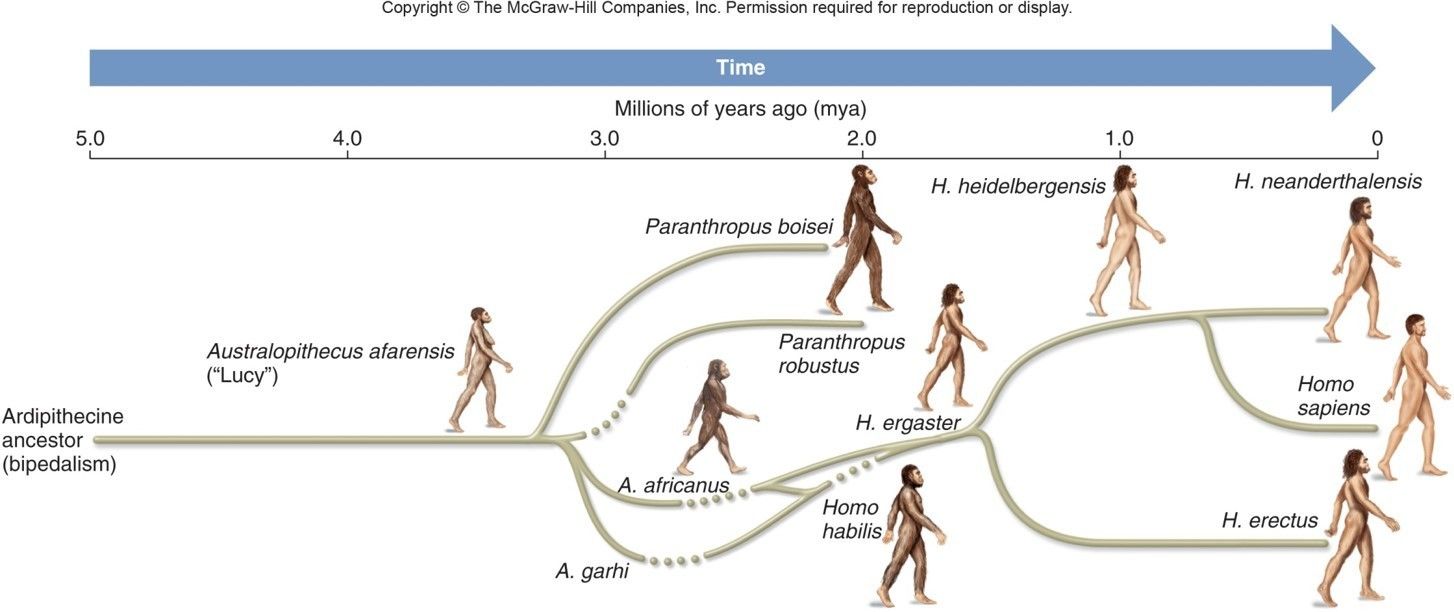
ii. Sahelanthropus tchadensis
a. The oldest known hominin, 6-7 million years old
b. Relationship to later hominins is unknown
c. Only known from a skull and some other fragments
iii. Ardipithecus ramidus
a. “Ardi”
b. ~4.4 million years old
c. A biped with a grasping foot like an ape
d. Probably spend mush time in the trees
e. Relationship to later hominins is uncertain
iv. Australopithecines
a. “southern ape”
b. There were several species of these early hominins
c. bipeds
d. Chimp sized brains and ape-like skulls
e. Short legs, long arms
f. Australopithecus afarensis
1. “Lucy”
2. ~3.5 million years old
3. Small
4. Known from several fossilized skeletons and footprints
5. Possible ancestor of later hominins
g. Australopithecus africanus
1. 2-3 million years ago
2. The first australopithecine discovered
3. Probably not an ancestor of modern humans
v. Paranthropus
a. A Genus of robust, plant eating hominins
b. At least 2 species
c. Survived up tp about 1 million years ago
d. They are not ancestors of modern humans
vi. Genus- Homo
a. Homo habilis
1. “Handy man”
2. Over 2 million years ago
3. The first; or one of the first; member of Genus “Homo” -> the first human
4. Had a larger brain than any australopithecine
5. Small sized
6. Has smaller brow ridge and smaller teeth than Australopithecus
7. They made simple stone tools
8. Relationship to later hominins is uncertain
b. Homo naledi
1. Discovered in 2013 in South Africa
2. 15 individuals
3. A strange mixture of advanced and primitive traits
4. 335,000 and 236,000 years ago
5. Relationship to other hominins is uncertain
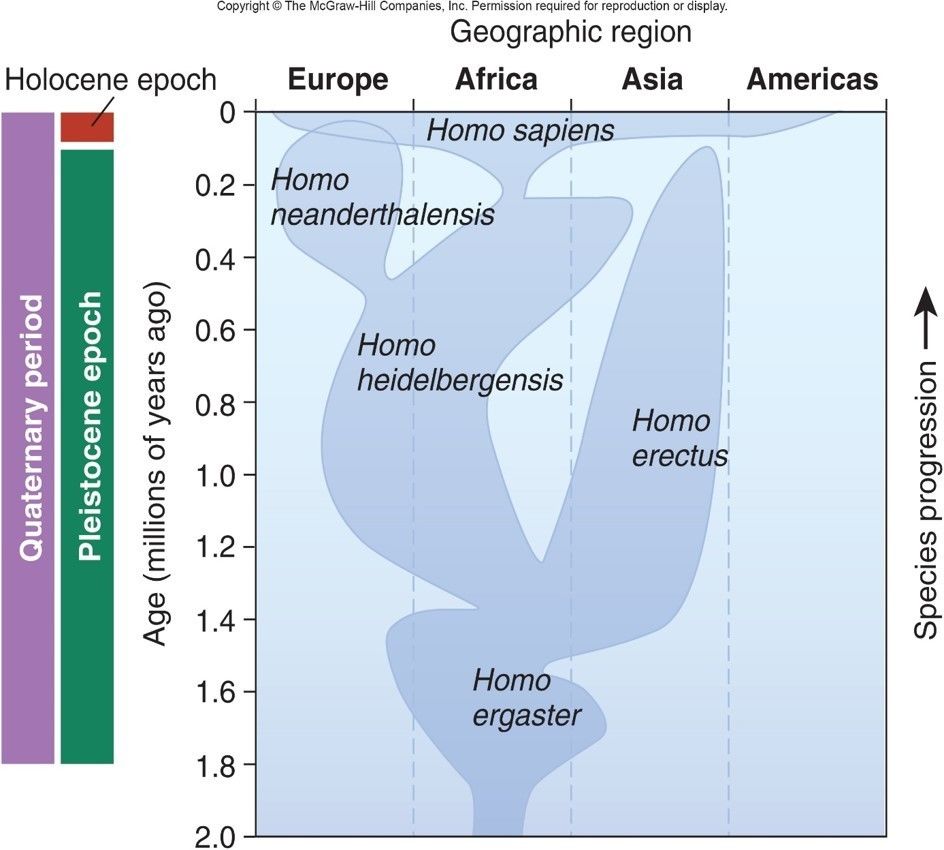
c. Homo erectus
1. “upright man”
2. Appeared almost 2 million years ago
3. The first hominin to spead out of Africa to Europe and Asia
4. Fairly large brain
5. 5-6 feet tall
6. Probably good runners
7. First to lose most of body hair
8. Social, living in groups of 20 -50
9. Made stone tools
10. True big game hunters unlike earlier hominins
11. Used fire by 500,000 years ago
12. Probably should be considered a group of species, in fact many call the earliest African variety “Homo ergaster”
13. Probable ancestor to later hominins
14. Many had survived on the Indonesian island of Java until 30-40,000 years ago
d. Homo heidelbergensis
1. Probable direct ancestor of modern human and Neanderthals
e. Homo neanderthalensis
1. Neanderthals
2. Lived during the ice age in Europe, the middle east, and central asia
3. Short, heavy built, would have been very strong and would have had long endurance
4. Heavy brow ridge, low forehead, and a long brain case with a bun on the back of the skull
5. Big brain
6. Big teeth
7. Big game hunters who made stone tools
8. Not the brutes they are often thought to have been
9. Not ancestors of modern humans but there was some interbreeding, we have neanderthal DNA
10. Died out as recently as 30,000 years ago
f. Homo floresiensis
1. “hobbits”
2. Tiny
3. From the island of Flores, Indonesia
4. Used fire and hunted mini elephants and giant rats
5. Survived up to 17,000 years ago
6. Last relatives to survive
7. 1/3 size brain as us but had fairly advanced tech (brain shape more important than size)
g. Homo sapiens
1. Modern humans
2. Originiated in Africa
3. Archaic H. sapiens appeared in Africa about 300-250,000 years ago
4. Fully modern humans (Homo sapiens sapiens) had evolved by 50-60,000 years ago (at least)
-Cultural evolution
-Non-genetic evolution
- Includes passing knowledge form generation to generation including language and history
-Developed art, the cave and rock paintings to 35-40,000 years ago
- Agriculture started developing ~10,000 years ago
- Language in unique to our species
- We have inherited many useful features from our ancestors including color binocular vision and grasping hands
vii. Denisovan
a. Known from a few fragments from Siberia
b. ~40,000 years old
c. Their DNA is found in modern humans
viii. New species
a. Recent DNA evidence shows another species of hominin existed with 100,000 years ago
ix. Recent hominins
a. Less than 100,000 years ago there was at least 6 living species of hominin
b. The species included” modern humans, Neanderthals, homo erectus, homo floresiensis, Denisovans and the new species