
Apuntes
Elements
Contenido del apunte (6)
Página 1
INTODUCTION
All matter is composed of atoms and each individual atom is composed of three different sub-atomic particles.
protons
neutrons
electrons
The center of an atom is called a nucleus and it's made up of Protons and Neutrons. While the Electrons orbit in shells or energy levels.
Atoms have no overall charge, however the particles have a specific charge, listed below
Electrons (- negative charge)
Protons (+ positive charge)
Neutrons (0 no charge)
Página 2
ELECTRON CONFIGURATION
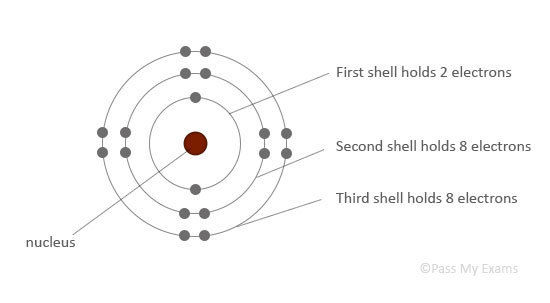
For an atomic structure diagram the nucleus is always is the center while rings circle around it.
The electrons in an atom occupy the innermost shells.
The first shell can hold 2 electrons.
The second and third can hold 8
This is when Electron Configuration is used. It's the numeric expression of the number of electrons in each of the shells.
Eg. For a Carbon atom it would have an electron configuration of 2,4. This is because in total there is 6 electrons.
Página 3
ATOMIC NUMBER
Each atom of a specific element contains the same number of protons. For example, all the atoms of carbon contain 6 protons in their nucleus, otherwise it would be a different element.
Atomic Number Definition - The number of protons in an element is called the atomic number.
Each element has a unique atomic number and this is used to arrange them in the periodic table.
Eg. Atomic number of Carbon= 6
Number of Protons= 6
Página 4
ATOMIC MASS
The number of protons and neutrons in an atom of an element is called Atomic mass, or Mass number.
Protons (Mass of 1 unit)
Neutrons (1 Unit)
Electrons (Almost 0)
Formula = Atomic Mass = number of protons + number of neutrons
Eg. For Carbon, the atomic mass is 12, and the atomic number is 6.
12 (protons + neutrons) - 6 (protons) = 6 (neutrons)
Since an atom has a neutral charge there has to be the same amount of Electrons and Protons so, the atomic number will always be the same as the number of electrons.
Página 5
ISOTOPES
Atoms of the same element that have the same number of protons but different number of neutrons are called isotopes of that element. BUT if there is a difference in the neutrons that will affect the mass number of the atom.
Eg. Carbon has a proton number of 6 and most Carbon atoms have a mass number of 12. But some have a mass number 14 which means that 12C and 14C are isotopes.
Página 6
RELATIVE ATOMIC MASS
Atoms are too light to measure on the conventional scale therefor we compare them to each other instead. So the relative atomic mass (R.A.M) is the relative mass of the different isotopes of an element, this is why is can have fractions/decimals while the mass number is a whole number.
Eg. Chlorine has two isotopes Chlorine-37 and Chlorine-35. If you take 100 Chlorine atoms, 75% of them will be Chlorine-35 and the remaining 25% will be Chlorine-37.
Formula for RAM =
R.A.M.=(mass of isotope-A x % of isotope-A) + (mass of isotope-B x % of isotope-B)/100
If we do this with Chlorine it would look like this
RAM = (35 x 75) + (37 x 25) / 100
= 3550/100
=35.5
Información
- Descripción
- Grade 10 (Elements) Chemistry Apunte sobre Elements, creado por Sofie 6710 el 03/06/2020.
- Creado por
- Sofie 6710
- Visitas
- 0
- Valoración