
Apuntes
Observing the Solar System
Contenido del apunte (1)
Página 1
Apparent Motion of Heavenly Bodies
Apparent motions are motions that something appears to be making. They can be real or they can be imagined. For example, if you whiz pass trees on a bicycle or car, it appears as though the trees are moving backwards. They are not really moving at all. It could appear that a car you pass on the road is moving backwards compared to your car, which is moving, but you are just going faster than the other car so it appears to go backwards. Apparent motions can be illusions or reality.
Horizon Diagrams
When you are standing on any point on the earth, and look up into the sky, it appears never ending. You look to the North, to the south, to the East, into the West, and if you’re view is not obstructed, you see the horizon in all directions. This gives us the illusion that the sky is a dome, or a half of a sphere, above us. When you look up into the sky at night, you see the stars of little points of light, and get the impression that there really is a dome with a little light spots all around.
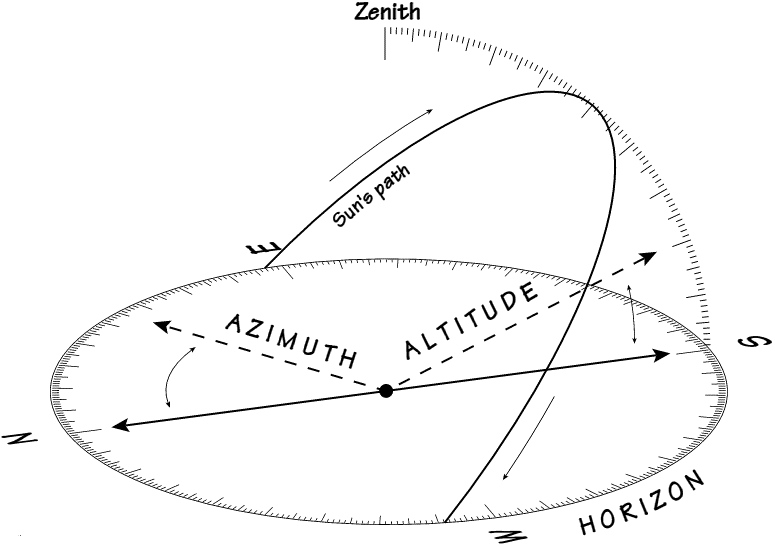
In trying to locate particular position of a celestial object, scientists use two points of reference. One is the angle from the earth where the object is located, or the altitudes angle. They also use a type of location called azimuth, which is a compass direction. When they use the compass direction like North, Northeast, South, Southeast, etc., they are talking about the flat plane of the horizon heading in those directions.
The elevation, or altitude, above the earth is the second point of reference. The horizon, where you stand, is 0° as you look up from the horizon your angle as the observer increases until you are looking directly overhead which is 90° if you could do a back bend would keep looking backwards until you see the other horizon at 180°.
Apparent Motion of the Stars
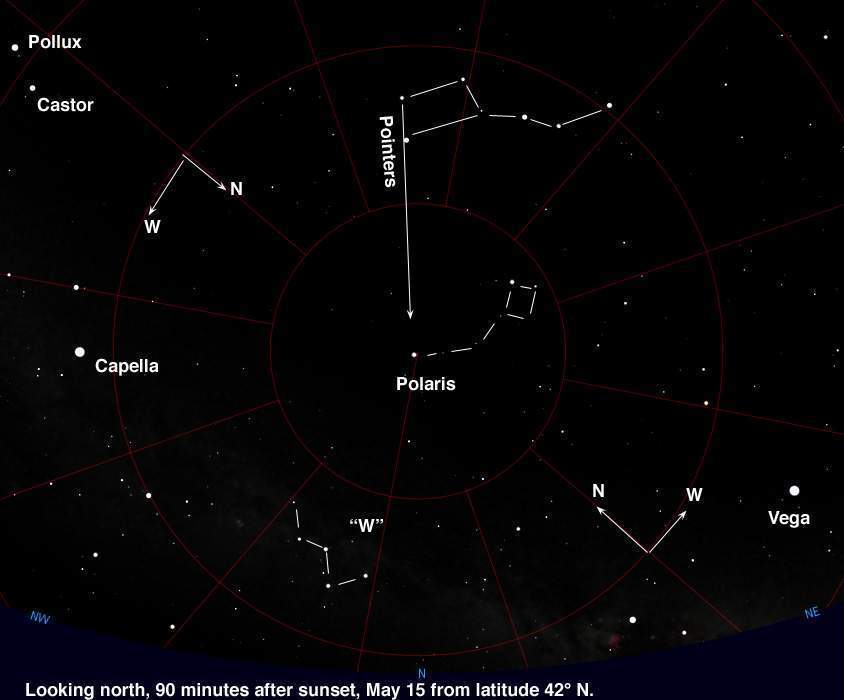
When you see the stars on a clear summer night and you notice the constellations on one side of the sky, and later at night you notice the stars have moved, have they really moved? No. The stars are so far away from the earth that any motion that you see is not from their movement. It is due to the rotation of the earth on its axis. The following pictures show the view of the night sky as viewed from the mid-latitudes in the northern hemisphere.
Polaris is located almost, but not quite, directly over the north pole. Polaris makes a little circle over 24hrs but, for our purposes, it doesn't move. All the other stars rotate around Polaris, or the North Star. This is also called the celestial north pole. The celestial horizon is the line between the Earth and the night sky 360 degrees around the observer. Don't forget, just like the sun the stars rise in the east and set in the west!
Apparent Motion of the Planets
One brilliant scientist back in the 1500's, named Kepler, was able to decipher and describe the movement of the planets. The planets appear to loop and change direction as they are viewed from the Earth. This confused the early astronomers because they thought the Earth was at the center of the universe. It wasn't until they realized the Sun was at the center of the universe that the confusing motion of the planets made sense. Constellations move 15 degrees per hour.
Telescopes
Telescopes are instruments that are used to view things that are far away. The 1st telescopes used for astronomy were in 1500, when Galileo began making observations of the sun and the planets. Modern-day telescopes have several advantages. They can detect light that the eyes cannot see because of the size of the lens that can be used.
Modern telescopes can also be equipped with specialized instruments that allow it to measure and record different things. Lux is the SI Unit of light intensity and is measured by a lux meter. These can be attached to telescopes.
There are 2 main different types of telescopes: refracting telescopes and reflecting telescopes. Telescopes like Galileo use are called refracting telescopes. The objective lens is the largest lens in a telescope. Incoming light comes into the lens causing the light to be focused on a particular focal point, which connects to the focal point of the eyepiece.
In a reflecting telescope a series of mirrors are used. The incoming light goes through the objective lens, which uses mirrors to bring the light into a focus. Large telescopes are used in observatories that are usually located high in the mountains to avoid the blurring effects of the atmosphere.
Some telescopes use other wavelengths besides visible light to observe distant places. Infrared, on the long wavelength side of the electromagnetic kinetic spectrum, and ultraviolet on the opposite side of the electromagnetic spectrum can also be used with mirrors. Specially designed telescopes use x-ray and gamma ray radiation to catch other information.
Información
- Descripción
- 9th grade (Astronomy ) Science Apunte sobre Observing the Solar System, creado por Caleb Hadyka el 29/04/2021.
- Creado por
- Caleb Hadyka · abr 2021
- Actualizado
- 29 abr 2021
- Visitas
- 0
- Valoración