
Apuntes
The Early Periodic Table C3.1
Contenido del apunte (1)
Página 1
By the 1860's over 50 elements had been discovered.
So scientists attempted to sort the elements into a logical sequence.
There were two main scientists that contributed to sorting the elements.
These were, John Newlands and Dmitri Mendeleev.EE
John Newlands' theory was the 'Law of Octaves'. He presented his theory in 1864.
He arranged all the elements in order of Relative Atomic Mass
He found a pattern from the resulting table, this pattern was that each element had a common feature with another element, which was 8 elements ahead of it.
So from the table, we can see that H (hydrogen) is similar to Na (sodium).
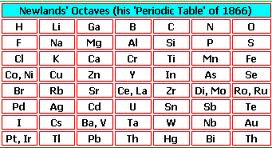
Newlands' table wasn't accepted by other scientists because he grouped elements together that shouldn't have been grouped together.
For example: he put Fe(Iron) with O (oxygen). A metal with a non-metal.
Dmitri Mendeleev published his theory in 1869. Five years after Newlands.
He also sorted the elements by there relative atomic mass, however he also used other methods.
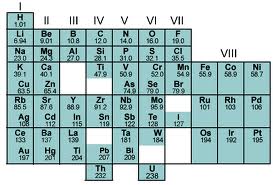
He made sure that groups of elements with similar properties fell into vertical columns in his table.
There was one problem with Mendeleevs' table, this was that by grouping them by similar properties meant that there was gaps in his table.
He didn't see the gaps as a problem but as places where undiscovered elements were supposed to go.
Meneleev made his table more convincing as he was able to predict the properties of the missing elements as he could work out the atomic mass of those elements.
When the elements were later found, his theory and table was proved right.
Similarities and Differences
Newlands’ Table Meneleev' Table
Ordered elements by atomic weight Ordered elements by atomic weight
Included only the elements known at the time Left gaps for elements he predicted would be discovered later
Maintained a strict order of atomic weights Swapped the order of some elements if that fitted their properties better
Every eighth element had similar properties Elements in groups had similar properties
Was criticised by other scientists for grouping Was seen as a curiosity to begin with, but then as a useful tool when some elements with others when they were the predicted elements were discovered later
obviously very different to each other
Introduction
John newlands
Dmitri Mendeleev
Similarities and Differences
Información
- Descripción
- GCSE (Chemistry) Science Apunte sobre The Early Periodic Table C3.1, creado por Elizabeth W el 28/10/2013.
- Creado por
- Elizabeth W · oct 2013
- Actualizado
- 8 nov 2016
- Visitas
- 1.572
- Etiquetas
- Valoración