
GCSE Maths: Pythagoras theorem
Diapositivas del conjunto (3)
-
- How Do I Use it?
- The Pythagoras theorem deals with the lengths of the sides of a right triangle. It is used any time we have a right triangle, we
- know the length of two sides, and we want to find the third side.
- It is often written in the form of the equation:
- a2 + b2 = c2
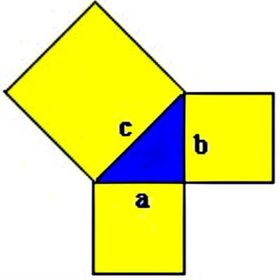
- The theorem states that:
- The sum of the squares of the lengths of the legs of a right triangle ('a' and 'b' in the triangle shown below) is equal to the square of the length of the hypotenuse ('c').
-
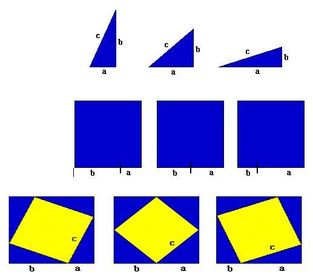
- Let's start by looking at a square whose side length is (a+b).
- Inside the blue square let's construct a yellow square of
- side length c. Its corners must touch the sides of the blue square.
- The remainder of the space will consist of four blue congruent abc
- triangles. Here it is for our example squares:
- In each case, the area of the larger blue square is equal to the sum of the areas of the blue triangles and the area of the yellow square. Since the area of a square is (sidelength)2 and the area of a triangle is 1/2(base)(height), we can write the equation:
- (a+b)2 = c2 + 4[(1/2)ab]
- Simplifying:
- (a+b)2 = c2 + 4[(1/2)ab]
- (a+b)(a+b) = c2 + 2ab
- a2 + 2ab + b2 = c2 + 2ab
- Now subtract the 2ab from both sides of the equation, and we have the Pythagorean theorem:
- a2 + b2 = c2
- Pie de imagen: Pythagoras theorem
Información
- Descripción
- GCSE Maths: Pythagoras theorem
- Creado por
- Landon Valencia · jul 2015
- Actualizado
- 13 abr 2017
- Visitas
- 580
- Etiquetas
- Valoración