
Apuntes
Conflict With Great Britain
Contenido del apunte (1)
Página 1
Conflict With Great Britain
Introduction The colonists believed that Great Britain had the best government
Due process of the common law
Trial by jury
Freedom of press
Pay no tax unless it was levied by their representatives
Colonial governments followed the British model, but protests of 1760's showed important differences.
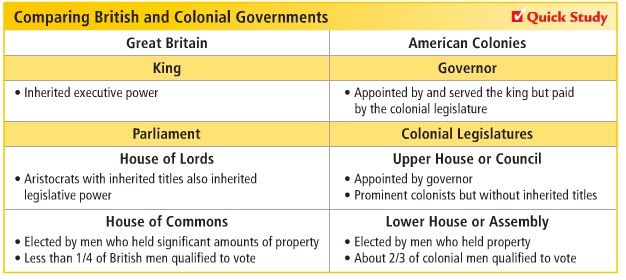
British Government VS Colonial Government Model British government had three branches
Executive power (belonged to the monarch)
Legislative power (divided between the houses of parliament: The House of Lords and the House of Commons)
The aristocrats inherited seats in the house of Lords. The House of Commons depended on elections by a small percentage of the people)
Similarly, each colony except Pennsylvania had a two-house legislature: an elected assembly and a council of prominent colonists appointed to life terms by the governor. The governor was appointed by, represented, and served the king. Only Connecticut and Rhode Island elected their own governor, while Pennsylvania's entire assembly was elected. The colonists did not elect any members of British Parliament.
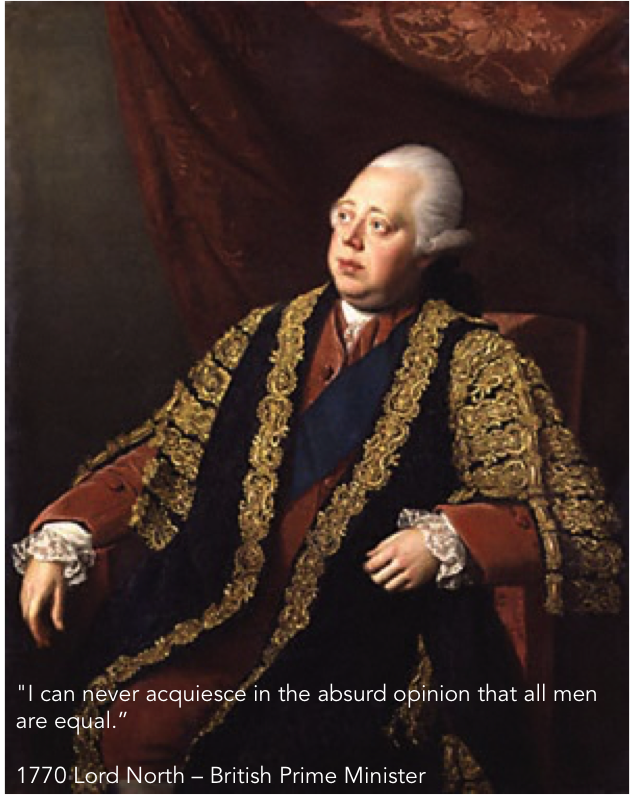
Democracy was seen as foolish and dangerous in a society where people inherited unequal property and status. British prime minister, Lord North said, "I can never acquiesce in the absurd opinion that all men are equal."
Differences in Colonial Government
Despite the similarities, colonial politics differed from the British in several ways
The British constitution was not a formal document, but a collection of laws and traditions accumulated over centuries. The colonists' rights had traditionally been spelled out in formal legal documents such as the royal charters of Maryland or South Carolina, as well as written in formal agreements like the Mayflower Compact.
Two thirds of free colonial men owned enough property to qualify to vote, compared to less than a fourth of British men.
By 1760, political upheaval in Great Britain and European wars had allowed the elected colonial assemblies to increase their powers at the expense of the royal governors. Since the colonies lacked aristocrats with inherited titles, the power went wealthy planters and merchants related by blood or marriage. These aristocrats often withheld salaries from unpopular governors. British officials hoped to change the situation by taxing the colonists to provide salaries to royal governors and judges. This angered the colonists, and they viewed their deviations from Britain as important advantages. While the British expected the colonies to obey, the colonies saw themselves as equal members of the British political body. These differences became a problem when Parliament tried to levy taxes on the colonies. The colonists believed that only their elected officials had that right
The Seven Years' War - called the French and Indian War in the colonies - nearly doubled Britain's national debt and greatly expanded its colonial territories. Parliament needed to raise money, both pay the debt and protect the colonies. People in Britain paid far more taxes than the colonists did. This imbalance seemed unfair, for the war had been fought largely to protect the colonists. Parliament decided that the colonists could and should pay more to help the Empire.
The Sugar, Quartering and Stamp Acts Colonial merchants had grown rich from trade, often smuggling goods and bringing officials to avoid duties or taxes on imports. In 1764, the new prime minister, George Grenville, proposed raising money by collecting duties already in effect. The law (known as the Sugar Act), actually lowered the cut on foreign molasses. However, it also assigned customs officers and created courts to collect the duties and prosecute smugglers. Greenville hoped that these measures would encourage colonists to pay the tax.
In 1765, parliament passed the Quartering Act. This required the colonies to provide housing and supplies for the British troops stationed there after the French and Indian War. Colonists complained, but mostly went along with the changes because the accepted Parliament's right to regulate trade and provide for defense.
In March 1765, Parliament passed a bill intended to raise money from the colonies. The Stamp Act required colonists to pay tax on all printed materials (newspapers, books, court documents, contracts, and land deeds). This was the first time that Parliament had imposed a direct tax within the colonies.
Taxation Without Representation The colonists angrily protested the Stamp Act, which was to take effect in November. Colonial leaders questioned parliament's right to tax the colonies directly, as the colonies had no representation in Parliament. Some colonists believed that if they accepted the tax, Parliament would add ever more taxes, stripping away their property and political rights. Parliament did not understand the colonists' protests, and dismissed them as selfish and narrow-minded. The Empire needed money, and Parliament had the right to levy taxes anywhere in the Empire.
Colonial Protests Intensify There were three forms of tax resistance:
intellectual protest
economic boycotts
violent intimidation.
The combined force of the three forced the British to back down.
Colonial leaders wrote pamphlets, drafted resolutions, gave speeches, and delivered sermons to persuade colonists to defy the new taxes. The surge in political activity was established by John Adams. John Adams was a prominent Massachusetts lawyer who observed, "Our presses have groaned, our pulpits have thundered, our legislatures have resolved, our towns have voted."
Enlightenment Ideas Colonial protests drew upon liberalism of the Enlightenment.
Europe's leading liberal writers included Baron de Montesquieu of France, and John Locke of England.
They argued that people had divinely granted natural rights, including:
life
liberty
property
A good government protected these individual rights
Government existed for the good of the people
People had the right to protest any government that violated this "social contract"
Patrick Henry, a young Virginia representative used the above ideas to draft a radical document known as the Virginia Resolves. He argued that the colonial government had the right to tax the colonists and that every attempt to vest such power in any other person or persons other than the General Assembly aforesaid is illegal, unconstitutional, and unjust. He said that it had the potential and the tendency to destroy both British and American liberty.
On May 30, 1765, the Virginia House of Burgesses accepted most of Henry's resolves, but rejected two including the one above. They deemed them to be too radical. Colonial newspapers, printed all six, believing that they had been accepted. Eight other colonies the adopted resolves similar to Henry's original proposal.
Patriot Leaders Emerge Colonists violently opposed the Stamp Act, which affected energy colonist. Colonists began working together to fight the act, which created a new, but still fragile sense of American unity. Those who opposed the British taxes called themselves patriots. To lead the popular protests, some men formed associations known as the Sons of Liberty. Their most famous leader was Boston's Samuel Adams, a cousin of John Adams.
Angry crowds assaulted the colonists who supported or helped to collect taxes. These crowds were especially violent in Boston. August 1765, a mob led by the Sons of Liberty tore down the office and damaged the house of the stamp tax collector. The Massachusetts lieutenant governor, Thomas Hutchinson, denounced this riot, insisting that the colonists had a legal duty to pay Parliament's taxes. Another mob destroyed Hutchinson's house. Thereafter, no one in Boston dared to voice support for the stamp tax. By the end of the year, every stamp collector in the colonies had resigned, leaving no one to collect the taxes.
Leaders Organize a Boycott Colonial leaders who opposed the tax, but feared the violence of the crowds sent delegates to a Stamp Act Congress in New York City, October 1765. Members of congress encouraged a consumer boycott of goods imported from Britain. Local committees enforced these nonimportation agreements, which threatened British merchants and manufacturers with economic ruin.
Women played an important economic role in the boycotts. When colonists stopped buying British goods, the needed "homespun" cloth to substitute for the British-manufactured cloth. Gatherings of women to spin thread and weave cloth drew applause from spectators and Patriotic newspapers. Women gave up certain comforts when they agreed to not buy any manufactured British goods. Known as Daughters of Liberty, these women won respect for their efforts in the political struggle.
Under pressure from British merchants and manufacturers, Parliament repealed the Stamp Act in 1766. The struggle was not over, because parliament passed an act declaring its right to levy taxes on the colonists.
New Taxes Lead to New Protests The Stamp Act crisis showed that the colonists would not accept direct tax, but maybe they would accept indirect tax. The British needed to raise money to pay its debt and support its troops in the colonies. Charles Townshend, the Crown's chief financial officer, thou that the colonists would accept indirect tax on commerce. Parliament passed the Townshend Act which levied new import duties on everyday items such as glass, lead, paint, paper, and tea. 1767
The colonists refused to pay any new taxes of any sort to Parliament. They resented that their taxes would be used to pay the colonial governors' salaries as the colonists valued their financial control of the governors.
Violence Erupts in Boston Colonists revived their protests, boycotts, and street violence in response to the Townshend Acts. The largest riots occurred in Boston, where many of the British customs officers abused their power. Customs officers seized the merchant ship Liberty in June 1768 for smuggling. The ship belonged to John Hancock, a wealthy merchant and prominent colonial politician. The seizure set off riots against customs officers, which caused the British to send 4000 soldiers to occupy Boston, which had a population of only 16000 people. For a year, the British troops inflamed popular anger, especially because poorly paid soldiers competed with unskilled workers for jobs.
March 1770, a group of colonists hurled snowballs and rocks at British soldiers guarding the Customs House. The nervous soldiers fire into the crowd and killed five colonists. The dead included Crisps Attucks, a sailor who may have been an escaped slave of mixed Indian and African ancestry. Under the leadership of Samuel Adams, the Patriots called the killings the Boston Massacre.
Adams later organized a network of local committees of correspondence throughout Massachusetts. The committees provided leadership and promoted cooperation. By 1773, several other colonies had created committees, which helped build colonial unity. Once again, Parliament backed down and withdrew troops from Boston, and dropped most of the Townshend duties. To preserve British supremacy, they kept the tax on tea. Colonists continued to boycott British tea and continued to drink smuggled Dutch tea.
The Boston Tea Party The tea boycott worsened the situation for the already struggling British East India trading company. To help the company and encourage the colonists to pay the tax, Parliament passed a law allowing the company to sell directly to the colonists. This made the tea cheaper than the smuggled tea, even with the tax. Colonists continued to buy the smuggled tea, protesting that the British were trying to trick them into paying the tax. If the East India Company sold tea directly, it would hurt the wealthy colonists who smuggled tea.
On the December 16, 1773, Boston Patriots took matters into their own hands. They dressed themselves as Indians, boarded three British ships laden with tea, and dumped the tea into the harbor. The event became known as the Boston Tea Party.
Colonies Unite Against Harsh Measures Enraged by the Bostonian's actions, Parliament and the Crown punished them with the Coercive Acts. They closed the port trade until the inhabitants paid for the destroyed tea, including the tax. They also increased the power of the governor at the expense of the elected assembly and town meetings. To enforce these measures, the British sent warships and troops to Boston.
The Intolerable Acts
The colonists were outraged. In addition to closing the port, the acts forced colonists to house British troops, and allowed British officials to be tried in Britain for crimes committed in the colonies. In addition the Quebec Act extended Canada's southern border, cutting off lands claimed by several colonies. The horrified colonists called the legislation the Intolerable Acts. They rejected the idea that the British would shut down trade and change colonial governments at will.
In Massachusetts, people reacted to the British action with violence. Armed with clubs and guns, they forced the courts of law to shut down. They assaulted anyone who accepted an office under the governor or spoke in favor of obeying Parliament. They coated some victims in hot tar and feathers.
The Colonies Take Action Like Massachusetts, the other colonies saw the Coercive Acts as a threat to their freedom. In the fall of 1774, delegates from every colony except Georgia met in Philadelphia, Pennsylvania, for the First Continental Congress.
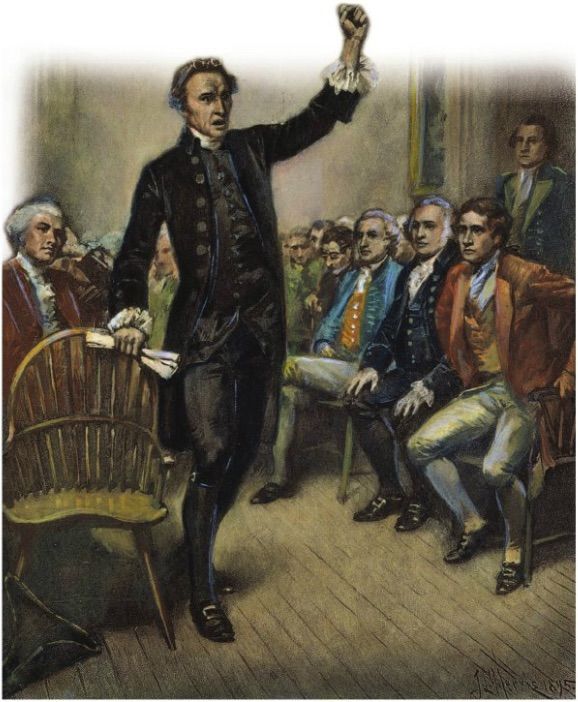
Virginia's delegates included the fiery Patrick Henry, who became famous for declaring, "Give me liberty or give me death!" He declared, "The distinctions between Virginians, Pennsylvanians, New Yorkers, and New Englanders are no more. I am not a Virginian, but an American!"
To pressure Parliament to withdraw the Coercive Acts, the delegates announced a boycott of all British imports. Throughout the colonies, the patriots established local committees and provincial congresses to enforce the boycotts. By including common shopkeepers, artisans, and farmers, the committees expanded the ranks of the politically active. In spring 1775, a newly arrived immigrant marveled, "They are all liberty mad."
By 1774, Patriot John Adams had decided that he already lived in a new country named America. He believed that America could unite to defeat the British. Adams was ahead of colonists who still hoped to remain within the British Empire, provided that Parliament would revoke the Coercive Acts and stop trying to tax them.
Información
- Descripción
- Lesson 1, Unit 1
- Creado por
- britneysoll · ago 2015
- Actualizado
- 19 feb 2016
- Visitas
- 8
- Valoración