
Apuntes
Topic 4c: Circuit elements
Contenido del apunte (7)
Página 1
Current (I): the rate of motion of electric charge
measured in units of amperes (A)
assumption that + charges are moving, but in reality negative charges only move

Current can be increased by:
increasing the amount of charge
increasing the magnitude of charge
increasing the area through which charge passes
increasing the velocity of the charge.

Página 2
Electromotive force (emf, ε): the voltage or potential difference generated by a battery or power source when no current is flowing.
Expressed in units of volts (V)
All voltage sources create a potential difference and can supply current if connected to a resistance.
However voltage is not the same magnitude as EMF, and tends to be lower than EMF.
the battery generates internal resistance when current is flowing through a circuit with conductive elements, resulting in a voltage drop through the battery.
Terminal voltage: the voltage output of a device measured across its terminals -->
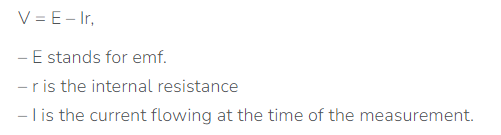
The direction of current is positive if current flows away from the positive terminal.
Current and voltage are inversely related, as are resistance and voltage.
Página 3
Resistance: the inherent property of a conductor by which it resists the flow of electric current.
Expressed in units of volts per ampere, more commonly known as the ohm (Ω).
Ohm’s Law states that the voltage across a resistor is proportional to the current through it; V= IR.
An increase in voltage drives more electrons through the wire at a greater rate, resulting in an increase in current.
If voltage remains constant and the wire is a poor conductor, the resistance against the flow of electrons increases, resulting in a decrease in the current.
Current is a dependent variable and cannot be manipulated to change voltage or resistance.
As current flows through the resistor, electric power is dissipated into the resistor.
expressed in units of watts (W).
Resistivity: Measures how strongly a material resists or conducts electric current; The main factor in determining whether a substance is a conductor or an insulator.
Expressed in units of ohm times meters (Ω *m).
low resistivity= current flows readily, material is a conductor.
high resistivity= current DOES NOT flow easily, material is an insulator
R= resistance
ρ= resistivity
L= length of material
A= area of material


Página 4
Conductivity: the ability of an object or substance to conduct electricity. This property can be applied to both metals and electrolytic solutions.
Metallic conductivity: directly related to the movement of valence electrons. When a metallic element is connected within an electric circuit and subjected to an electrical power source, electric current exerts a force on the free electrons causing them to move between the positive and negative terminals of the battery, instead of spinning randomly in position.
electrolytic conductivity: electrodes are placed in an electrolyte solution and voltage is applied.
Lone electrons cannot typically pass through the electrolyte.
A chemical reaction occurs at the cathode consuming electrons being produced from the anode.
As a result of these reactions, negative charge builds around the cathode, and positive charge builds around the anode.
These charges are neutralized by the ions in the electrolyte, which allows electrons to continue flowing and the reactions to continue.
Without the electrolyte there is no conductivity. However a higher concentration of the electrolyte can hinder ion mobility, which reduces conductivity.
Every conductor has a limit to the amount of current it can carry. When the conductor reaches its limit, the material melts from the heat released due to resistance.
Conductivity meter: a probe designed to measure the conductivity of a substance within a solution. The probe is placed within the solution, and electric voltage is applied between two electrodes within the probe. The electrical resistance provided by the solution causes of reduction in voltage. This voltage change is a reflection of the solution’s ionic strength and thereby the conductivity of the substance.
Insulators: materials in which internal charge cannot flow freely, and thus cannot conduct electric current when exposed to an electric field.
There is no perfect insulator with infinite resistivity, however materials with high resistivity like glass, paper, and Teflon can serve as insulators.
Insulators also have physical limits; a large enough voltage causes an insulator to experience electrical breakdown, where current breaks through and the material suddenly becomes a conductor.
Página 5
Electric circuits:
DC circuit: electricity in the form of an electric charge generated by a voltage source flows as current turn arrangement of circuit elements or devices connected by a conductor.
series circuit: 2 or more circuit elements are connected in sequence, one after the other
parallel circuit: 2 or more circuit elements connected in a branching arrangement, such that a charge may pass through one element or another.

the total current flowing through a series circuit remains the same through each of the individual elements.
I net (series) = I1= I2= I3= …In
current in parallel circuits is divided among the branch elements. Therefore the current that enters each of the branch elements depends on the resistance of that elements, net current is equal to the sum of the current flowing through all connected branch elements.
I net (parallel)= I1 + I2 + I3 + … In

net voltage in a parallel circuit is identical to the individual voltages across each element of the circuit.
net voltage in a series circuit is the sum of individual voltages across each conductive element in the circuit.
Vnet (series)= V1 + V2 + V3 +…Vn
Vnet (parallel)= V1=V2=V3=…Vn

the equivalent resistance (Req) in a series circuit is the sum of the resistance of the individual components.
Req= R1 + R2 + R3 +...Rn
The equivalent resistance of a circuit in parallel is equal to the sum of the inverse of each of the individual components.


Página 6
Capacitors: circuit elements that store charge, typically consist of two conductors of arbitrary shape carrying equal and opposite charges separated by an insulator.
Capacitors can store energy when a battery or other voltage source is connected.
Capacitance: Measures an object’s ability to store electric charge.
expressed in units of farads (F)
C= capacitance
q= magnitude of charge
V= voltage/potential difference


the most common type of capacitor is the parallel plate capacitor: 2 conducting plates separated by dielectric. Charge builds up on the plates when the electrodes are connected to the power supply. The capacitor is fully charged when they reach equilibrium. Charge is stored via the attraction between the positive and negative terminals, even when the voltage source is removed
capacitance of a parallel plate capacitor -->
C= capacitance
K= dielectric constant
εo= 8.85 × 10^−12 F/m
A= area of capacitor plate
d= distance between plates

Energy of a charged capacitor: work is done in separating the positive and negative charge is stored in the separate capacitor plates. This energy stored as electric potential energy (W) in the capacitor and is calculated by-->
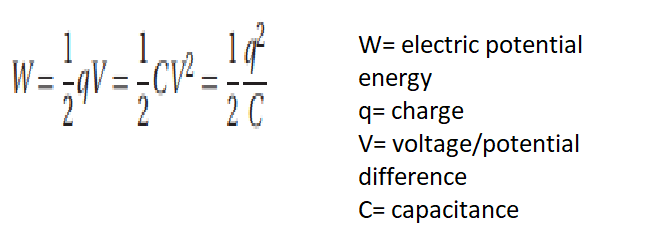
capacitors in series: the effective capacitance of capacitors connected in a series circuit is the sum of the inverse capacitance of each individual capacitor -->

The effective capacitance of capacitors connected in parallel is equal to the sum of each individual capacitance -->

Dielectric: an insulator typically used to fill the gap between the plates of capacitor because it increases the capacitance.
C = κCo
C= new capacitance with the dielectric present
κ= dielectric constant
κ = 1 for a vacuum, and it's slightly greater than one for air.
Co= original capacitance without dielectric
Página 7
Ammeter: measures current, must be connected in series to the rest of the circuit elements. Must have the lowest resistance possible so that it does not impact the current it is measuring.
Voltmeter: measures potential difference. Must be connected parallel to the two points in the circuit that it is measuring the potential difference between. The resistance of the voltmeter must be much larger than the resistance of any circuit element to which it is connected so that it does not alter the voltage it is measuring.
multimeter: a single meter containing a switch that allows it to serve as an ammeter, voltmeter, or ohmmeter (measure resistance)
Información
- Descripción
- Apunte sobre Topic 4c: Circuit elements, creado por 000 000 el 03/03/2022.
- Creado por
- 000 000 · mar 2022
- Actualizado
- 11 mar 2022
- Visitas
- 0
- Valoración