
Mapa mental
The Zoo Story: Props, Costume & Setting
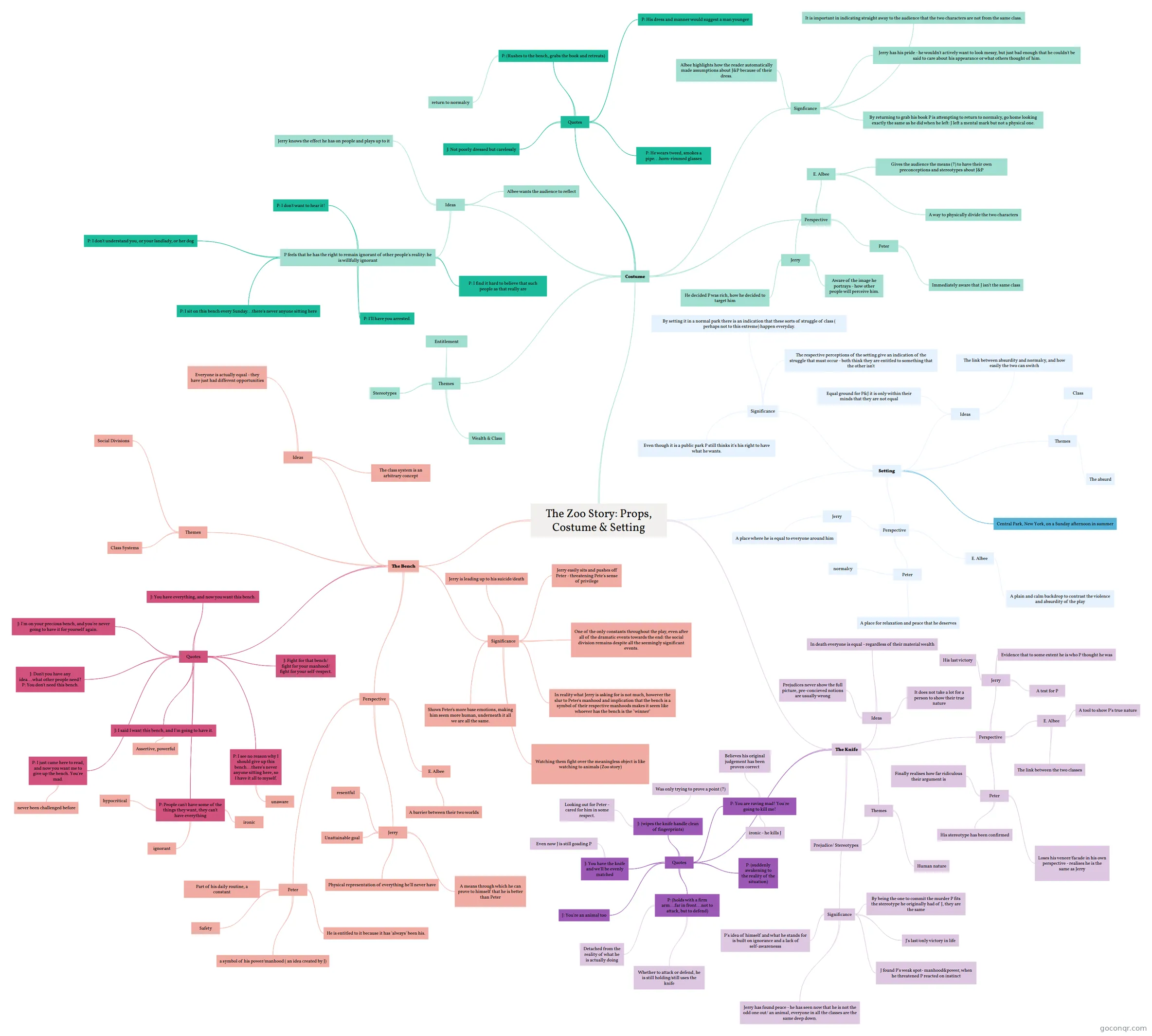
Mind map: The Zoo Story: props, costume and setting
Contenido del mapa
The Zoo Story: Props, Costume & Setting
The Bench
- Themes
- Social Divisions
- Class Systems
- Ideas
- The class system is an arbitrary concept
- Everyone is actually equal - they have just had different opportunities
- Quotes
- P: I see no reason why I should give up this bench...there's never anyone sitting here, so I have it all to myself.
- unaware
- J: I said I want this bench, and I'm going to have it.
- Assertive, powerful
- P: People can't have some of the things they want, they can't have everything
- hypocritical
- ignorant
- ironic
- P: I just came here to read, and now you want me to give up the bench. You're mad.
- never been challenged before
- J: I'm on your precious bench, and you're never going to have it for yourself again.
- J: You have everything, and now you want this bench.
- J: Don't you have any idea...what other people need? P: You don't need this bench.
- J: Fight for that bench/ fight for your manhood/ fight for your self-respect.
- P: I see no reason why I should give up this bench...there's never anyone sitting here, so I have it all to myself.
- Significance
- Jerry easily sits and pushes off Peter - threatening Pete's sense of privilege
- One of the only constants throughout the play, even after all of the dramatic events towards the end: the social division remains despite all the seemingly significant events.
- Shows Peter's more base emotions, making him seem more human, underneath it all we are all the same.
- Watching them fight over the meaningless object is like watching to animals (Zoo story)
- In reality what Jerry is asking for is not much, however the slur to Peter's manhood and implication that the bench is a symbol of their respective manhoods makes it seem like whoever has the bench is the "winner"
- Jerry is leading up to his suicide/death
- Perspective
- Peter
- Part of his daily routine, a constant
- a symbol of his power/manhood ( an idea created by J)
- He is entitled to it because it has 'always' been his.
- Safety
- Jerry
- Unattainable goal
- Physical representation of everything he'll never have
- resentful
- A means through which he can prove to himself that he is better than Peter
- E. Albee
- A barrier between their two worlds
- Peter
- Themes
The Knife
- Significance
- By being the one to commit the murder P fits the stereotype he originally had of J, they are the same
- J found P's weak spot- manhood&power, when he threatened P reacted on instinct
- P's idea of himself and what he stands for is built on ignorance and a lack of self-awarenesss
- Jerry has found peace - he has seen now that he is not the odd one out/ an animal, everyone in all the classes are the same deep down.
- J's last/only victory in life
- Ideas
- Prejudices never show the full picture, pre-concieved notions are usually wrong
- It does not take a lot for a person to show their true nature
- In death everyone is equal - regardless of their material wealth
- Perspective
- Jerry
- His last victory
- A test for P
- Evidence that to some extent he is who P thought he was
- Peter
- His stereotype has been confirmed
- Finally realises how far ridiculous their argument is
- Loses his veneer/facade in his own perspective - realises he is the same as Jerry
- E. Albee
- The link between the two classes
- A tool to show P's true nature
- Jerry
- Quotes
- J: You have the knife and we'll be evenly matched
- Even now J is still goading P
- P: (suddenly awakening to the reality of the situation)
- P: You are raving mad! You're going to kill me!
- Believes his original judgement has been proven correct
- ironic - he kills J
- P: (holds with a firm arm...far in front...not to attack, but to defend)
- Detached from the reality of what he is actually doing
- Whether to attack or defend, he is still holding/still uses the knife
- J: (wipes the knife handle clean of fingerprints)
- Was only trying to prove a point (?)
- Looking out for Peter - cared for him in some respect.
- J: You're an animal too
- J: You have the knife and we'll be evenly matched
- Themes
- Prejudice/ Stereotypes
- Human nature
- Significance
Costume
- Quotes
- P: (Rushes to the bench, grabs the book and retreats)
- return to normalcy
- P: His dress and manner would suggest a man younger
- P: He wears tweed, smokes a pipe...horn-rimmed glasses
- J: Not poorly dressed but carelessly
- P: (Rushes to the bench, grabs the book and retreats)
- Signficance
- It is important in indicating straight away to the audience that the two characters are not from the same class.
- Albee highlights how the reader automatically made assumptions about J&P because of their dress.
- By returning to grab his book P is attempting to return to normalcy, go home looking exactly the same as he did when he left: J left a mental mark but not a physical one.
- Jerry has his pride - he wouldn't actively want to look messy, but just bad enough that he couldn't be said to care about his appearance or what others thought of him.
- Perspective
- E. Albee
- A way to physically divide the two characters
- Gives the audience the means (?) to have their own preconceptions and stereotypes about J&P
- Jerry
- He decided P was rich, how he decided to target him
- Aware of the image he portrays - how other people will perceive him.
- Peter
- Immediately aware that J isn't the same class
- E. Albee
- Themes
- Wealth & Class
- Stereotypes
- Entitlement
- Ideas
- Jerry knows the effect he has on people and plays up to it
- P feels that he has the right to remain ignorant of other people's reality: he is willfully ignorant
- P: I don't understand you, or your landlady, or her dog
- P: I find it hard to believe that such people as that really are
- P: I don't want to hear it!
- P: I sit on this bench every Sunday...there's never anyone sitting here
- P: I'll have you arrested.
- Albee wants the audience to reflect
- Quotes
Setting
- Ideas
- The link between absurdity and normalcy, and how easily the two can switch
- Equal ground for P&J it is only within their minds that they are not equal
- Perspective
- Jerry
- A place where he is equal to everyone around him
- Peter
- A place for relaxation and peace that he deserves
- normalcy
- E. Albee
- A plain and calm backdrop to contrast the violence and absurdity of the play
- Jerry
- Significance
- Even though it is a public park P still thinks it's his right to have what he wants.
- By setting it in a normal park there is an indication that these sorts of struggle of class ( perhaps not to this extreme) happen everyday.
- The respective perceptions of the setting give an indication of the struggle that must occur - both think they are entitled to something that the other isn't
- Central Park, New York, on a Sunday afternoon in summer
- Themes
- The absurd
- Class
- Ideas
Información
- Descripción
- The Zoo Story
- Creado por
- cynthia.anyadi · feb 2016
- Actualizado
- 7 abr 2018
- Visitas
- 413
- Etiquetas
- Valoración