
Apuntes
P4 Light
Contenido del apunte (1)
Página 1
Reflection with Light Waves/Rays The angle of incidence is equal to the angle of reflection!
The light ray hits a mirror plane and reflects so that you are able to see an image. The mirror creates a virtual image as the light rays do not pass through the mirror plane. Therefore, these images cannot be put onto a screen.
The image in a plane mirror is always:
Laterally inversed (i.e. back to front)
Has the same distance behind the mirror as the object is in front
Same size as the object
Same shape and colour
Same way up
However, in a camera, a real image is created as light is able to pass behind the lens and be captured onto a screen.
Radio waves: television and radio
micro waves: satellite TV broadcasting
infrared radiation: remote controls for devices, security alarms
visible light
ultraviolet: fluorescent lights, sunlight
x-rays: hospitals and clinics
gamma rays: kill cancer cells
Virtual image: cannot be formed on a screen
all mirrors have virtual images
Refraction: change in direction of light when it passes from one material or medium to another
Light
Light is bent towards the normal when it moves from a less dense medium into a more dense medium
Light is bent away from the normal when it moves from a more dense medium into a less dense medium
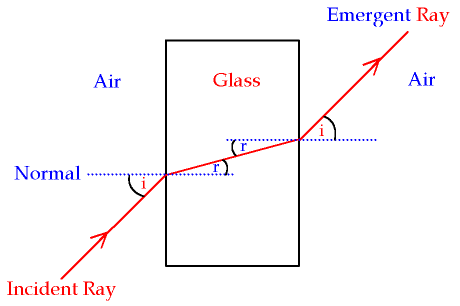
Bending relates to the change of speed of light as it moves from one medium to another
Light travels slower in glass than it does in air
- bends toward the nomel when it travels from air to glass
Total Internal Reflection TIR only occurs when there is a different density between the media that the light ray is travelling through.
e.g. When it travels through glass.
It is the process in which the light rays are reflected from the inside edge of the media.
Critical Angle:
It is the angle which causes the light ray to exit the glass block at 90 degrees to the normal i.e. That there is NO refraction.
If an angle of incidence i below the critical angle then TIR does not occur.
If an angle of incidence is above the critical angle then TIR does occur.
Uses in Optical Fibres:
Uses TIR to travel along a solid rod made from glass/plastic
The centre core of a Optical fibre is made from a glass with a high reflective index i.e.OPTICALLY DENSE
The coating is made of a material less optically dense
The light hits the boundary between the two media at an angle greater than the critical angle so that TIR takes place
A bundle of Optical Fibres are able to make an endoscope to look inside a body.
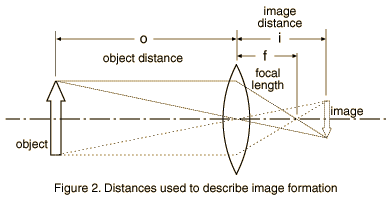
Focal point: point where image is at the most focus
Real Image: can be formed on a screen
Virtual: cannot
Erect: upright
Inverted: upside down
Diminished: smaller
Drawing Ray Diagrams:
- one ray passing through centre of lens
- one parallel to principal acis but is bent when it goes through optical centre (refraction)
-- or other way round
Light:
- t
Light:
- transverse wave
- small wavelength
- very high speed (3x10^9 m/s)
When
When white light is refracted through a prsm it splits up into its individual colours
- happens because each colour (wavelength) travels at a different speed in the glass prism
CALLED DISPERSION
RE
RED is fastest
VIOLET is slowest
Reflection of Light
Refraction
Total Internal Reflection
Converging Lens
Colour and Dispersion of Light
Información
- Descripción
- IGCSE (P4 Light and the Electromagnetic Spectrum) Physics Apunte sobre P4 Light, creado por ShreyaDas el 13/03/2014.
- Creado por
- ShreyaDas · mar 2014
- Actualizado
- 11 ago 2017
- Visitas
- 1.055
- Etiquetas
- Valoración