
Apuntes
Developmental plasticity
Contenido del apunte (1)
Página 1
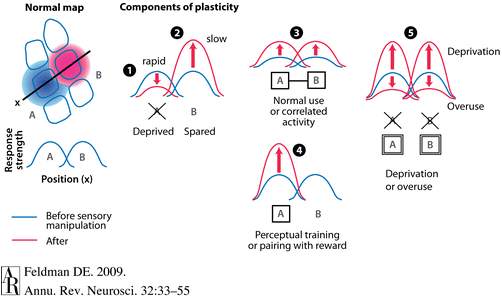
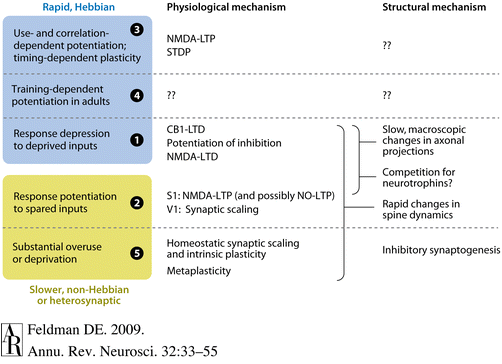
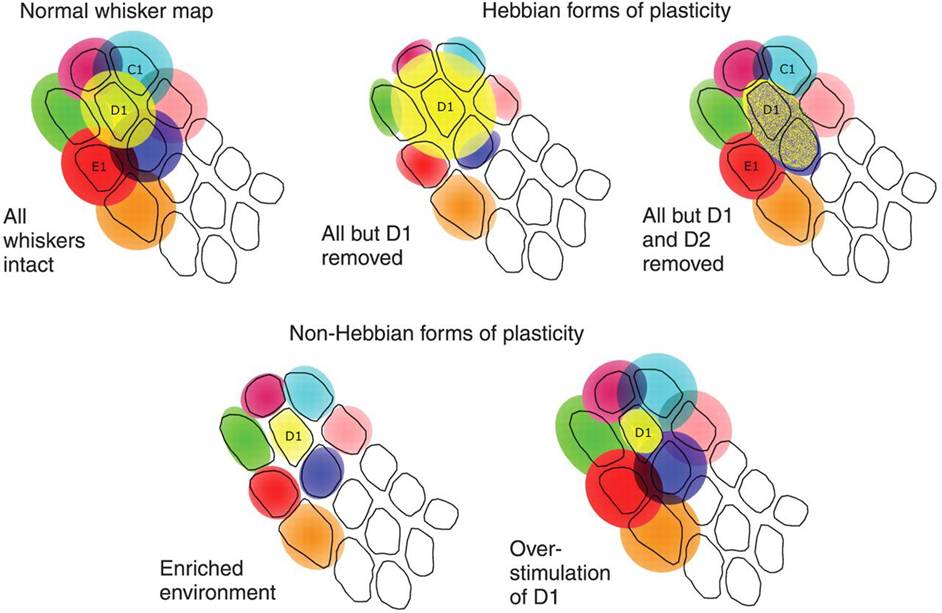
Fig:
When all whiskers are intact the receptive fields stay their relevant space,
however when for example all but 1 whisker are removed (D1) the receptive field
grows to try to compensate to the loss in sensory input, however the resolution
would decrease massively. See fig for other situations.
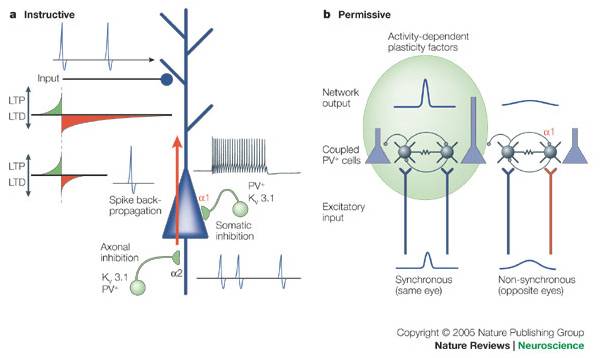
a |
Somatic inhibition by fast-spiking parvalbumin-positive (PV+) cells
(green) expressing the potassium channel Kv3.1 is mediated by the GABAA
(γ-aminobutyric acid type A) α1-subunit, whereas axonal inhibition is mediated
by the GABAA α2-subunit. Somatic inhibition is ideally situated for
suppression, or 'editing' of unwanted spikes, preventing them from
back-propagating through the cell body into the dendritic tree (red arrow).
This is an 'instructive' model, as individual action potentials can produce
long-term potentiation (LTP) or depression (LTD) based on precise spike-timing
dependent windows at individual synapses of coincident pre- and postsynaptic
activity123, 124. Notably, failure to regulate excess spiking at
the axon initial segment can still be differentiated by fast-spiking inhibition
at the cell body. b | Gap junctional coupling endows networks of
parvalbumin-positive (PV+) interneurons with the ability to detect
synchronous input128, 129, 130. Even a slight jitter in input timing (for
example, between eyes) dampens network activity through reciprocal
GABA-mediated contacts (enriched with GABAA-receptor α1-subunits131). Only synchronous open-eye input will produce
maximal, activity-dependent release or uptake of 'permissive' factors for
neurite growth (for example, tissue-type plasminogen activator78, 86 and brain-derived neurotrophic factor).
Competition is determined extracellularly.
components of cortical plasticity
mechanisms
barrel cortex plasticity
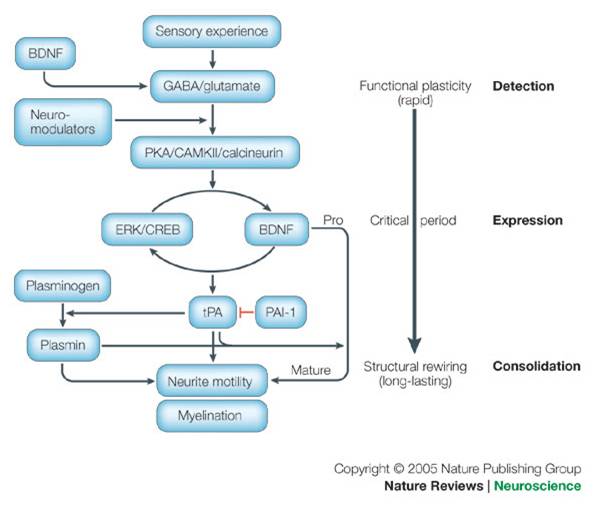
molecular mechanisms of visual plasticity/ circuit plasticit
Información
- Descripción
- Synaptic plasticity Apunte sobre Developmental plasticity, creado por Cher Bachar el 09/05/2013.
- Creado por
- Cher Bachar · may 2013
- Actualizado
- 29 dic 2016
- Visitas
- 993
- Etiquetas
- Valoración