
Apuntes
The Restless Earth
Contenido del apunte (2)
Página 1
Key Words
Plates - the large pieces of broken crust that cover the earth
Plate Margins - where two tectonic plates meet
Constructive - a plate margin where the tectonic plates are moving apart .
Conservative - a plate margin where the tectonic plates are sliding past each other
Destructive - a plate margin where the tectonic plates collide
Collision Zones - a type of destructive margin
Oceanic Crust - the crust under the ocean
Continental Crust - the crust under continents or land masses
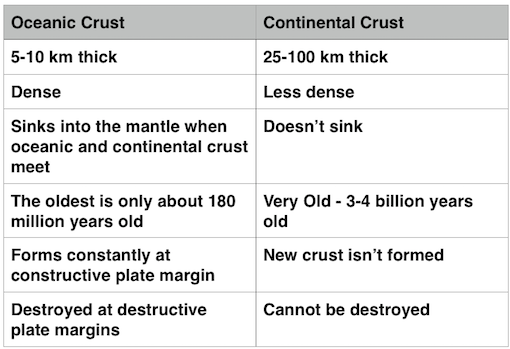
Subduction - when the oceanic plate sinks beneath the continental plate because it is denser
Fold Mountains - a mountain range formed by the collision of a continental plate with either another continental plate or and oceanic plate
Ocean Trenches - a deep depression on the ocean floor formed at the subduction zones of destructive plate margins
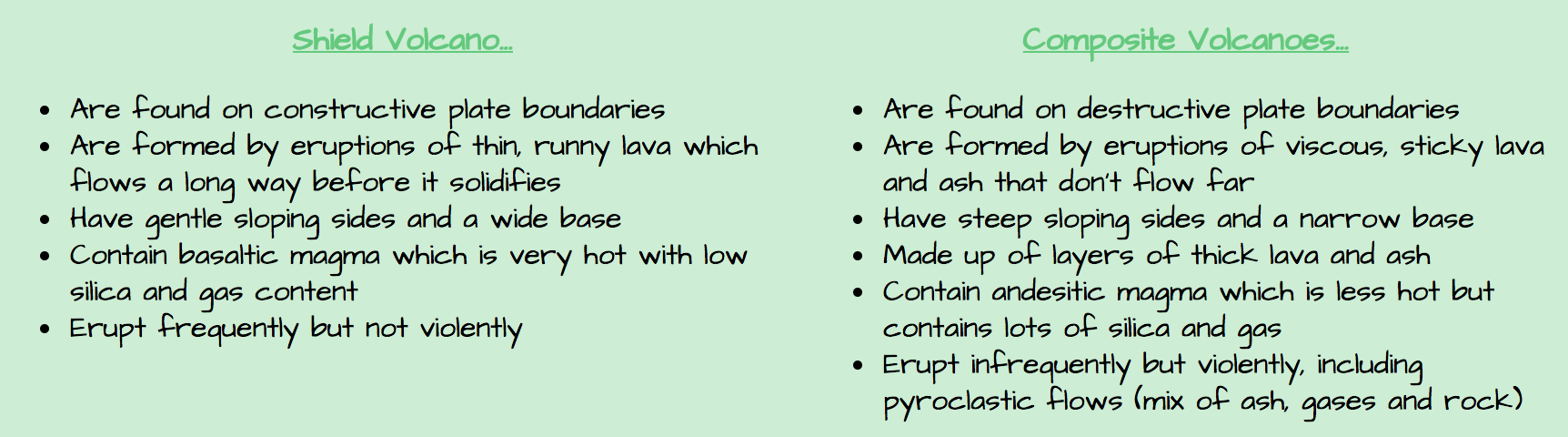
Pyroclastic Flows - fast moving mixtures of volcanic fragments , ash, mud and toxic gases (at temperatures of over 500°C)
Super Volcano - a volcano capable of erupting on a much larger scale then a normal volcano
Caldera - a large cauldron-like depression that forms following the evacuation of a magma chamber/reservoir. When large volumes of magma are erupted over a short time period, structural support for the crust above the magma chamber is lost.
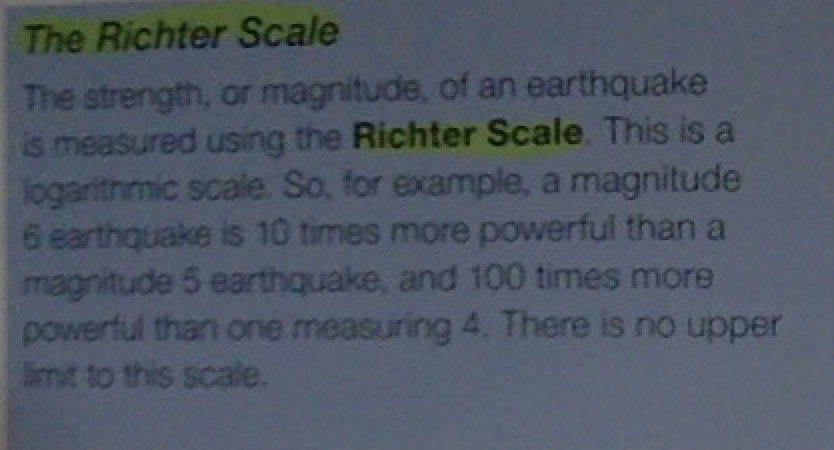
Volcanic Explosivity Index - a way of measuring eruptions. It measures the volume of material erupted. The index is logarithmic so VEI 5 is 10 times bigger than VEI 4 an 100 times bigger than VEI 3.
Shock Waves - the energy waves created by an earthquake
Focus - the point of origin of an earthquake
Epicenter - the point on the ground directly above the focus (centre) of an earthquake
Richter Scale - a measure of how strong an earthquake is
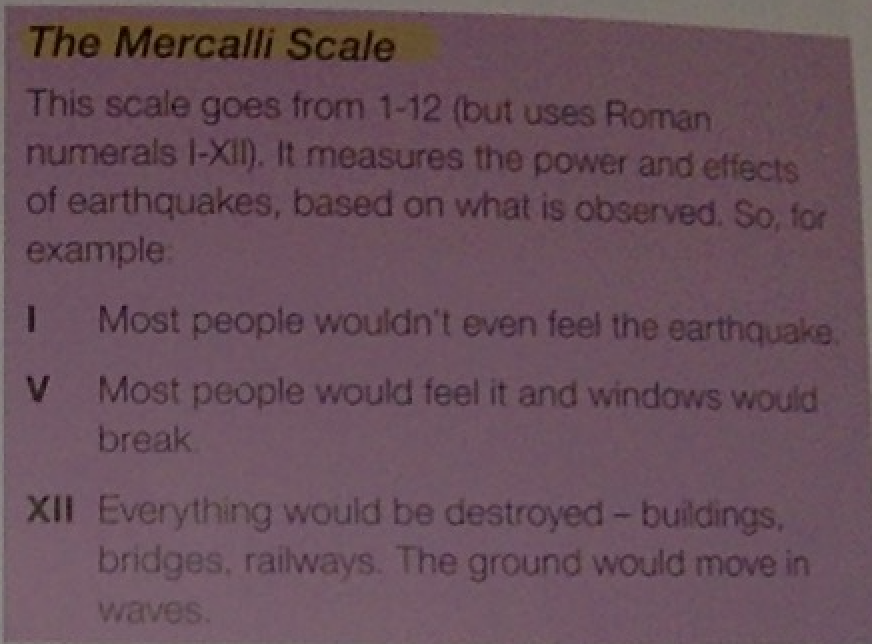
Mercalli Scale - this scale goes from I-XII and measures the power and effects of earthquakes
Tsunami - huge waves caused by an earthquake under the sea
Página 2
Your Questions
Pg. 9
1a. Explain what these terms mean: plates, plate margins.
Plates - the large pieces of broken crust that cover the earth
Plate margins - where the plates meet
1b. Name the two types of crust and list three differences between them.
Oceanic crust and Continental crust. Oceanic crust is only 5-10 km thick opposed to continental crust which is 25-100 km thick. Oceanic crust is denser than continental and sinks to the mantel when it meets continental crust which does not sink.
2. Describe the differences between constructive, conservative and destructive plate margins.
Constructive - where plates are moving apart
Conservative - where plates are sliding past each other
Destructive - where the plates collide
3a. Which plate is the UK on?
The Eurasian plate
3b. Name a country which is being split by two plates.
Guatemala and Papua New Guinea
3c. Name two plates that are moving apart
African and North American plates
3b. Name two plates that are colliding
Nazca and South American plate are colliding.
Pg. 11
1. What does subduction mean?
When the oceanic plate sinks beneath the continental plate because it's denser.
2.
Información
- Descripción
- GCSE (The Restless Earth) Geography Apunte sobre The Restless Earth, creado por Emily Feeke el 22/03/2017.
- Creado por
- Emily Feeke · mar 2017
- Actualizado
- 22 mar 2017
- Visitas
- 0
- Valoración