
Test
Cnidaria
Este test tiene tipos de pregunta que se abren en el reproductor de siempre.
Preguntas del test (22)
1they are circum global but entirely Aquatic
- AVerdadero
- BFalso
2this phylum are charaterised by having [blank_start]radial[blank_end] symmetrical and are [blank_start]diploblastic.[blank_end] They possess [blank_start]cnidae[blank_end] and have a [blank_start]nerve net[blank_end], they posses a single [blank_start]body cavity[blank_end].
- Aradial
- Bdiploblastic.
- Ccnidae
- Dnerve net
- Ebody cavity
3they have alternating generation, with a:
- AAsexual polypoid
- BSexual medusiod
- CAsexual Larvae
- Dleciothrophic larvae
- Eprecociol
4they have cilliate planula larvae
- AVerdadero
- BFalso
5Describe what a dipoblastic structure is?
- AOuter ectoderm, Inner entoderm, Separated by noncellular mesenchyme.
- BEndoderm, epidermis and cytoplasm
- Csingle celled membrane
- Dhas a three structured system
6Add the labels
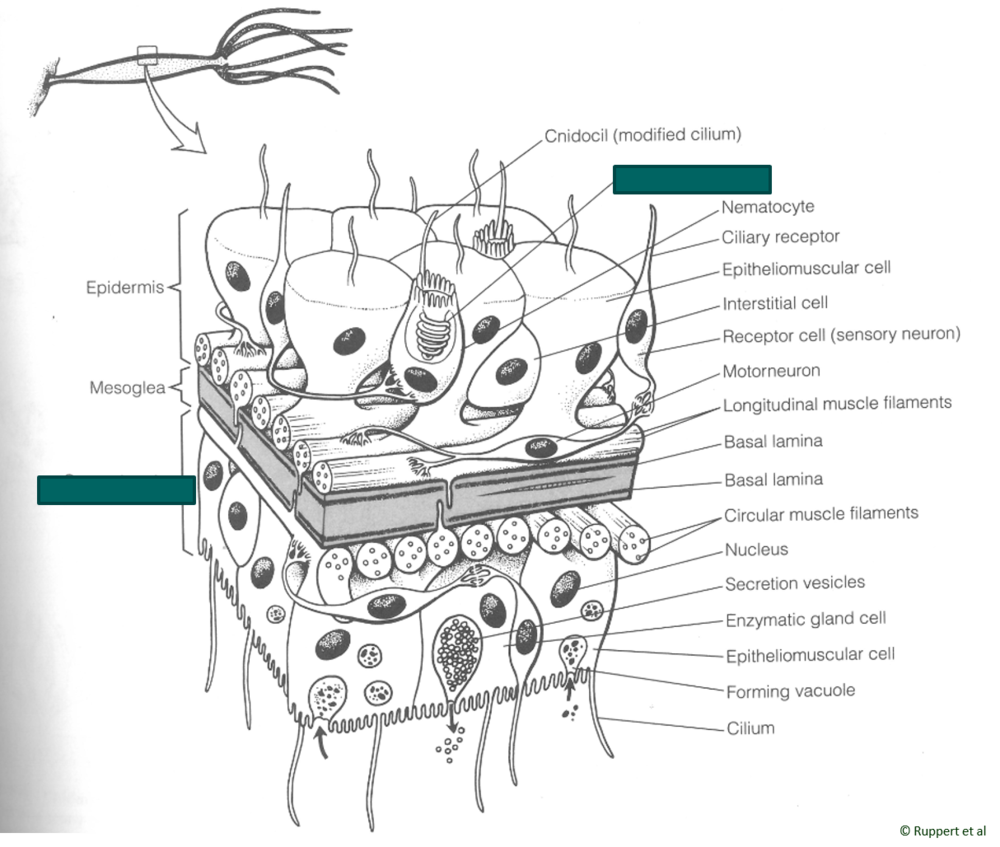
- AGastrodermis
- BNemondermata
- CEdodermis
- Dmesenchyme
- Enematocyte
- FGatrobalder
- GReceptor cell
- HReproductive cell
7Check the type of cnidae
- Apentrant
- Bglutinant
- Cvolvent
- Dvolitile
- Ekickstart
- Fpropeller
8the cnidarian is produce in the layers from cnidoblasts, becoming cnidocytes.
- AVerdadero
- BFalso
9what type of feeders are they
- AAmbush predators
- Bsuspension
- Cfilter
- Dforager
- Eautotrophic
10they have nematocyst covered feeding tentacles
- AVerdadero
- BFalso
11prey are [blank_start]partially[blank_end] digested in [blank_start]gastrovascular cavity,[blank_end] completed in food [blank_start]vascuoles[blank_end].
- Apartially
- Bgastrovascular cavity,
- Cvascuoles
12polypoid, is a stage which occurs in [blank_start]all[blank_end] classes, its s [blank_start]tubular sessile[blank_end] organism that reproduce [blank_start]asexually[blank_end] by plates which produce [blank_start]medusa[blank_end], they are [blank_start]radially[blank_end] symmetrical.
- Aall
- Btubular sessile
- Casexually
- Dmedusa
- Eradially
13The medusoid occur in all [blank_start]medusozoa[blank_end] classes, the are [blank_start]free-swimming disc-shaped[blank_end] structures they use [blank_start]propulsion[blank_end] to move through the [blank_start]water column,[blank_end] they are also [blank_start]radially[blank_end] symmtrical, these reproduce [blank_start]sexually[blank_end] and are usually [blank_start]dioecious[blank_end].
- Amedusozoa
- Bfree-swimming disc-shaped
- Cpropulsion
- Dwater column,
- Eradially
- Fsexually
- Gdioecious
14label the diagram
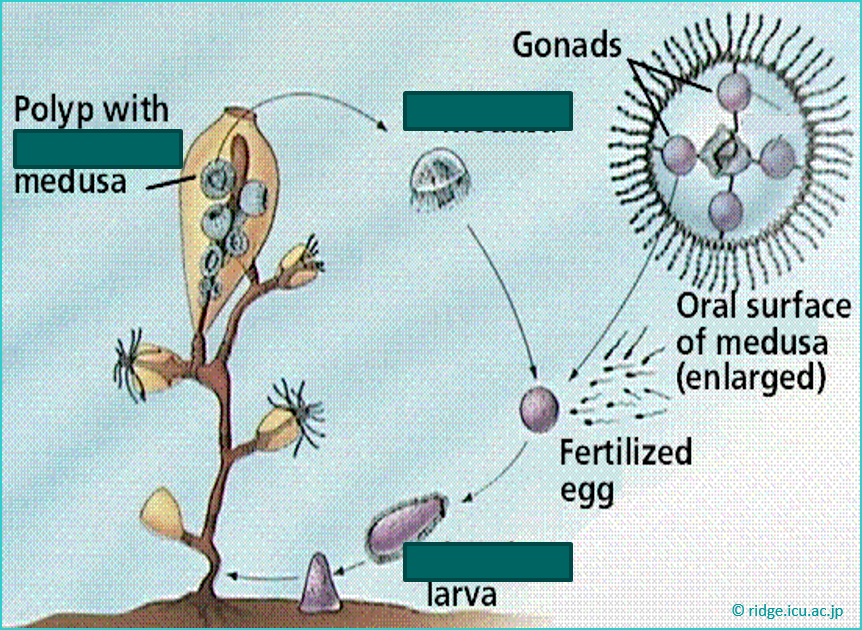
- Adeveloping
- BMedusa
- CPlanula
15Name all the symbiosis relationships shown by cnidarian?
- AZooxanthellae
- Bfish
- Ccrustaceans
- Dechinoderm
- Eporifera
- Fmollusca
- Gcetaceans
16class Hydrozoa, these are the [blank_start]simplest[blank_end] cnidarians with [blank_start]alternating[blank_end] generations, they have [blank_start]benthic colonial[blank_end] stage may be [blank_start]polymorphic[blank_end] where the small medusa stay attached to the polyp
- Asimplest
- Balternating
- Cbenthic colonial
- Dpolymorphic
17Class Scyphozoa, is the [blank_start]true jellyfish[blank_end] they're exclusively [blank_start]marine[blank_end]. dominant and [blank_start]well-developed[blank_end] medusa phase
- Atrue jellyfish
- Bmarine
- Cwell-developed
18Cubozoa
contain the order of box jelly fish ([blank_start]cubomedusae[blank_end]), they are largely restricted to the [blank_start]tropics[blank_end], and they only produce a [blank_start]sigle medusa[blank_end]. they have well developed eye and also have [blank_start]toxic[blank_end] nematocysts- Acubomedusae
- Btropics
- Csigle medusa
- Dtoxic
19what classes are bioluminescence common in
- AHydrozoa
- BScphozoa
- Calcyonaria
- DZoantharia
- Eholothoriodia
20bioluminescence produce luciferin de novi, reacts with oxygen to produce light
- AVerdadero
- BFalso
21The class Alcyonaria, contains sea pens, [blank_start]sea fans[blank_end] and soft coral, they are [blank_start]modularly[blank_end] colonial so there non-polymophism. they also have no medusal stage. they have an [blank_start]internal[blank_end] syupport system and [blank_start]pinnate[blank_end] tentacles, arranged in [blank_start]eight[blank_end].
- Asea fans
- Bmodularly
- Cinternal
- Dpinnate
- Eeight
22Class Zoantharia, which are [blank_start]sea anemones[blank_end] and hard corals [blank_start]solitary[blank_end] or modularly colonial and also have no medusa stage, have [blank_start]external[blank_end] support with tentacles in multiples of [blank_start]six.[blank_end]
- Asea anemones
- Bsolitary
- Cexternal
- Dsix.
Información
- Descripción
- first year revision
- Autor
- chloe allen
- Idioma
- English
- Visitas
- 152
- Historial
- Creado el 24 may 2017 · actualizado el 24 may 2017
- Etiquetas
- Valoración
- Aún sin valoraciones Valora este test