
Mind map
Biogenic Habitat & Engineers
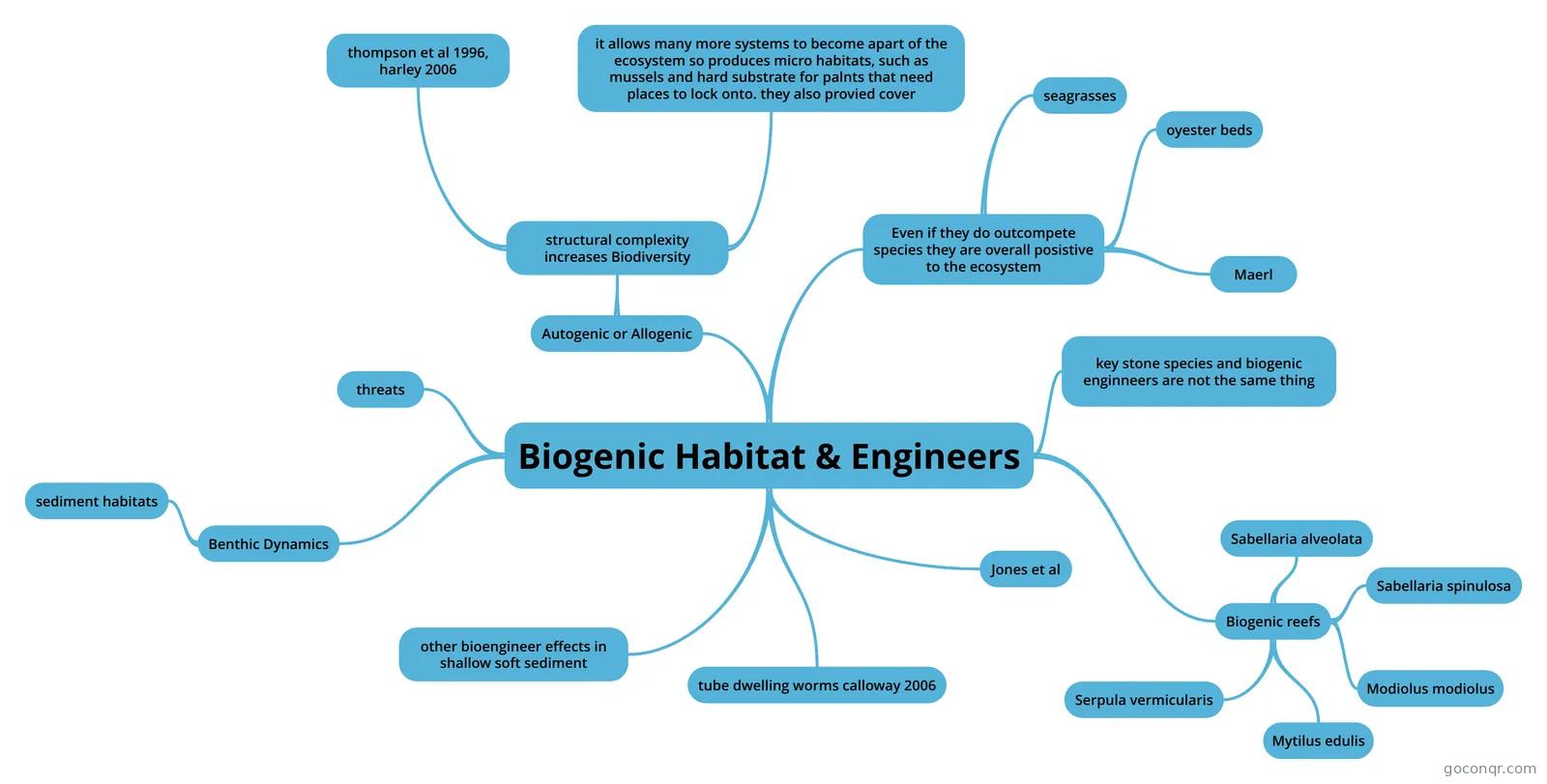
Mind map: Biogenic habitat and engineers
Map content
Biogenic Habitat & Engineers
Jones et al
- Biogenic engineers directly or indirectly control the availability of resources to other organisms by changing the biotic and abiotic resources available
- physical ecosystems engineers do this by physical modification, maintenance, or creation of habitats
Autogenic or Allogenic
- Autogenic are organisms that change the environment by their actual bodies and structure such as corals or tube worms
- Allogenic change the environment by their behaviour such as beavers creating dams for shelter
- structural complexity increases Biodiversity
- thompson et al 1996, harley 2006
- it allows many more systems to become apart of the ecosystem so produces micro habitats, such as mussels and hard substrate for palnts that need places to lock onto. they also provied cover
Even if they do outcompete species they are overall posistive to the ecosystem
- Predator refugee stress relief protection from flow rates refugee from sedmentation encourages sedimentation hard substrate for settlement
- seagrasses
- oyester beds
- Maerl
- free calcareous Algae - they reomve sediment under moderate flow = when they die they support fauna
key stone species and biogenic enginneers are not the same thing
Biogenic reefs
- massive structures made up of entirely biogenic engineers either by thier own bodies such as tubes and shells or by sediment and rocks held together by substances secreted by said organisms, it is discrete from the substrate usually rising from it.
- Sabellaria alveolata
- this is a polycheate live up to 4-5 years they have tube like structures that aggriate together they are very fragile and conditions for them are unknown things attached to them and promotes diversity
- Sabellaria spinulosa
- less common then its cousin species, but is home to the shrimp Pandulose montagui
- Modiolus modiolus
- its a slow growing species with a 25 year life span, it becomes reproductively active at ages 3 to 5 onceestablished they are stable strutures - extremely rich communitys, embeded into the sediment
- Mytilus edulis
- these are small organisms in the uk but they form dense sea beds with verdiverse communities due to thier hard substrate and binding gel creating a micro habitat
- Serpula vermicularis
- prevented at low depth due to lack of O2, they are normally found in semienclosed scottish locks - allowing groeth
threats
- these are all anthropogenic impacts - bottom fishing - changes in sedimentation from management - trampling - gravel extraction - pipelaying, trenching, oil rigs - aquaculture enrichment
Benthic Dynamics
- soft sediment habitats cosist of 90% of the sea floor we know very little about this as it is very different to terrestrial environments if we knew the process we could see the evolution of these bioengineers
- soft sediments are alot more ort livid then rocky shores so biogenic engineers basically stablise the sediment
- sediment habitats
- these are influence greatly by engineers due to - particle size and sorting - sedment quality - decreasing toxicity and om content - depth - improves attchment alter sedjiment properties -alters currents
tube dwelling worms calloway 2006
- he studied wether small groups or single tubes effected the area more they found that single tubes just lead to destablisation where as dense aggregation led to stablisation
- so for single the sediment was more flowing making it easier for isopods and amphipods to move and forage and became a better nursing are for polycheates
- also single worms created a piston effect wich lowered the oxygenic layer in the sediment
other bioengineer effects in shallow soft sediment
- mat-forming autotrophs sliming motile benthos burrows as habitats sediment reworking and irrigation by infuana
Information
- Description
- basic over view on biogenic habitats and ecosystem engineers, includes a definition and the effects it has, lists different engineers and mentions the threats they face
- Created by
- chloe allen
- Views
- 80
- Tags
- Rating