
Test
Music Therapy Practice Exam (with explanations)
Este test tiene tiempo límite, así que se abre en el reproductor de siempre.
Preguntas del test (130)
1A music therapist would like to compare the outcomes from a client's music therapy sessions and physical therapy sessions. Which of the following is the BEST way to do this?
- ATalk to the physical therapist about how the physical therapy sessions have progressed.
- BUse an appropriate standardized measurement tool that is also used in physical therapy.
- CObserve one of the client’s physical therapy sessions to compare progress.
- DDevelop a music therapy evaluation to use specifically with this client.
2A music therapist is working with a client who is depressed and withdrawn. In an improvisational dyad, the music therapist gradually changes the tempo, range, and articulation, while reflecting and supporting any change in playing by the client. Which of the following is the music therapist MOST likely attempting to encourage?
- Aimprovement in sustained attention
- Bincreased emotional expressiveness
- Cdemonstration of sensory awareness
- Dresponse to musical behavioral cues
3A child with cerebral palsy who communicates non-verbally brings an electronic augmentative communication system to group music therapy. The BEST way to plan to accommodate this client's inclusion in a group singing experience is to
- Aencourage the child to touch 'stop/go'.
- Bteach the child hand gestures for several song lyrics.
- Cask the staff to sing for the child.
- Dpre-record song lyrics onto the system.
4When playing a song for a group of clients, the music therapist is reminded of feelings of love for a romantic interest. The therapist should
- Acontinue working and internally acknowledge these feelings.
- Bblock these feelings out and focus on the clients' needs.
- Cshare these feelings with the clients when the song is over.
- Dplay this song in future sessions only when feeling uninspired.
5A client with Autism Spectrum Disorder (ASD) claps to musical accompaniments, clapping when the music plays and stopping when the music stops. The music therapist uses these responses to assess which of the following areas of functioning?
- Avibroacoustic
- Bvestibular
- Cproprioceptive
- Dsensorimotor
6Determining a client's musical background and skills is an important task during which phase of the music therapy plan?
- Aevaluation
- Btermination
- Cimplementation
- Dassessment
7A music therapist is working with a patient who has suffered a stroke on the left side of the brain and exhibits significant language comprehension issues. It is MOST effective to provide ongoing acknowledgement and reflection of the client's responses through
- Adetailed instruction which create context
- Bexaggerated verbal and nonverbal prompts
- Csimple singing of directions through a song
- Dsimple non-verbal cues and gestures
8A music therapist works in a remote area where the field is not prominent and there are no other practicing music therapists. The music therapist is feeling isolated. Several clients at the hospital where he works are challenging, and he feels that he could really benefit from another person to "bounce ideas off of." Which of the following is the MOST effective way to address the music therapist's immediate need?
- ASeek peer supervision through an online community of music therapists.
- BConnect with a non-music therapy co-worker who can listen and offer feedback.
- CFind a therapeutic outlet by playing recreationally with local musicians.
- DAttend a conference session that focuses on the music therapist's concerns.
9A child with Autism Spectrum Disorder (ASD) starts pacing during a music therapy session. Which of the following is the music therapist's MOST effective response to redirect the child?
- ATap on the chair
- BChant a rhythmic pattern "it's okay"
- CPlay sol-do on xylophone
- DSing a melodic phrase "sit down"
10A music therapist in a private school setting conducts a weekly social skills group for students with high-functioning Autism Spectrum Disorder (ASD). Goals include controlling impulses, turn-taking, and reciprocity. Data indicates three of the four students are making progress towards their goals, but one student expresses "music is stupid" and records indicate he participates less than 5% of the time. Which of the following is the music therapist's BEST action?
- ARefer the student to a non-musical social skills group.
- BIgnore the student and focus on the remaining group members.
- CPosition the student in a leadership position.
- DDismiss the student from the group until he can demonstrate cooperation.
11A music therapist is completing an initial assessment of an adult client in a hospital setting. The therapist reviews the patient chart beforehand to gather information about demographics, clinical history, and personal resources. During a brief interview with the patient, the therapist gathers information regarding cultural and spiritual background, family dynamics, and support systems. Which of the following additional information should the music therapist obtain that may affect the music therapy session with the client?
- Asocial and interpersonal relationships
- Blearning styles and academic skills
- Cmusic background and preferences
- Dresponses to tempo and pitch
12A music therapist is working with a group of young women with eating disorders. The goal is to verbalize thoughts and feelings. The music therapist wants to lead a group vocal improvisation, but the women find it difficult to use their voices in a free and expressive way. Which of the following is the music therapist's BEST action to prepare the group for vocal improvisation?
- AHave each woman talk to the group about her fears.
- BLet the group pick songs they especially like to sing together.
- CDo a vocal call-and-response with the therapist leading.
- DHelp them write a group song using words from each woman.
13A music therapist is working at a shelter house with women survivors of abuse and trauma. The new music therapy group seeks to empower women and facilitate emotional expression. After a lyric analysis intervention in which clients discuss themes of healing and recovery, which of the following interventions should the music therapist facilitate NEXT?
- Amusic improvisation in which clients play a variety of unpitched instruments focusing on themes of trauma
- Bmusic-centered relaxation in which clients practice progressive muscle relaxation with recorded music
- Cgroup singing in which clients sing along to an original recording of another song with a therapeutic theme
- Dfill-in-the-blank songwriting in which clients insert their own words and phrases into the song
14A music therapist is aware of what she is thinking and feeling during the session and can communicate this to clients when appropriate. This is an example of developing the therapeutic relationship by being
- Areflective
- Bclinical
- Cauthentic
- Daccessible
15During a music therapy session, a client demonstrates a pattern of behavioral responses towards the therapist based on a significant past relationship outside of music therapy. This is referred to as
- Aappropriation
- Bmisplacement
- Ctransference
- Dresistance
16Which of the following is a purposefully sequenced course of therapy with a specific outcome?
- Aassessment
- Bobjective
- Ctarget behavior
- Dtreatment plan
17During a music therapy session a client has a grand mal seizure. Which of the following should be the music therapist's FIRST action?
- ALeave the room to call for help
- BMove harmful objects away from the client
- CRestrain the client by holding his arms and legs
- DPut something between the client's teeth
18A music therapist has been asked to write a song to help an adult with intellectual disabilities remember the steps involved with teeth brushing. The MOST effective song lyrics to promote functional independence includes
- A"I squeeze paste on the brush" to an unfamiliar tune.
- B"I like to brush my teeth" to a familiar tune.
- C"My toothbrush is blue" to an unfamiliar tune.
- D"I remove the cap from the tube" to a familiar tune.
19A music therapist in private practice has been working with an adult outpatient client for a year and all goals have been met. Ongoing assessment indicates no new goals and the client has been functioning well for some time now. As the music therapist prepares the client for termination, which of the following are important to consider?
- Atreatment summary of the client's progress, date for the last session, and recognition of feelings regarding termination
- Brecognition of feelings regarding termination, transition plan to another expressive arts therapy, and date for the last session
- Ctreatment summary of the client's progress, date for the last session, and summary of music therapist's feelings about the client
- Drecognition of feelings regarding termination, date for the last session, and summary of client's goals and progress to the client's family
20A music therapy referral is made for a 31-week-old premature infant in the NICU. To ensure the music therapist is following current guidelines for clinical practice, which of the following is the therapist's BEST course of action when completing the treatment plan?
- ADetermine the goals and objectives with the nursing staff.
- BConsult with the interdisciplinary team for best practices.
- CResearch clinical literature for evidence-based protocol.
- DAsk the parents or caregivers for additional information.
21A music therapist is planning a session for a group of residents in a nursing home, focusing on reality orientation and reminiscence. To increase the number of reminiscent statements that the residents make during the session, the music therapist should plan to focus their attention on
- Asinging client-preferred songs from the residents' young adult years.
- Bviewing sentimental album covers from various decades.
- Cplaying popular musical instruments from the residents' teenage years.
- Dinterviewing each other about musical events they attended in their youth
22A music therapist is working with an adult inpatient psychiatric group. The therapist is leading an instrument improvisation experience and notices that one of the men in the group begins breathing rapidly and beating his drum very intensely. He gets up from his chair, throws his drum to the floor, starts pacing around and hitting his mallet aggressively on chairs in the circle. Which of the following should be the music therapist's FIRST action?
- AAsk the client to pick up the drum and return it to the instrument box.
- BTell the client he needs to leave the group immediately and not return until he has calmed down.
- CEnsure the group members' safety and call for help from another staff member.
- DIgnore the client's behavior as he will work through it on his own.
23A child with Autism Spectrum Disorder (ASD) who communicates non-verbally spends much of the initial session exploring the environment of the room, touching the walls, and playing instruments that the music therapist has set out in the treatment room. Which of the following should the music therapist concentrate on FIRST?
- Aengaging the child by reflecting the child's actions and mood through improvisation
- Bdeveloping compliance for in-seat behaviors through positive reinforcement
- Cincreasing the child's attention span through listening experiences requiring discrimination of the instruments heard
- Dencouraging the child to vocalize while playing instruments
24When asking a client to improvise a melody using only the black keys on a piano, the music therapist should provide an accompaniment based on which of the following scales?
- Aionian
- Bpentatonic
- Cwhole tone
- Dchromatic
25A music therapist is working with a group of students with developmental disabilities. The music therapist teaches the children a song about the names of the colors to build skills in which of the following areas?
- Aaffective
- Bmotor
- Ccognitive
- Dsocial
26A music therapist writes an objective that is well-defined, specifies the criteria for the behavior, and establishes a timeline. This type of objective is
- Atranslatable
- Bdefendable
- Cmeasurable
- Denforceable
27In a group home for young male offenders, a music therapist meets weekly with a group of clients. During a session, each client is asked to pick a song recording to communicate something about themselves to the others in the group. The therapist and the group members then verbally reflect thoughts and feelings that are shared in relationship to the chosen song. It is MOST likely that the music therapist is operating from which of the following theoretical orientations?
- Apsychodynamic
- Bholistic
- Chumanistic
- Dcognitive
28When a music therapist arrives to work at a memory care facility, the spouse of a client expresses sadness that his loved one with late-stage dementia does not recognize him. When the music therapist enters the client's room, the client is sitting in the corner of the room and staring at the floor. Which of the following strategies should the music therapist include in the session?
- AUse the client's favorite song to facilitate a musical interaction between the spouses.
- BPlay calming music to diminish the client's agitated behaviors.
- CPresent a list of preferred songs for the client to select.
- DImprovise a song about love and marriage with the spouse present.
29A patient with late-stage dementia has not vocalized in several years. During the assessment process, the patient makes ongoing attempts to sing "Na, na, na, na" when presented with childhood chants. The music therapist should conclude that music therapy may
- Aelicit vocal responses
- Brestore lost speech skills
- Cbe met with frustration
- Dnot effectively benefit this patient
30Which of the following interventions BEST addresses a goal of increased self-esteem?
- Alyric analysis
- Bguided imagery
- Cperformance ensemble
- Dmusic appreciation
31A 6-year-old client with Autism Spectrum Disorder (ASD) is consistently meeting his communication goals during music therapy sessions, but the family reports that music therapy is the only place where the child willingly engages in his environment. To facilitate transfer of progress into the client’s everyday life, which of the following is the music therapist's BEST action?
- AExplain to the family that it is typical for children with ASD to not transfer behaviors from therapy.
- BDiscuss ways the family can independently integrate music at home to encourage interaction.
- CContinue current music therapy interventions, to enforce stronger brain connections.
- DExplore ways to incorporate additional musical involvement through adaptive music lessons.
32A music therapist is facilitating a music therapy group for children with emotional and behavioral disorders. One of the goals of the group is to improve social skills. The therapist is attempting to structure and organize music therapy experiences within the session to create a therapeutic contour focused on this goal. Following a greeting song, which of the following interventions should be the music therapist's NEXT step?
- Aan improvisational experience that facilitates turn-taking and interaction
- Brewriting a popular song to reflect appropriate emotional self-regulation strategies
- Cbreathing and movement to practice relaxation using a repetitive guitar chord progression
- Dlive guitar and singing of a closing song using a client-preferred music genre
33To receive third party reimbursement for music therapy services, a music therapist is required to include a code for the specific procedures used in music therapy treatment. These codes are defined in the
- ACurrent Procedural Terminology® (CPT).
- BProspective Payment System (PPS).
- CMinimum Data Set (MDS).
- DPhysicians' Desk Reference® (PDR).
34A group of clients in an outpatient mental health setting have verbalized that they lack healthy support systems. Which of the following interventions BEST addresses this within the music therapy context?
- Asongwriting that focuses on qualities of positive relationships
- Bgroup singing of popular songs chosen by the group members
- Crhythmic improvisation within a framework provided by the music therapist
- Dstructured group movement exercises to upbeat and rhythmic music
35A military veteran undergoing treatment for Post-Traumatic Stress Disorder is enrolled in beginning guitar lessons with a volunteer instructor at the Veterans Affairs (VA) hospital where he receives his treatment. The veteran experiences recurrent distressing memories of his combat experiences, hypervigilance, and difficulty experiencing positive emotions. The veteran tells the music therapist during a large group session that he is enjoying guitar lessons and is using the guitar to relieve stress. Which of the following is the music therapist's BEST action?
- AGive the guitar instructor advice on what techniques to teach the veteran that will help him manage his symptoms and provide greater relaxation.
- BRecommend that the veteran further explore how to use music independently for self-care in individual music therapy.
- CEncourage the veteran to write songs independently with positive lyrics, so he can perform them on the guitar and retrain himself to feel happiness.
- DSuggest that the veteran make a list of songs that remind him of his time in active duty and have the guitar instructor teach him to play those songs.
36A patient with late-stage dementia has aphasia, difficulty following directions, and significant memory loss. To develop a treatment plan that reflects the patient's needs and interests, which of the following should be the music therapist's FIRST action?
- AInterview the patient to determine music preferences.
- BConsult with the patient's caregiver to determine music preferences.
- CAsk the patient to indicate preferences after listening to a variety of recorded music.
- DGive the patient a questionnaire about music preferences.
37Children with Down syndrome often have mild hearing loss that can be difficult to detect. During the music therapy assessment, this hearing loss would MOST impact which of the following responses?
- Asocial
- Bcommunicative
- Cemotional
- Dphysiological
38A music therapist has been working with a client at a residential facility for children with intellectual disabilities for several years. The client was referred to music therapy due to limited communication abilities, and has made exceptional progress throughout treatment. Recently, however, the client seems to have reached a plateau and has not met an objective in several months. The music therapist has varied the strategies and techniques used with this client, but the changes have not affected the client’s progress. The facility offers multiple types of therapy, but clients have limited blocks of time during which they can receive therapy services. Which of the following is the music therapist's BEST action?
- AContinue to try other techniques until finding something that the client responds to.
- BCommunicate only verbally, without music, until the client makes progress.
- CConclude that the client has become resistant to music therapy.
- DConsider termination of music therapy and referral to another therapy.
39A music therapist is working with an older adult client diagnosed with depression. Which of the following is the music therapist's BEST approach to help elevate the client's mood?
- AIncorporate progressively more stimulating client-preferred music.
- BIntroduce the client to a new song to stimulate interest.
- CPlay slower, somber music to match the client's activity level.
- DSing an upbeat song with positive lyrics.
40A music therapist is assisting a terminally ill client who is preparing for his impending death. The BEST choice of music for the client's final hours is music that has been
- Aselected by the client.
- Bdesigned to elicit relaxation.
- Cselected previously by the family or significant others.
- Ddesigned for spiritual transformation.
41When a music therapist arrives for a group music therapy session at a residential psychiatric treatment facility for adolescents, the therapist finds five group members sitting together laughing and talking loudly. A new patient is sitting alone and appears quiet and sullen. The therapist notices bandages wrapped around the new patient's wrists. One of the group members tells the therapist the patient is new to the unit and none of them even know her name. After introductions, the therapist should
- Ainvite the new patient to join the group and encourage other group members to share their music therapy experiences.
- Bproceed with the group as planned and invite the new patient to observe the group.
- Corient the new patient to the policies and procedures of the treatment facility.
- Dask the new patient to explain why she is in the facility and share her musical background.
42The act of focusing on a particular object for a period of time while simultaneously ignoring irrelevant information that is also occurring is
- Asustained attention
- Barousal
- Cvigilance
- Dselective attention
43Which of the following must be submitted to third-party payers when seeking reimbursement for music therapy services?
- Adiagnostic codes, music therapy credentials, and billing forms
- Bcost-benefit analysis, diagnostic codes, and music therapy credentials
- Cbilling forms, cost-benefit analysis, and music therapy treatment plan
- Dmusic therapy treatment plan, music therapy credentials, and diagnostic codes
44During a music therapy session, a client experiences an emotional reaction related to an impending loss. This is typically referred to as
- Aanticipatory grief
- Baffective state
- Cbereavement
- Dcomplicated grief
45A music therapist is working with a stroke patient who demonstrates left neglect and difficulty crossing midline. In order to address both needs through instrumental playing, the therapist should position a drum
- Ato the patient's right side and place a mallet in each hand.
- Bto the patient's right side and place a mallet in the right hand.
- Cto the patient's left side and place a mallet in the right hand.
- Ddirectly in front of the patient and place a mallet in the right hand.
46The appropriateness of a referral for music therapy is ultimately determined by the
- Aspeech therapist
- Bphysician
- Ccounselor
- Dmusic therapist
47A student who typically communicates non-verbally becomes more vocal during a session, with increased humming and babbling. Which of the following should the music therapist do FIRST to facilitate increased vocal production?
- Aimitate the student's sounds
- Bplay a familiar song
- Cadd rhythmic accompaniment
- Dintroduce additional sounds
48When working within adult oncology, which of the following is the BEST reason to prioritize a music therapy referral for a particular patient?
- Aisolation due to a lengthy hospital stay
- Black of family support system
- Cdifficulty with treatment adherence
- Dacute pain unmanaged by medication
49Which of the following is being used when the music therapist organizes the session into a specific order, creating music experiences for the beginning, middle, and end of the session?
- Afading
- Bchaining
- Csequencing
- Dshaping
50A music therapist working with a mental health group facilitates an opening song in which clients are asked to participate verbally by stating their names. This exercise primarily assesses
- Areality orientation
- Baffective state
- Cmusical behavior
- Dsensorimotor skills
51Which of the following is the MOST valid and reliable way to document functional outcomes related to specific goals and interventions?
- Adigital media systems
- Ban interval recording schedule
- Conline outcome measures
- Dstandardized measurement tools
52At the end of an initial music therapy assessment in a skilled nursing facility, a music therapist noted that a client with Parkinson’s disease who rarely had mobility issues paused at the door to the treatment room for 30 seconds, and seemed to have trouble initiating the movement necessary to walk through the door. When interpreting the results of the assessment, the MOST likely conclusion the music therapist should make is that the client may have
- Aalready developed a strong attachment to the therapist, which should be discussed in the next session.
- Bbeen experiencing effects of changes in medication which could affect movement, and limit the accuracy of the assessment findings.
- Cserious deficits in fine motor skills, which should be included as a goal for music therapy treatment.
- Dcognitive deficits that require further evaluation using a standardized non-musical assessment tool.
53During a music therapy experience, which of the following is the term used to describe two or more processes being joined together systematically, one at a time?
- Afading
- Breinforcement
- Cchaining
- Dgeneralization
54Which of the following standardized assessments would give a music therapist information about the client's functioning level in the sensorimotor domain?
- AKhan-Lewis Phonological Analysis
- BMini-Mental State Examination (MMSE)
- CHamilton Anxiety Rating Scale
- DBerg Balance Scale
55A music therapist receives a referral for a client who has a diagnosis that is unfamiliar to the therapist. The therapist has read the client’s history and has spoken to the client's nursing staff. Which of the following should be the music therapist's FIRST action to obtain the information needed for effective treatment planning?
- ALook at the library for recent books about the client’s diagnosis.
- BDiscuss the client with a supervisor in the facility.
- CConfer with a colleague about possible interventions.
- DUse a database to find music therapy research on the diagnosis.
56When a client reaches some of his goals in less time than expected, the music therapist should
- Aterminate treatment
- Brevise the treatment plan
- Cconsult with other professionals
- Dwrite up a treatment summary
57A music therapy treatment approach that focuses on how music interventions stimulate the brain to influence a client’s affective, cognitive, and sensorimotor behaviors is
- Apsychodynamic
- Bneurologic
- Cholistic
- Dbehavioral
58A music therapist introduces instrument choices to a child, playing each instrument to demonstrate its different sounds and uses. The music therapist asks the child to choose an instrument to which he is especially drawn. The music therapist is MOST likely trying to ascertain the child’s
- Apreferences for styles of music.
- Blimits of sustained attention.
- Ccapacity for verbal expression.
- Dresponses to musical elements.
59A music therapist working with an adult client diagnosed with schizoaffective disorder who exhibits restricted emotional expression has involved the client in a song discussion focusing on the affective qualities of a familiar song. As the therapist continues singing and playing the song, she notices that the client has begun talking to herself while rocking back and forth and laughing. The music therapist's BEST response is to
- Astop the music until the client's verbalizations have ended.
- Badjust the tempo of the song to correspond to the client's rocking behavior.
- Csing and play the song at a higher volume to mask the client's verbalizations.
- Drefocus the client by directing her to sing along with the therapist.
60A music therapist facilitates a music experience in which the client plays an instrument while the music therapist plays the piano, pauses when the music therapist stops playing, and waits to continue when the music therapist resumes playing. Which of the following is the MOST likely goal of this intervention?
- Anonverbal expression
- Bimpulse control
- Cauditory discrimination
- Dmotor skills
61A music therapist asks a client to close her eyes, presents a musical tone, and asks the client which direction the sound is coming from. The music therapist is assessing the client's auditory
- Amotor matching
- Bsequencing
- Cdiscrimination
- Dsensitivity
62A music therapist has recently started a new job working with inner-city at-risk adolescents at a community center. To help adolescents identify and express their emotions, she introduces song-writing activities. Though the therapist has a strong background in jazz and classical music, she notices that the clients criticize her accompaniments. To BEST meet the clients' needs, the therapist should
- Adevelop therapeutic music lessons to teach basic music literacy.
- Bmove from song-writing to active music listening to broaden clients' exposure to new musical styles.
- Cadapt the clients' preferred music to the styles with which the therapist is most comfortable.
- Dseek out resources to learn more contemporary music styles.
63A music therapist is designing a group experience for adults in a psychiatric hospital who are reluctant to verbalize. Which of the following experiences will MOST likely encourage non-verbal expression?
- Aimprovisational drumming
- Bexercise with music
- Cguided imagery
- Dprogressive muscle relaxation
64Which of the following is a method of stress reduction that involves tensing and releasing of the body?
- Aguided imagery
- Bprogressive muscle relaxation
- Cautogenic training
- Dsystematic desensitization
65Which of the following is a diagnosis characterized by deterioration from a previous functioning level, disorganized thinking or speech, and hallucinations or delusions?
- Abipolar disorder
- Bschizophrenia
- Cdepressive episode
- Dsomatization disorder
66A music therapist is completing an assessment for a 5-year-old girl with Rett Syndrome. Which of the following music therapy assessment experiences would BEST assess the client's motor skills?
- Asinging a rhythmic marching tune while the client plays a maraca
- Bobserving the client's facial expressions while she listens to a recording of her preferred music
- Crecording the number of vocalizations as the client sings her favorite song
- Dpresenting the client with instrument choices and observing her nonverbal communication
67Which of the following interventions MOST directly addresses social language use?
- AWrite tongue twister songs using a variety of consonants and vowels.
- BStimulate spontaneous completion of song lyrics in a familiar song.
- CCreate a musical improvisation that simulates a question/answer dialogue.
- DHave client play a drum while following the dynamic changes in the music.
68A music therapist is working with adolescents in an inpatient psychiatric unit. The goal for the music therapy group is to improve coping skills, with an objective that the adolescents identify at least one adaptive skill they can use when in distress. Which of the following music therapy interventions would BEST facilitate this outcome?
- AA lyric analysis intervention in which participants relate the lyrics of the song to their personal lives.
- BA music and imagery intervention in which participants visualize successful involvement in stressful situations.
- CAn adaptive guitar lesson in which participants learn to accompany breathing exercises using a simple chord progression.
- DA songwriting intervention in which participants write a song about things they can do to help themselves when faced with stressors.
69A music therapist is writing a treatment plan for a 6-year-old student with Autism Spectrum Disorder (ASD) addressing areas of impulse control and expressive language. The student has a tendency to become distracted during transitions between activities, frequently getting out of his chair to try to play other musical instruments in the room. Which of the following should the music therapist plan to do to help keep the student on task?
- AMake sure no activity within the session lasts longer than two minutes in order to maintain the student’s attention.
- BCreate a transition song to sing at the end of each activity that prompts the student to choose, from two options, which activity will come next.
- COffer a contingency whereby the student can engage in a preferred activity for five minutes at the end of the session if he demonstrates on-task behavior.
- DEliminate all transitions and spend the entire session focusing on one activity to remove opportunities for off-task behavior.
70A music therapist is working with a respiratory therapist to regulate a patient's breathing during weaning from the mechanical ventilator. Which of the following would be the MOST effective?
- Arhythmic music matched to the patient's target breathing rate
- Bpatient-preferred music to calm the patient
- Cmusic to support imagery during weaning from ventilation
- Dmusic to distract the patient from the ventilator
71A music therapist is working with an older adult male who leads a sedentary life style, has some interest in music, is currently medically stable, lacks strong friendships or relationships, and feels isolated after his spouse's death several years ago. Which of the following wellness programs is the MOST beneficial?
- Arelaxation sessions for stress management
- Bimprovisation to address bereavement
- Cintergenerational choir for socialization
- Dmusic lessons for cognitive functioning
72Which of the following adaptations would BEST allow a client who has a weak palmar grasp to play the xylophone?
- AVelcro shaker
- Bmallet cuff
- Cweighted glove
- Dinstrument mount
73Which of the following assessment experiences will best assess a client's functioning level, strengths, and need areas to determine goals for treatment related to expressive aphasia?
- Amovement to music
- Bplaying a rhythm instrument
- Csinging a familiar song
- Dimprovising on the piano
74During a weekly hospice visit, a client and her daughter give a piece of piano sheet music to a music therapist, stating that it was a favorite of the client’s deceased husband. The music therapist is unfamiliar with the song. Noticing that the client appears eager to hear the song, which of the following is the music therapist's BEST action?
- ADecline to play the song, stating that it is unfamiliar.
- BAssure the client that the song will be played the following session.
- CSight read the piece, playing a reduced piano part.
- DSuggest another song that the client likes.
75A preschool aged child and her new nanny arrive late to an outpatient music clinic for a music therapy assessment. The nanny and child rush into the music room. The child begins to cry, pushes instruments away, does not follow the music therapist's directions, or answer when spoken to. The therapist should conclude that
- Amusic therapy is contraindicated since few responses were observed.
- Bthe child does not react well to new and unfamiliar situations.
- Cseveral factors may have impeded the accuracy of the information gathered.
- Dthe child should be brought back in 6 months for a follow-up assessment.
76A music therapist is playing "If You're Happy and You Know It" on the guitar. The group of students with Attention-Deficit/Hyperactivity Disorder are provided with castanets and instructed to play them only at the cued time. The goal is MOST likely to improve
- Aimpulse control
- Bendurance
- Ctrust
- Dreality orientation
77To produce a bass sound on a djembe, the instrument should be struck
- Aon the edge
- Bin the middle
- Cclose to the edge
- Don the side
78A music therapist records observations of a client's self-stimulatory behaviors every 2 minutes. This type of recording is referred to as
- Acontinuous
- Binterval
- Cduration
- Devent
79A music therapist has recently started to work in a forensic setting. The music therapist was given very clear instructions concerning safety of the clients: no instruments can be brought onto the unit, including guitar, keyboard, and percussion instruments. Which of the following is the BEST action for the therapist to take?
- AQuestion the administration about the severe restrictions.
- BBring in small instruments based on best professional judgement.
- CRequest permission to bring in small instruments.
- DAdhere to the instructions.
80Which of the following interventions BEST demonstrates how a music therapist could use music as a cue for a relaxation response when helping a patient prepare for a painful medical procedure?
- ATeach the patient to practice breathing deeply while listening to a soothing piece of music.
- BEncourage the patient to participate in a lyric analysis to initiate a discussion about coping skills.
- CEngage the patient in improvisational drumming to distract them from the procedure.
- DHelp the patient write a song expressing how they feel about the procedure.
81When planning a music and movement intervention for elderly adults in a skilled nursing facility, the music therapist should FIRST consider what aspect of the music?
- Aharmonies
- Blyrics
- Ctempo
- Ddynamics
82A group of 25 to 36-month-old toddlers gather for a weekly music and movement group. To learn an entire dance routine, the music therapist sets a storybook to music. Dance movements are introduced one at a time, and assigned to each page as the story is sung/read. Which of the following techniques is being used to integrate movement with music?
- Amodeling
- Bchaining
- Cerrorless learning
- Dgroup contingencies
83A client with Parkinson's disease is experiencing decreased volume and a breathy, hoarse quality to his voice. Which of the following interventions should the music therapist use to MOST effectively address these vocal production issues?
- AProgressive muscle relaxation specifically addressing the vocal apparatus.
- BStructured vocal exercises using piano accompaniment and a small pitch range.
- CSinging familiar songs while varying the pitch range from high to low.
- DUnstructured a cappella improvisation encouraging vocal exploration.
84A client who is originally from a different country has undergone a traumatic experience. The music therapist encounters resistance to questions about the trauma, despite the client’s willingness to engage in musical interaction. The music therapist can infer from the client’s responses that
- Athe client does not feel the need to address the trauma in music therapy sessions.
- Bthe therapist should be more persistent in using follow-up questions after engaging in musical interaction.
- Cthe client’s cultural group may have a different perspective regarding questions of a personal nature.
- Dthe client may have doubts about the music therapist’s ability to address the trauma.
85During an assessment, a music therapist observes that a client responds better to visual cues than verbal directions and excels while using a hands-on approach to manipulate objects. How should the music therapist categorize this type of information?
- Apreference
- Blearning styles
- Cclinical history
- Dresources
86At the beginning of a session, a client is asked to choose an instrument and play along. The music therapist improvises a chant about the client's instrument choice, the view from the therapy room window, and the fact that they are together for music time. The therapist is MOST likely addressing which of the following objectives?
- Aimproving orientation to the environment
- Benhancing decision-making skills
- Cincreasing the client's self-esteem
- Dproviding opportunities for musical self-expression
87A music therapist worked with an 8-year-old patient for 2 weeks prior to a surgical procedure. To create comfort through structure and familiarity immediately preceding the surgery, the music therapist should
- Ause puppets or stuffed toys.
- Bprovide known experiences in a predictable order.
- Cuse a songwriting experience to express feelings.
- Dintroduce a new relaxation intervention.
88A music therapist is preparing an individualized music playlist for a patient who is terminally ill. Which of the following is the MOST clinically useful information about the patient for the music therapist to consider?
- Amusical skills
- Bmedication regimen
- Ccultural
- Dfamily support structure
89A patient is admitted to an acute psychiatric unit for treatment of depression 4 months after experiencing a stroke which left him with severe dysarthria. The family approaches a music therapist because they have heard about a technique which uses music to address dysarthria, and they would like the music therapist to assess whether the client would be a good candidate. The music therapist is not familiar with the technique or current assessment procedures in this area. Which of the following is the music therapist's BEST action?
- AResearch current assessment procedures and conduct the assessment.
- BAsk a speech-language pathologist in the community for an assessment recommendation.
- CSearch for a music therapist trained in this area and refer the family at discharge.
- DOffer an alternative music therapy technique that the therapist is trained to implement.
90A private practice music therapist is completing an assessment and treatment plan for a 7-year-old boy with Autism Spectrum Disorder (ASD) in a special education program. He has received speech therapy and occupational therapy for several years and is showing an interest in music. The mother is very concerned that her son is withdrawn and does not speak many words. The music therapist should initially
- Acall the school where the student attends and schedule an observation.
- Bask the principal for permission to visit with the student during music class.
- Cemail his therapists and ask for the student's current progress.
- Dget a signed release from his parent to speak to his teacher and therapists at school.
91A music therapist receives a request to take over treatment of a colleague’s private client, a 4-year-old girl with a developmental delay. The colleague reports that the child was initially uncomfortable leaving the classroom to go to the treatment room with an unfamiliar person and cried and resisted. To ensure a successful transition for the client, the music therapist should
- Aarrive at the classroom several minutes early to allow sufficient time for the transition to the treatment room.
- Barrange to co-treat with her colleague for a few sessions so that the child can get used to the music therapist.
- Cschedule the first session in the client’s classroom to facilitate an easier adjustment to the new music therapist.
- Dconduct the initial session when the client’s parents can also be present to provide a familiar stimulus while the client adjusts.
92A music therapist working in a community outpatient facility has a new group of adolescents in music therapy. As the session begins, the clients keep talking about outside events and topics that are not related to therapy. They also ask the music therapist personal questions related to their discussions. Which of the following is the FIRST course of action for the music therapist?
- AIdentify expected behaviors for the group and set contingencies for non-desired behaviors.
- BAllow the clients some time to talk about other things, but refrain from answering personal questions.
- CPlay music that is popular with the clients' age group as a means to get them engaged in music.
- DRedirect the group to talk together about group goals and enlist their help in making group rules.
93A music therapist is leading a group of children with an array of developmental disabilities. The therapist pays close attention to whether the clients seem bored or frustrated at different points of the session. Which of the following is the music therapist monitoring to ensure the children's success?
- Apacing
- Bstructure
- Cenvironment
- Dcurriculum
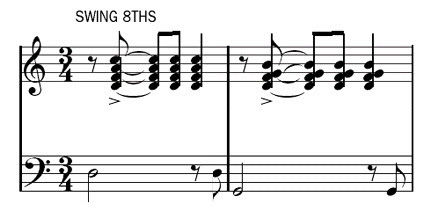
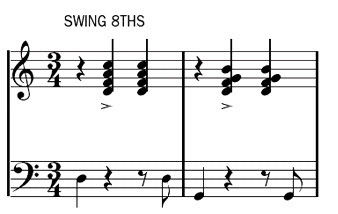
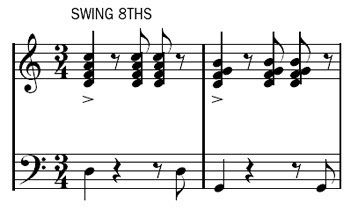
94Which of the following BEST represents a keyboard accompaniment rhythm for the jazz waltz style?
- A
- B
- C
- D
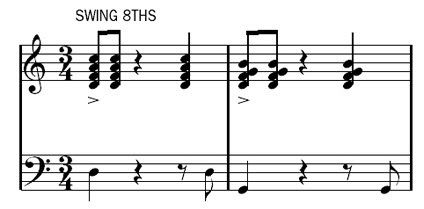
- A
95A music therapist records the following responses after the initial assessment of an infant:
- When the music therapist played a maraca in front of the infant, the infant reached for the maraca.
- When the music therapist played and moved a bell, the infant tracked the bell.
- When the music therapist sang the infant's name, the infant kicked his legs and smiled.
What domain is the music therapist primarily assessing?- Acognitive
- Bsensorimotor
- Cphysiological
- Demotional
96To fully assess a client for music therapy services, a music therapist should use
- Aa variety of musical assessment procedures.
- Bnon-musical standardized assessment tools.
- Cboth musical and non-musical assessments.
- Dexisting assessment tools and procedures.
97A music therapist is working in a hospital with an older adult patient who has Generalized Anxiety Disorder and a low tolerance for pain. The patient will be undergoing a painful medical procedure and expresses that she wants her children in the room with her during the procedure. She appears anxious before the procedure starts and is verbalizing that she is afraid of how much it is going to hurt. The music therapist should
- Aimprovise music to distract the patient from her anxiety, and redirect her focus to the procedure.
- Buse familiar music to engage the patient and decrease her fears so her pain perception will be diminished.
- Cinvite the family members to participate by singing along so the patient feels supported.
- Dtalk the patient through the procedure and provide relaxing music after it is completed.
98In inpatient pediatric medical care, children may begin to experience developmental delays or regression. This is MOST likely a result of
- Along-term hospitalization.
- Bpsychotropic drug use.
- Cunresolved feelings of anger.
- Dlack of interaction with peers.
99A music therapist is facilitating a song choice and discussion intervention for adolescents in an inpatient psychiatric setting. One of the adolescents is new to the unit, and although verbal and articulate during an individual assessment, he declines to share within the group, even when his preferred song is played. The MOST likely reason for this behavior is that the adolescent
- Amay be guarded and not willing to share because he does not yet feel comfortable with others in the group.
- Bhas low tolerance for the song choices of others in the group and is being quiet out of frustration.
- Chas difficulty expressing his thoughts, feelings, and insights and may not have anything to add to the discussion.
- Dmay be experiencing active symptoms of psychosis in which he has difficulty concentrating on the music.
100When using music to facilitate and enhance functional movements, it is MOST important to provide music that
- Asupports the temporal, spatial, and muscular dynamics of the movement.
- Bhas been chosen by the client as their preferred music for movement.
- Cpromotes movement exploration through varying rhythmic patterns.
- Dprovides a novel experience to motivate, focus, and engage the client.
101In the weekly psychiatry rounds at a residential facility, team members note that a particular client avoids attending music therapy groups but attends art therapy and occupational therapy groups regularly. The music therapist, after discussion with the treatment team and the client, completes a termination plan from music therapy services. Which of the following reasons might be given for termination of services for this particular client?
- AClient was discharged from the facility.
- BClient made minimal progress in goal areas.
- CClient attained therapeutic goals and objectives.
- DClient displayed resistance to music therapy services.
102Exploring the ways in which clients passively accept their circumstances and surrender control in order to make choices and start to consciously take charge of their own lives, is employing principles from which of the following psychotherapeutic models?
- Aexistential therapy
- Bpsychoanalytic therapy
- Ccognitive behavioral therapy
- Dreality therapy
103A music therapist who works with a student once a week in a school setting writes the following in the student’s treatment plan: "The student will make eye contact while simultaneously greeting the music therapist in 3 out of 4 trials for 4 consecutive sessions." This is an example of a
- Along-term objective.
- Blong-term goal.
- Cshort-term objective.
- Dshort-term goal.
104A patient in a geriatric setting tells the music therapist that he enjoys bluegrass music and requests it for the next session. This genre of music is not in the therapist's repertoire. Which of the following is the music therapist's BEST action?
- AAgree to learn bluegrass music for the next session.
- BExplain that this genre is not in the repertoire and suggest alternatives.
- CDismiss this request and sing another genre.
- DInform the client that bluegrass music is available online.
105A 14-year-old boy is referred to an outpatient music therapy group. The group is learning to play a 12-bar blues pattern using guitars, keyboards, and drums. The client's records indicate low self-esteem and difficulty processing auditory information. To engage the client quickly in the group, the therapist should
- Aexplain the chord structure of the 12-bar blues.
- Bplay a drum along with the client in a steady beat.
- Cshow the client how to play the chords in first position on the guitar.
- Dask the client to listen while the group plays through the 12-bar blues.
106In a new music therapy group of recently incarcerated women, a music therapist notices that one of the women is friendly and social with others until the session begins. Once the session begins, she does not want to participate in the music experiences other than to pick a favorite recorded song, and she is unwilling to talk about her feelings and emotions with the other group members. When assessing this client, it would be BEST for the music therapist to explore issues related to
- Afear
- Bresistance
- Cdepression
- Dtrust
107Which of the following would give a music therapist the MOST objective information about the client’s existing abilities?
- Acollaborative work
- Bprompted task
- Cindependent responses
- Dbaseline data
108A music therapist is writing objectives for a client whose goal is to increase self-esteem. Which of the following is an example of a measurable objective?
- A"Client will display a brighter affect over the course of one session by April 15."
- B"Client will improve feelings of worth and belonging by April 15."
- C"Client will state a positive personal quality within one session by April 15."
- D"Client will demonstrate a sense of pride after music improvisation by April 15."
109A music therapist is giving an end-of-the-school-year evaluation report for a 2nd grade student with dyslexia. The music therapist reports that the student has made significant gains during treatment; however, not all goals have been met. The music therapist also reports that the student is having difficulty with several speech sounds and has verbalized feelings of low self-worth. The music therapist's recommendations should include
- Atermination of music therapy services, referral for a speech and language evaluation, and a referral for counseling.
- Bcontinued music therapy services for the next school year, referral for a speech and language evaluation, and a referral for counseling.
- Cintermittent music therapy services for the next school year as needed, referral for an occupational therapy evaluation, and a referral for counseling.
- Dtaking a break from music therapy for a year to focus on speech therapy and emotional concerns.
110A client has met the stated goals and objectives for music therapy, and the treatment team feels the client has received the maximum possible benefit from these services. The client is away on vacation and will not return for 4 weeks. Which of the following is the music therapist's BEST action?
- ASchedule 1 or 2 additional sessions upon the client's return to address closure.
- BNotify the client in writing that music therapy services are terminated.
- CRequest that services be extended for another 3 months to prepare the client.
- DAsk the caregiver to communicate this information to the client.
111As a music therapist sings a hello song to a hospitalized infant, the infant orients to the music therapist's voice, makes eye contact with the music therapist, reaches for the music therapist's hand, and smiles and kicks legs upon hearing the infant's name being sung. Which of the following types of behaviors did the infant successfully display?
- Aauditory perception
- Bexecutive functions
- Cnon-verbal expression
- Dmotor skills
112A music therapist is in a session with an adult patient on an oncology unit at a general hospital. A nurse asks the music therapist to monitor and record the patient's vitals because she needs to attend to another patient. Which of the following is the music therapist's BEST response?
- AAgree to help the nurse monitor and record the patient's vital signs.
- BDecline the nurse's request and keep working with the patient.
- CInform the nurse that this is out of the scope of practice for music therapy.
- DLook for another staff member to record the patient's vital signs.
113A music therapist visits an older adult female with chronic obstructive pulmonary disease (COPD) at a nursing home. The client is tearful and verbalizes feelings of sadness about the recent death of her daughter, repeating the statement "If only God could have done better." What should the music therapist do FIRST to meet the spiritual needs of the client?
- ABegin singing a variety of hymns to support the client's verbalizations.
- BDirect the client in prayer to affirm the client's verbal responses.
- CAsk the client questions about her specific spiritual affiliation.
- DFacilitate fill-in-the-blank song writing using the phrase, "If only God."
114A music therapist is arranging the music therapy setting prior to conducting a reminiscence group for four clients diagnosed with dementia. To facilitate the clients' therapeutic involvement, the BEST arrangement for the chairs is a
- Asemicircle with the therapist facing the group.
- Bstraight line with the therapist facing the group.
- Ccircle with the therapist sitting between the clients.
- Dcircle with the therapist sitting in the middle of the circle.
115A music therapy production is planned for presentation to clients, staff, and guests at an institution. The music therapist is asked to design a printed program providing recognition to the participating clients. The therapist must
- Aprovide a printed program for the clients only.
- Bdecline to print the program because of the potential breach of confidentiality.
- Censure that clients whose names are to be printed have signed a written release form.
- Donly choose clients to participate in the production who will allow the use of their names in the program.
116A hospice patient shares that she is very spiritual and misses the community feeling she experienced while attending worship services on Sundays. Which of the following would BEST address the patient's needs?
- AProvide live spiritual music that the patient enjoys.
- BInvite the chaplain and patient's family to the next session.
- CValidate the patient's thoughts and feelings.
- DStream live worship services online during the session.
117A student with social (pragmatic) communication disorder occasionally verbally interrupts at inappropriate times, becoming disruptive in social settings. To BEST address social language use, the music therapist should first sing a phrase from a song, make eye contact with the student, and then sing
- A"Now it's your turn."
- B"Look at me."
- C"I like to sing."
- D"Let's sing together."
118A music therapist has been jointly treating a client with vascular dementia and the client’s daughter, once a week for one hour. Recently, the client has become more withdrawn, presenting with a reduced emotional response and increased passivity. Despite changes, the daughter continues to encourage the client to be active and engaged, yet the client is agitated and combative. Which of the following is the music therapist’s BEST response?
- AContinue treatment using the music to address agitation and combativeness.
- BDiscontinue treatment as the client’s passivity will increase with disease progression.
- CRemove the daughter from the music therapy session immediately.
- DRe-evaluate the session length and interventions used during music therapy sessions.
119A child with a profound intellectual disability frequently displays self-stimulating behaviors, including moving his fingers in front of his eyes. Which of the following would be the MOST effective use of music to decrease self-stimulating behavior?
- AGive the child a maraca and play preferred music when he shakes the maraca.
- BWithhold preferred music when he moves his fingers in front of his eyes.
- CPlay loud, unfamiliar music during instances of self-stimulating behavior.
- DPlay preferred calming music any time the child moves his fingers in front of his eyes.
120A 10-year-old client with cerebral palsy and above average intellectual functioning has a goal to increase muscle control for independence in self-feeding. A music therapist should use a xylophone-playing experience to address the development of the client's
- Asocialization skills.
- Bcommunication skills.
- Ccognitive skills.
- Dmotor skills.
121Which of the following are the MOST common indicators of pain in a hospice patient who is non-verbal?
- Aanxiety and involuntary movement of the face and jaw
- Btense muscles like clenched fists and facial grimacing
- Crestless behavior and increased verbalizations
- Deyes tightly shut and yawning
122In a group music therapy session on an adult psychiatric unit, a client becomes upset with another and starts to escalate, yelling and threatening to harm him. The music therapist has a good rapport with the angry client. Initially, the music therapist should
- Acall the unit for staff to come and remove him from the session, then discharge him from the group.
- Btell him he needs to leave immediately and follow up with writing a termination note in his chart.
- Cattempt to redirect the client and ask him to communicate his feelings verbally or musically.
- Doffer him hand percussion from which to pick and ask him to improvise feelings with the other client.
123After a music therapist introduces a client to a variety of rhythm instruments, the client is asked to identify each of the instruments as it is being played behind a screen. This exercise requires the patient to practice
- Aaesthetic sensitivity
- Bdivided attention
- Cauditory perception
- Dimpulse control
124Asking a client to play back five notes that were just played on a piano addresses
- Aepisodic memory.
- Bworking memory.
- Csemantic memory.
- Dlong-term memory.
125A music therapist is assessing adult clients with chronic psychiatric needs for possible inclusion in an outpatient music therapy psychosocial rehabilitation group. What is the BEST non-music assessment tool or procedure to use with these clients to determine appropriateness for music therapy services?
- Aa background survey
- Ban individual interview
- Can intelligence test
- Da personality inventory
126During a music therapy session, a 52-year-old inpatient describes his plans to kill his ex-wife. The music therapist should
- Amaintain confidentiality and not share this information with anyone.
- Bcontact the family of the ex-wife and request that they tell her in person.
- Cpost the patient's intention on the Internet to warn the public of the potential threat.
- Dconsult federal, state, and local regulations and organizational policies and procedures to determine what to do.
127A recently board-certified music therapist will begin to facilitate an outpatient support group for cancer patients at a local hospital. She has a variety of patients in the group, including patients recently diagnosed, those currently undergoing treatment, and cancer survivors. Which of the following is the music therapist's BEST action to prepare for the first group?
- AReview current research and literature in music therapy related to cancer care.
- BAttend rounds on the oncology units to meet with physicians and nurses.
- CFind music activities online that are appropriate for adults in cancer treatment.
- DInterview other music therapists who work with cancer patients and survivors.
128A music therapist in private practice has been asked to complete a music therapy assessment for a first grade student enrolled in a public school who has an Individualized Educational Program (IEP). In order to BEST communicate the results of the assessment, the music therapist should
- Acomplete a written report, and email it to the school principal.
- Btelephone the school IEP team leader and summarize the assessment results.
- Cattend the IEP meeting to give a written and oral summary of the results.
- Dgive a written report to the parent who can pass it on the IEP team.
129A music therapist in a hospice setting is supervising a music therapy intern who is halfway through the internship. The intern has had two visits with his first patient with amyotrophic lateral sclerosis (ALS). The patient is declining quickly and can no longer speak or swallow. The intern appears increasingly distraught and has begun creating excuses to avoid returning to this patient. The supervisor has learned that the intern's father was recently diagnosed with ALS. The supervisor should
- Areassign the patient to another therapist.
- Boffer support and guidance.
- Cencourage the intern to share his personal experience with the patient.
- Drefer the intern to the local ALS chapter.
130A music therapy experience that requires a client to recall information and events is addressing which of the following types of memory?
- Asensory
- Bprocedural
- Cworking
- Dexplicit
Información
- Descripción
- Praxis Music therapy Test sobre Music Therapy Practice Exam (with explanations), creado por Hannah Rebecca el 27/11/2018.
- Autor
- Hannah Rebecca
- Idioma
- English
- Visitas
- 3.320
- Etiquetas
- Valoración
- 5,0 de 5 · 3 valoraciones Valora este test