
Test
Forensics Final MCQs 2- 5th Year PMU
Este test tiene tipos de pregunta que se abren en el reproductor de siempre.
Preguntas del test (65)
1Which one of these are correct?
- AThe presence of petechial haemorrhages does not automatically point to asphyxia as a cause of death
- BThe presence of petechial haemorrhages automatically points to asphyxia as a cause of death
2Which one of these are correct?
- AMore recently still the arm lock has been used as means of restraint by law enforcement officers, sometimes with fatal results
- BMore recently still the arm lock has been used as means of restraint by law enforcement officers, not causing death due to asphyxia
3Which one of these are correct?
- AAirway obstruction is a contributory factor in some hangings where the hyoid bone and tongue are pushed upwards and backwards against the laryngo-pharynx. This type of obstruction produces “air hunger” which is a frightening sensation and a feature of vascular compression in the neck
- BAirway obstruction is a contributory factor in some hangings where the hyoid bone and tongue are pushed upwards and backwards against the laryngo-pharynx. This type of obstruction produces “air hunger” which is a frightening sensation and is not a feature of vascular compression in the neck
4Which one of these are correct?
- ALigature strangulation can be defined as a circumferential squeezing of the neck which is dependent of the gravitational weight or suspension of the head
- BLigature strangulation can be defined as a circumferential squeezing of the neck which is independent of the gravitational weight or suspension of the head
5Which one of these are correct?
- AThe ligature mark is a vital part of the evidence as it often reproduces the pattern and dimensions of the ligature itself
- BThe ligature mark is a vital part of the evidence as it often reproduces the colour and material of the ligature itself
6Which one of these are correct?
- AHanging is usually suicidal, in some cases it may be accidental, particularly those related to autoerotic asphyxiation
- BHanging is always suicidal
7Which one of these are correct?
- AExternal appearances of strangulation are injuries to the larynx; laryngeal bleeding; intramuscular bleeding; intimal carotid artery laceration — Amussat's sign; Simons's bleeding; Hangman’s fracture
- BInternal appearances of strangulation are injuries to the larynx; laryngeal bleeding; intramuscular bleeding; intimal carotid artery laceration — Amussat's sign; Simons's bleeding; Hangman’s fracture
8Which one of these is correct?
- AHangings that involve free swinging result in an almost instantaneous death due to sudden pressure on the neck arteries. If a long drop is involved the cervical spine may be broken
- BHangings that involve free swinging result in an almost instantaneous death due to sudden pressure on the neck arteries. If a long drop is involved, the cervical spine is always broken
9Which one of these is correct?
- AWhen oxygen is not able to reach the lungs because of occlusion of the mouth and / or nose, or the airway at the level of the larynx is obstructed (eg by a bolus of food), the cause of the asphyxial death is 'obstruction of the airways’
- BWhen oxygen is not able to reach the lungs because of occlusion of the mouth and/ or nose, or the airway at the level of the larynx is obstructed (eg by a bolus of food), the cause of the asphyxial death is strangulation
10Which one of these is correct?
- ARestraint asphyxia is a variant in which chest, diaphragm and accessory muscles are impaired by the act of physical restraint
- BRestraint asphyxia is a variant in which chest, diaphragm and strap muscles are impaired by the act of physical restraint
11Which one of these is correct?
- AManual strangulation can be both homicidal and suicidal
- BManual strangulation is always homicidal
12Which one of these is correct?
- AThe location of the hanging mark is situated higher on the neck, usually being directly under the chin anteriorly, passing round beneath the jaw-bones and rising up at the sides or back of the neck to the usual gap under the knot
- BThe location of the ligature mark is situated higher on the neck, usually being directly under the chin anteriorly, passing round beneath the jaw-bones and rising up at the sides or back of the neck to the usual gap under the knot
13Which one of these is correct?
- AAmussat’s sign is a laceration of the intimal carotid artery
- BAmussat’s sign is a laryngeal bleeding
14Which of these is correct?
- AHangman’s fracture is an internal appearance in strangulation
- BHangman s fracture is an external appearance in strangulation
15Which of these is correct?
- AThe appearance of finger indentations around the neck area indicates manual strangulation
- BThe appearance of finger indentations around the neck area indicates chest compression
16Which of these is correct?
- AMechanism of death is a physical abnormality produced by cause of death that is incompatible with life
- BThe cause of death is a physical abnormality produced by the mechanism of death
17Which of these is correct?
- ACause of death is a disease or an injury that initiates the events that led to death
- BMechanism of death is a disease or an injury that initiates the events that led to death
18Which of these is correct?
- AThe external examination at autopsy includes examination of each organ in the body cavities
- BThe external examination at autopsy includes the age, sex, race, physique, height, weight and nourishment of the deceased
19Which of these is correct?
- AThe internal examination at autopsy includes examination of each organ in the body cavities
- BThe internal examination at autopsy includes the age, sex, race, physique, height, weight and nourishment of the deceased
20Which one of these is correct?
- AThe bruise is a leakage of blood from ruptured small vessels (veins or arterioles) into the surrounding tissues
- BThe bruise is a settling of blood into the lowermost blood vessels under gravity after the circulation ceases
21Which one of these is correct?
- AAbrasions are injuries involving superficial layers of the skin - the epidermis or mucus membrane due to impact against some hard, blunt, and rough object
- BAbrasions are injuries involving the full thickness of the skin - epidermis or mucus membrane due to impact against some hard, blunt, and rough object
22Which one of these is correct?
- AAfter 7-10 days the colour of the scab of an abrasion is reddish — brown
- BAfter 2-3 days the colour of the scab of an abrasion is reddish — brown
23Which one of these is correct?
- ALaceration is a leakage of blood from ruptured small vessels into the surrounding tissues
- BLaceration is a full thickness tearing of the skin (or other tissue) due to stretching, pinning and crushing of tissues by blunt force trauma
24Which one of these is correct?
- ALacerated wounds are characterised by ragged edges, bruising of skin and tissue bridges
- BAbrasions are characterised by ragged edges, bruising of skin and tissue bridges
25Which one of these is correct?
- ALacerated wounds heal by scarring
- BLacerated wounds heal by scabbing
26Which one of these is correct
- AThe lacerated wound is due to blunt force
- BThe lacerated wound is due to sharp force
27Which one of these is correct?
- ATissue bridges in depth of lacerated wound are intact nerves, vessels and tendons
- BTissue bridges in depth of cut wound are intact nerves, vessels and tendons
28Which one of these is correct?
- AHealing of wound is through three phases - phase of inflammation, phase of proliferation and phase of scar formation and remodeling
- BHealing of wound is through three phases - phase of inflammation, phase of proliferation and phase of scab formation and remodeling
29Which of these is correct?
- AAbrasions are injuries involving superficial layers of the skin - epidermis or mucus membrane, due to impact against some hard, blunt and rough object / weapon
- BLacerations are injuries involving superficial layers of the skin - epidermis or mucus membrane, due to impact against some hard, blunt and rough object / weapon
30Which one of these is correct?
- ATissue bridges are intact edges
- BTissue bridges are intact nerves, vessels and tendons
31Which one of these is correct?
- ALaceration is not a full thickness tearing of the skin (or other tissue) due to stretching, pinning and crushing of tissues by blunt force trauma
- BLaceration is a full thickness tearing of the skin (or other tissue) due to stretching, pinning and crushing of tissues by blunt force trauma
32Which one of these is correct?
- AEarly changes take place between the first 12 to 24 hours
- BEarly changes take place between the first 24 to 48 hours
33Which one of these is correct?
- AEarly changes are changes of the skin and mucous membranes, body cooling, rigor mortis and Llivor mortis
- BEarly changes are changes of the skin and mucous membranes, body cooling, rigor mortis and adipocere
34Which one of these is correct?
- ALate changes take place after 24 hours
- BLate changes take place between the first 24 to 48 hours
35Which one of these is correct?
- ALate changes are putrefaction, mummification and adipocere
- BLate changes are putrefaction, mummification and livor mortis
36Which one of these is correct?
- AThe "Spot of the Larche” is a dark discoloration of a portion of sclera exposed to air
- BThe ,"Spot of the Larche” is a hemorrhage associated with strangulation
37Which one of these is correct?
- AThe "Spot of the Larche” is an early post-mortem change
- BThe "Spot of the Larche” is a hemorrhage associated with strangulation
38Which one of these is correct?
- AThe "Spot of the Larche” is a dark discoloration of a portion of sclera exposed to air
- BThe "Spot of the Larche” is a late post-mortem change
39Which one of these is correct?
- AThe incised wound is a clean division of the full thickness of skin (or other tissue) under the pressure of a sharp-edged weapon
- BThe incised wound results from hacking or chopping motion made with a fairly sharp and relatively heavy weapon
40Which one of these is correct?
- AThe incised wound is deeper than it is long due to a Swipe action
- BThe incised wound is longer than it is deep due to a Swipe action
41Which one of these is correct?
- AThe incised wound reflects weapon type, not sharp edge
- BThe incised wound reflects sharp edge, not weapon type
42Which one of these is correct?
- ADefence wounds are due to the immediate & instinctive reaction of the Victim to save himself/ herself, either by raising the arm to prevent the attack, or by grasping the weapon
- BHesitation wounds are due to the immediate & instinctive reaction of the victim to save himself, either by raising the arm to prevent the attack, or by grasping the weapon
43Which one of these is correct?
- AHesitation wounds are signs of a homicide
- BHesitation wounds are signs of a suicide
44Which one of these is correct?
- APenetrating wounds are caused by separation of the skin and soft tissues under the pressure of a sharp or blunt pointed instrument
- BIncised wounds are caused by separation of the skin and soft tissues under pressure of a sharp or blunt pointed instrument
45Which one of these is correct?
- AA straight in and out stab wound is slightly shorter than the width of the blade due to stretching of the skin over the point of the knife on insertion and elastic recoil withdrawal
- BA straight in and out stab wound is slightly longer than the width of the pace due to stretching of the skin over the point of the knife on insertion and elastic recoil withdrawal
46Which one of these is correct?
- AStab wound width must be assessed with the edges taped together because the wound is often shortened and widened into an ellipse by skin elasticity and underlying muscle tone
- BStab wound width must be assessed with the edges not taped together because the wound is often shortened and widened into an ellipse by skin elasticity and underlying muscle tone
47Which one of these is correct?
- AThe best indicator of blade width is the shortest (least rocking), deepest wound (weapon fully inserted)
- BThe best indicator of blade width is the longest (most rocking), deepest wound (weapon fully inserted)
48Which one of these is correct?
- AFirearm injuries occur when someone is shot by a bullet or other sort of projectile from a firearm
- BFirearm injuries occur when someone is hit with the handle of a pistol
49Which one of these is correct?
- AThe kinetic energy of a bullet is proportional to mass and velocity
- BThe kinetic energy of a bullet is proportional to deformation and fragmentation
50Which one of these is correct?
- ASkin defect is due to passing of the projectile through the skin
- BSkin defect is due to deposition of soot from partially burnt gases
51Which one of these is correct?
- AForward motion of bullet indents the skin and abrades the margin of exit wound
- BForward motion of bullet indents the skin and abrades the margin of entry wound
52Which one of these is correct?
- ATattooing is a deposition of soot from partially burnt gases
- BSmudging is a deposition of soot from partially but gases
53Which one of these is correct?
- AAn entry wound is typically larger and more irregular than an exit one due to bullet tumbling and deformation
- BAn exit wound is typically larger and more irregular than an entry one due to bullet tumbling and deformation
54Which one of these is correct?
- AMuzzle impression is due to the skin impact against muzzle produced by discharge gases in distant wound
- BMuzzle impression is due to the skin impact against muzzle produced by discharge gases in contact and near contact wounds
55Which one of these is correct?
- ALubricant and debris on bullet surface wipe off onto the wound edge and produce abrasion ring
- BLubricant and debris on bullet surface wipe off onto the wound edge and produce grey ring
56Which one of these is correct?
- AA contact entry wound is generally large and cruciate ( stellate, or star shaped), due to explosive effects of the gases liberated
- BA contact entry wound is generally small and cruciate ( stellate, or star shaped), due to explosive effects of the gases liberated
57Which one of these is correct?
- AA distant entry wound is produced by mechanical action of bullet penetration of skin only
- BA near entry wound is produced by mechanical action of bullet penetration of skin only
58Which one of these is correct?
- AThe entry wound shows a punched clean hole in the outer table of the skull
- BThe exit wound shows a punched clean hole in the outer table of the skull
59Which one of these is correct?
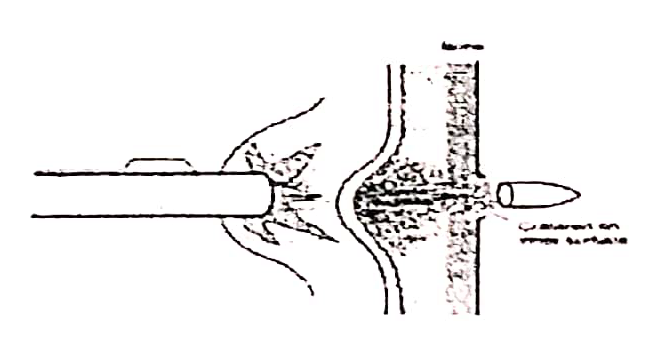
- AThis scheme shows contact range of fire
- BThis scheme shows distant range of fire
60Which one of these is correct?
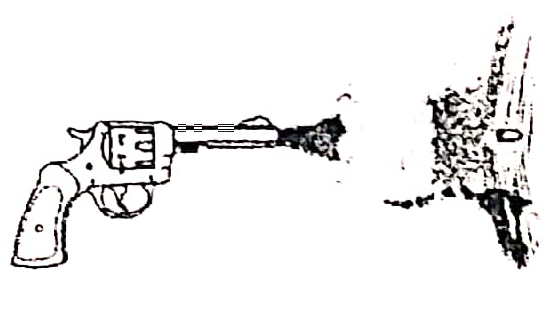
- AThis scheme shows near range of fire
- BThis scheme shows distant range of fire
61Medicolegal case. After familiarizing yourself with the autopsy - external and internal examination, answer the following questions:
In external exam of the cadaver of a young girl the following signs are found- petechial haemorrhages of the skin, eyelids, conjunctiva and sclera and finger-nail scratches on the neck.
In internal exam of the cadaver the following signs are found - petechial haemorrhages of the heart with subepicardial localization and of the lungs with subpleural localization intramuscular bleeding in the neck and fractures of hyoid bone and larynx.
1. What is the mechanism of death?- [blank_start]Asphyxia[blank_end]
2. What is the cause of death?- [blank_start]Contriction of the soft tissues[blank_end] of the neck by [blank_start]manual strangulation[blank_end]
3. Determine the manner of death - homicidal, suicidal or accidental?- [blank_start]Homicidal[blank_end]- AAsphyxia
- BContriction of the soft tissues
- Cmanual strangulation
- DHomicidal
62Medicolegal cause. After familiarizing yourself with the crime scene circumstances and the autopsy - internal andexternal examination, answer the following questions:
A deceased naked young girl with visible bruises on the breast, thighs and neck with the following characteristics — oval form and red colour. There are finger scratches on the neck, covered by a reddish scab. On the back of the dead body tramline bruises with yellowish colour are found.
1, What is the most probable mechanism of death?- [blank_start]Asphyxia[blank_end]
2. What is the most probable cause of death?- [blank_start]Manual Strangulation[blank_end]
3. What is the most probable manner of crime?- [blank_start]Rape[blank_end]
4. Distinguish the dating of the damages.- AAsphyxia
- BManual Strangulation
- CRape
63Medicolegal cause. After familiarizing yourself with the crime scene circumstances and the autopsy - internal andexternal examination, answer the following questions:
A dead body with a wound on the neck is found. The margins of the wound are clean-cut well defined, the large blood vessels are severed, there are multiple shallow incised wounds on the left wrist, blood soaked clothes, blood staining and spattering of surroundings, blood staining of the knife.
1. What is the mechanism of death?- [blank_start]Loss of Blood[blank_end]
2. What is the cause of death?- [blank_start]Severance[blank_end] of neck [blank_start]vessels[blank_end]
3. What is the most probable manner of death - homicidal, suicidal or accidental?- [blank_start]Suicidal[blank_end]- ALoss of Blood
- BSeverance
- Cvessels
- DSuicidal
64Medicolegal case. After familiarizing yourself with the autopsy - internal and external examination, answer the following questions:
There is a star-shaped skin defect on the right temple and an abraded ring. The edges of the skin defect are inverted. The adjacent tissues are cherry- red in colour. Around the skin defect there is a muzzle impression. The nght hand and the face are blood stained. There is a wound on the left temple which ts smaller in size than the skin defect.
The edges of this wound are everted. The colour of the surrounding tissues is dark red. During the crime scene investigation a pistol and a letter from the deathbed are found.
Internal examination:
During the check of the skull two defects are found- the first one of them is on the right temple area and shows a punched clean hole in the outer table. The inner table has a cone-shaped piece of bone. It is detached forming a crater that is larger than the hole on the outer table. The defect on the left temple area shows a contrary feature. There is severe cerebral damage.
What is the cause of death?- [blank_start]firearm injury[blank_end]
What is the mechanism of death?- severe [blank_start]cerebral damage[blank_end]
What is the most probable manner of death?- [blank_start]suicidal[blank_end]
What is the range of fire?- [blank_start]contact range[blank_end]
What is the direction of the fire?- from the [blank_start]right[blank_end] temple to the [blank_start]left[blank_end] temple- Afirearm injury
- Bcerebral damage
- Csuicidal
- Dcontact range
- Eright
- Fleft
65Case:
A dead body with a wound on the neck is found. The margins of the wound are clean-cut, well defined, the large blood vessels in the area of the wound are severed, there are multiple shallow incised wounds only on the left wrist, blood soaked clothes, blood staining. and spattering of surroundings, blood staining of the knife, found near the corpse.
Questions:
What is the most probable cause of death?- [blank_start]Incision[blank_end]
What is the mechanism of death?- [blank_start]Loss of blood[blank_end]
What is the manner of death?- [blank_start]Suicide[blank_end]- AIncision
- BLoss of blood
- CSuicide
Información
- Descripción
- Forensics Final MCQs 2- 5th Year PMU
- Autor
- Med Student
- Idioma
- English
- Visitas
- 1.130
- Etiquetas
- Valoración
- Aún sin valoraciones Valora este test