
Test
Part 1-US History EOC Review Test
Preguntas del test (38)
1Most historians consider Alexander Hamilton to have been a successful Secretary of the Treasury because he
- Aexpanded trade with all nations
- Bestablished a sound financial plan for the new nation
- Celiminated tariffs between the states
- Dopposed payment of previous federal government debts
2As Secretary of the Treasury, Alexander Hamilton was most noted for
- Adevising a plan to pay off the nation's debts
- Bbeginning a system to tax exports
- Carranging necessary loans from European nations
- Draising revenue from the sale of western lands
3One major reason that Alexander Hamilton proposed a national bank was to
- Aimprove the economic position of the United States government
- Bhelp state governments collect taxes
- Cmake loans available to owners of small farms
- Dreduce foreign investment in the United States
4One reason James Madison and Thomas Jefferson objected to Alexander Hamilton's financial policies was that they believed
- Athe establishment of a national bank was unconstitutional
- Ba laissez-faire policy would not help the country's economy
- Cthe government should encourage industrial development
- Dhigh tariffs were needed to protect America's economic interests
5Which action during Washington's administration led to the Whiskey Rebellion in western Pennsylvania?
- Apassage of a new excise tax
- Bestablishment of a presidential cabinet
- Ccreation of the Bank of the United States
- Dban on slavery in the Northwest Territory
6Conflicts between Jeffersonians and Hamiltonians during President George Washington's first administration led directly to the
- Aend of the Era of Good Feelings
- Bdecision to replace the Articles of Confederation
- Caddition of the elastic clause to the Constitution
- Dstart of the first political parties
7-Alien and Sedition Acts
-Virginia and Kentucky Resolutions
These pieces of legislation reflected the conflict between- ACongress and the president
- Bstates' rights and federal supremacy
- Cthe military and the civilian government
- Dthe United States Supreme Court and the state courts
8The decision in Marbury v. Madison (1803) expanded the power of the Supreme Court by
- Arestricting the use of the elastic clause
- Bestablishing the power of judicial review
- Cupholding the constitutionality of the National Bank
- Dinterpreting the interstate commerce clause
9How did Supreme Court decisions under Chief Justice John Marshall affect government in the United States?
- AFederal power increased at the expense of the states.
- BStrict limits were placed on congressional use of the elastic clause.
- CThe impeachment of federal judges was declared unconstitutional.
- DState powers under the 10th Amendment were expanded.
10On what grounds would strict constructionists of the United States Constitution have questioned the purchase of the Louisiana Territory?
- AIt violated the guarantee of stats' rights
- BThe president was not specifically given the power to purchase new land.
- CCongress was opposed the expansion west of the Mississippi River.
- DThe Constitution applied only to the original thirteen states
11How did President George Washington react to the conflict between France and England in 1793?
- AHe used the opportunity to begin the war for American independence.
- BHe declared the neutrality of the United States.
- CHe aided the French because they had supported the American Revolution.
- DHe negotiated a peace settlement between the warring nations.
12"'Tis [It is] or true policy to steer clear of permanent alliances with any portion of the foreign world...."
-----President George Washington, Farwell Address, 1796
The United States was able to follow this advice from President Washington for several decades primarily because of- Aindustrial and agricultural self-sufficiency
- Bstrong support from other Western Hemisphere nations
- Cgeographic isolation from Europe
- Dpeaceful relations between the European powers
13The foreign policies of George Washington, Thomas Jefferson, and James Monroe were similar in that they each
- Asupported wars against England
- Bfailed to acquire new territory
- Cattempted to avoid involvement in European affairs
- Daided the French in return for their help during the Revolutionary War
14Which is an example of the concept of Manifest Destiny in action?
- AThe Missouri Compromise
- Bthe annexation of Mexican territory
- Cthe Transatlantic Slave Trade
- Dthe Compromise of 1850
15During the first half of the 19th century, territorial expansion led to
- Aincreased tensions over slavery
- Bimproved relations with bordering nations
- Cfewer conflicts with Native American Indians
- Ddecreased domestic demand for manufactured goods
16In the mid-1800s, the growth of the populations of California and the western territories was mainly a result of the
- Adiscovery of gold and silver
- Bopening of the Panama Canal
- Cmigration of freedmen after the Civil War
- Dsecession of the Southern states
17As a result of President Andrew Jackson's policies, Native American Indians were
- Arelocated to reservation in Mexico
- Bforcibly removed to areas west of the Mississippi River
- Cgradually allowed to return to their ancestral lands
- Dgiven United States citizenship
18Why were James Fennimore Cooper's novels "The Last of the Mohicans" and "The Pathfinder" considered the first "American" novels?
- ACooper focused on themes of the frontier that were prominent in American culture.
- BCooper imitated the formal style of European essays.
- CCooper wrote on the current political themes of abolition and temperance.
- DCooper used European attitudes and values to form his American themes.
19Prior to 1850, what was a main reason the North developed and economy increasingly based on manufacturing while the South continued to rely on an economy based on agriculture?
- AProtective tariffs applied only to northern seaports.
- BGeographic conditions supported different types of economic activity.
- CSlavery in the North promoted rapid economic growth.
- DManufacturers failed to make a profit in the South
20Which group's numbers increased the most as a result of the industrial Revolution?
- Askilled craftsmen
- Blanded aristocracy
- Curban middle class
- Downers of small farms
21Which statement describes a result of the Industrial Revolution in the United States?
- AFarm production decreased.
- BSlavery in the South increased.
- CThe population of the cities decreased.
- DImmigration to the United States increased.
22In an outline, which main topic would include the other three?
- AErie Canal
- B19th-Century Internal Improvements
- CTranscontinental Railroad
- DNational Road
23What economic change resulted from the transportation revolution before the Civil War?
- AThe Northeast became better connected to the western section of the country
- BTrade between the United States and Europe was sharply reduced.
- CThe system of slavery on southern plantations began to disappear.
- DThe federal government began to regulate new businesses
24The Major purpose of the Monroe Doctrine (1823) was to
- Acreate a military alliance for the defense of North America
- Bguarantee democratic governments in Latin America
- Csecure new colonies in the Caribbean
- Dlimit European influence in the Western Hemisphere
25From 1820 to 1865, the debates over nullification, protective tariffs, and the spread of slavery into the new territories concerned the constitutional issue of the
- Abalance of power between the federal and state governments
- Bbalance between rights of individuals and the need to maintain order
- Cprotection of the rights of ethnic and racial groups
- Dseparation of power between the executive and legislative branches
26President Andrew Jackson claimed that use of the spoils system increased democracy in the federal government because it
- Aremoved property-holding qualifications for voting
- Blimited the role of the Electoral College in presidential elections
- Callowed larger numbers of citizens to hold office
- Dused nominating conventions to pick political party candidates
27 The Declaration of Sentiments from the Seneca Falls Convention of 1848 proclaimed that
- Athe abolition of slavery was necessary
- Ball men and women are created equal
- CCalifornia should be admitted as a free state
- Dthe sale of alcoholic beverages should be illegal
28Base your answer to question 28 on the information below and on your knowledge of social studies.
To the Honorable Senate and House of Representatives in Congress Assembled, We the undersigned, citizens of the United States, but deprived of some of the privileges and immunities of citizens among which, is the right to vote, beg leave to submit the following resolution: Resolved; that we the officers and members of the National Woman Suffrage Association, in convention assembled, respectfully ask Congress to enact appropriate legislation during its present session to protect
women citizens in the several states of this Union, in their right to vote.
— Susan B. Anthony, Matilda Joslyn Gage, and Elizabeth Cady Stanton (1873) Source: National Archives and Records Administration
This resolution illustrates the constitutional right to- Apetition for redress of grievances
- Bprotection against unreasonable search and seizure
- Ca speedy and public trial
- Dfreedom of religion
29 During the 1840s, abolitionists opposed annexation of new western territory because they
- Afeared the admission of new slave states
- Bwanted to limit the power of the national government
- Cwere concerned with the legal rights of Native American Indians
- Dsupported an isolationist foreign policy
30“A house divided against itself cannot stand. . . . I do not expect the Union to be dissolved; I do not expect the house to fall; but I do expect it will cease to be divided. It will become all one thing or all the other. . . .”
— Abraham Lincoln, 1858
The “divided house” referred to in this speech was caused primarily by- Aexpansionism
- Bwar with Mexico
- Cslavery
- Dthe suffrage movement
31The Missouri Compromise (1820), and the Compromise of 1850 were both efforts to
- Aend fighting between Midwestern farmers and Native American Indians
- Bencourage manufacturing in the West
- Cincrease the number of people who voted in presidential elections
- Dsettle disputes over the spread of slavery to the western territories
32In the Kansas- Nebraska Act of 1854, popular sovereignty was proposed as a way to
- Aallow northern states the power to ban slavery
- Bdeny southern states the legal right to own slaves
- Callow settlers in new territories to vote on the issue of slavery
- Doverturn previous Supreme Court decisions on slavery
33Base your answer to question 33 on the poster to the left and on your knowledge of social studies.
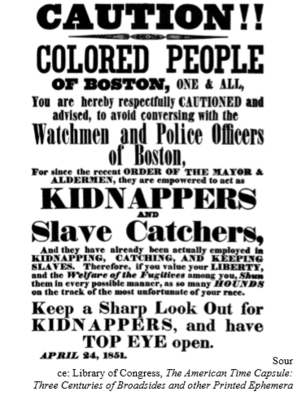
- Apassage of the fugitive slave law
- Bstart of the Civil War
- Cissuance of the Emancipation Proclamation
- Denactment of the 13th Amendment
34One way that “Bleeding Kansas,” the Dred Scott decision, and John Brown’s raid on Harper’s Ferry had a similar effect on the United States was that these events
- Aended conflict over slavery in the territories
- Beased tensions between the North and the South
- Ccontributed to the formation of the Whig Party
- Dmade sectional compromise more difficult
35 “. . . Liberty and Union, now and forever, one and inseparable!”
— Daniel Webster, 1830
The principle expressed in this statement was also reflected in- AThomas Jefferson’s call for nullification of the Alien and Sedition Acts
- BFederalist Party threats during the War of 1812
- CJohn Calhoun’s defense of States rights
- DAbraham Lincoln’s attitude toward Southern secession
36 As the Civil War began, President Abraham Lincoln stated that his primary goal was to
- Aend slavery
- Bset new national boundaries
- Cincrease congressional powers
- Dpreserve the Union
37Actions Taken by President Abraham Lincoln during the Civil War
I. Increased the size of the army without congressional authorization
II. Arrested and jailed anti-Unionists without giving a reason
III. Censored some anti-Union newspapers and had some editors and publishers arrested
Which statement is most clearly supported by these actions of President Lincoln?- AWartime emergencies led President Lincoln to expand his presidential powers.
- BPresident Lincoln was impeached for violating the Constitution.
- CChecks and balances effectively limited President Lincoln’s actions.
- DPresident Lincoln wanted to abolish the Bill of Rights.
38 The Civil War affected the northern economy by
- Acausing a severe depression
- Bincreasing unemployment rates
- Cdecreasing demand for agricultural products
- Dstimulating industrialization
Información
- Descripción
- Part 1-US History EOC Review Test
- Autor
- april.robinson.s
- Idioma
- English
- Visitas
- 402
- Etiquetas
- Valoración
- 5,0 de 5 · 1 valoración Valora este test