
Test
BIO 0005 Test #2
Este test tiene tipos de pregunta que se abren en el reproductor de siempre.
Preguntas del test (82)
1When an egg and sperm combine, they form a [blank_start]zygote[blank_end].
- Azygote
2[blank_start]Mitosis[blank_end] is the type of cell division used to repair damaged skin.
- AMitosis
3A [blank_start]chromosome[blank_end] is a single strand of DNA and it's associated proteins.
- Achromosome
4Eight [blank_start]histones[blank_end] come together come together with a strand of DNA to make a nucleosome.
- Ahistones
5DNA must be in it's [blank_start]unpacked[blank_end] state in order to be used for replication.
- Aunpacked
6[blank_start]Chromatin[blank_end] is the collection of DNA and proteins combined in the nucleus.
- AChromatin
7DNA replication is considered to be [blank_start]semi-conservative[blank_end].
- Asemi-conservative
8The cell cycle is a sequence of events during which a cell prepares to divide [blank_start]into daughter cells[blank_end].
- Ainto daughter cells
- Binto sister chromatids
- Cinto gamets
- Dinto homologous chromosomes
9The S phase of mitosis is the event that
- Asister chromatids join to centromere
- Bcytoplasm divides
- Ccell gathers materials for DNA replication
- DDNA is replicated
10At the end of the G2 phase [blank_start]centrosomes[blank_end] form outside the nucleus along with pairs of [blank_start]centrioles[blank_end].
- Acentrosomes
- Bcentrioles
11During interphase, chromatin is [blank_start]still uncondensed[blank_end].
- Astill uncondensed
- Bforming homologous chromosomes
- Ccondensed
- Dnot contained in nucleus anymore
12Interphase contains; [blank_start]46[blank_end] chromosomes and [blank_start]92[blank_end] DNA strands.
- A46
- B92
- C23
- D92
- E23
- F46
13Prophase contains; [blank_start]46[blank_end] chromosomes and [blank_start]92[blank_end] DNA strands.
- A46
- B23
- C96
- D92
- E46
- F23
14Metaphase contains; [blank_start]46[blank_end] chromosomes and [blank_start]92[blank_end] DNA strands.
- A46
- B23
- C96
- D46
- E23
- F92
15Anaphase contains; [blank_start]46[blank_end] chromosomes and [blank_start]92[blank_end] DNA strands.
- A92
- B46
- C23
- D92
- E46
- F23
16Telephase contains; [blank_start]46[blank_end] chromosomes and [blank_start]92[blank_end] DNA strands.
- A46
- B92
- C23
- D92
- E46
- F23
17During prophase, chromatin
- ACondenses into homologous chromosomes
- BCondenses into sister chromosomes
- CCondenses into sister chromatids
- DCondenses into DNA strands
18Check off all the events that occur during prophase.
- ANuclear envelope breaks apart
- BChromatin condenses
- CMotor proteins "walk" along microtubules
- DCentrioles push apart to elongate the cell
- ECentrosomes move apart and start forming spindle fibers
- FSister chromatids float in cytoplasm; attached to microfilaments
- GChromosomes line up at central plate
19What is the name of the phase where sister chromatids line up at the central plate (equator of the cell)?
- AMetaphase
- BMetaphase I
- CMetaphase II
20Label the following diagram
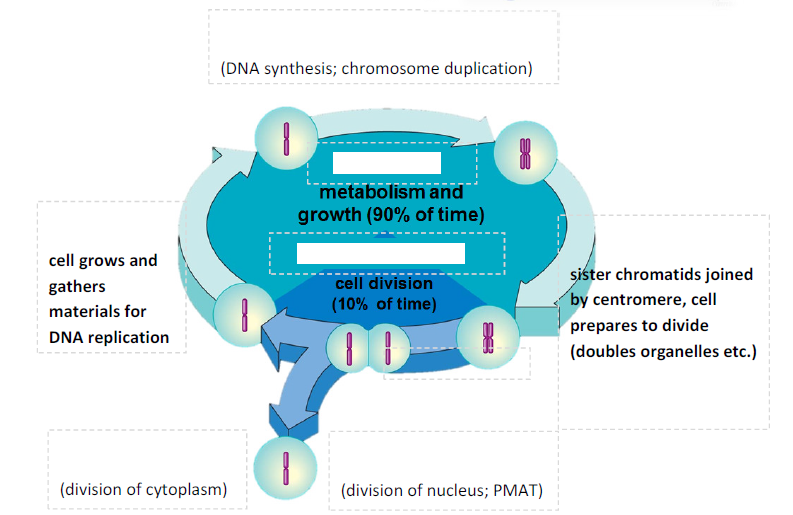
- AS phase
- BG1 phase
- CG2 phase
- Dcytokinesis
- EMitosis
- Finterphase
- Gcytokinesis
- Hmitosis
- IG1 phase
- JG2 phase
- KS phase
- LInterphase
- MS phase
- NG2 phase
- OG1 phase
- PMitosis
- QCytokinesis
- RInterphase
- SMitotic (M) phase
- TMitotic (M) phase
- UMitotic (M) phase
- VS phase
- WG1 phase
- XG2 phase
- YCytokinesis
- ZMitosis
- AAInterphase
- ABMitotic (M) phase
- ACS phase
- ADG1 phase
- AEG2 phase
- AFCytokinesis
- AGMitosis
- AHInterphase
- AIMitotic (M) phase
- AJS phase
- AKG1 phase
- ALG2 phase
- AMCytokinesis
- ANMitosis
- AOMitotic (M) phase
- APInterphase
- AQS pahse
- ARG1 phase
- ASG2 phase
- ATCytokinesis
- AUMitosis
- AVInterphase
- AWMitotic (M) phase
21Mitosis is a form of [blank_start]asexual[blank_end] reproduction.
- Aasexual
22Meiosis is a form of [blank_start]sexual[blank_end] reproduction.
- Asexual
23Cytokinesis is the last phase of the cell cycle.
- AVerdadero
- BFalso
24Interphase is the first phase of the cell cycle.
- AVerdadero
- BFalso
25What happens when a cell spends too little time in interphase?
- ACauses cancer
- BIs treated with radiation
- CDivides really slowly
- DHas no effect on organism
26Meiosis II is nearly identical to mitosis, except for
- Ameiosis has twice the number of chromosomes as mitosis
- Bmitosis has half the number of chromosomes as meiosis
- Cmeiosis has half the number of chromosomes as mitosis
- Dmitosis has twice the number of chromosomes as meiosis
27During interphase before meiosis; cells are [blank_start]diploid[blank_end] in number with [blank_start]92[blank_end] DNA strands.
After meiosis I; cells are [blank_start]haploid[blank_end] with [blank_start]46[blank_end] DNA strands.
After meiosis II; cells are [blank_start]haploid[blank_end] with [blank_start]23[blank_end] DNA strands.- Adiploid
- B92
- Chaploid
- D46
- E(n)
- F23
28Prophase I contains; [blank_start]46[blank_end] chromosomes and [blank_start]92[blank_end] DNA strands.
- A46
- B92
- C23
- D92
- E46
- F23
29Metaphase I contains; [blank_start]46[blank_end] chromosomes and [blank_start]92[blank_end] DNA strands.
- A46
- B92
- C23
- D92
- E46
- F23
30Anaphase I; contains; [blank_start]46[blank_end] chromosomes and [blank_start]92[blank_end] DNA strands.
- A46
- B92
- C23
- D92
- E46
- F23
31Telophase I contains; [blank_start]46[blank_end] chromosomes and [blank_start]92[blank_end] DNA strands.
- A46
- B23
- C92
- D92
- E46
- F23
32Prophase II; contains; [blank_start]46[blank_end] chromosomes and [blank_start]92[blank_end] DNA strands.
- A46
- B23
- C92
- D92
- E46
- F23
33Metaphase II; contains; [blank_start]46[blank_end] chromosomes and [blank_start]92[blank_end] DNA strands.
- A46
- B92
- C23
- D92
- E46
- F23
34Anaphase II; contains; [blank_start]46[blank_end] chromosomes and [blank_start]92[blank_end] DNA strands.
- A46
- B92
- C23
- D92
- E46
- F23
35Telophase II; contains; [blank_start]46[blank_end] chromosomes and [blank_start]92[blank_end] DNA strands.
- A46
- B92
- C23
- D92
- E46
- F23
36Gamete cells are [blank_start]haploid[blank_end] cells with [blank_start]23[blank_end] chromosomes.
Somatic cells are [blank_start]diploid[blank_end] cells with [blank_start]46[blank_end] chromosomes.- Ahaploid
- B23
- Cdiploid
- D46
37When do homologous chromosomes exchange genetic information?
- AProphase
- BProhase I
- CProhase II
38What is the name of the phase where homologous chromosomes line up at the central plate (equator of the cell)?
- AMetaphase
- BMetaphase I
- CMetaphase II
39Maternal and Paternal chromosomes line up randomly are positioned [blank_start]randomly[blank_end] on either side of the equatorial plate.
- Arandomly
40At what point are homologous chromosomes considered tetrads?
- AWhen they are exchanging genetic information
- BWhen they are duplicating
- CWhen they are separating
- DWhen they are attached via spindle fibers
41What key events occur during anaphase I
- AHomologous chromosomes separate to opposite poles of the cell
- BSister chromatids separate to opposite poles of the cell
- CDaughter chromosomes separate to opposite poles of the cell
- DSpindle fibers elongate the cell
- ESpindle fibers attach to each centrioles pulling on chromosomes
- FSpindle fibers attach to each centromere pulling on chromosomes
42Interphase occurs between meiosis I and meiosis II
- AVerdadero
- BFalso
43What methods are used to treat cancer?
- AMastasis
- BChemotherapy
- CSlashing
- DSurgery
- EPoison
- FIntravenous fluid
- GRadiation
44A group of interbreeding organisms of the same species.
- APopulation
- BGene pool
- CAllele frequency
- DEvolution
45All of the different genes and alleles in a population.
- AGene pool
- BEvolution
- CAllele Frequency
- DPopulation
46The number of copies of a specific allele relative to all the alleles for the same gene in a population.
- AAllele frequency
- BGene pool
- CPopulation
- DEvolution
47Evolution occurs at the population level
- AVerdadero
- BFalso
48Changes in genetic characteristics of a population over time - potentially creating a new species
- ADescent with modification
- BAdaptations
- CEvolution
- DMutation
49The reproductive success "fitness" of specific alleles causes [blank_start]evolution[blank_end].
- Aevolution
50[blank_start]Adaptation[blank_end]; features of an organism with a selective advantage.
- AAdaptation
- BEvolution
- CNatural selection
- DMutation
51Cytokinesis is the division of the [blank_start]cytoplasm[blank_end] and the [blank_start]organelles[blank_end].
- Acytoplasm
- Borganelles
52In a pair of [blank_start]chromosomes[blank_end], there are two [blank_start]chromatids[blank_end] united in the center by a centromere.
[blank_start]Sister chromatid[blank_end] is only used during cell division when the structures are in an X-shape (when there are two copies connected by a centromere.
When a centromere joins two [blank_start]non-identical[blank_end] copies of a chromosome (one from each parent); they are called [blank_start]homologous chromosomes[blank_end].- Achromosomes
- Bsister chromatids
- Cchromatids
- Dhomologous chromosomes
- Enon-identical
- Fchromatids
- Gchromosomes
- Hsister chromatids
- Ihomologous chromosomes
- Jnon-identical
- KSister chromatid
- Lchromosomes
- Mchromatids
- Nnon-identical
- Ohomologous chromosomes
- Pnon-identical
- Qchromosomes
- Rchromatids
- Ssister chromatid
- Thomologous chromosomes
- Uhomologous chromosomes
- Vchromosomes
- Wchromatid
- Xsister chromatid
- Ynon-identical
53If nondisjunction happened in a species with 10 chromosomes; how many chromosomes would any abnormal gametes have?
- A6, 4
- B9, 1
- C7, 3
- D12, 8
54Label the following diagram; mix of both meiosis and mitosis.
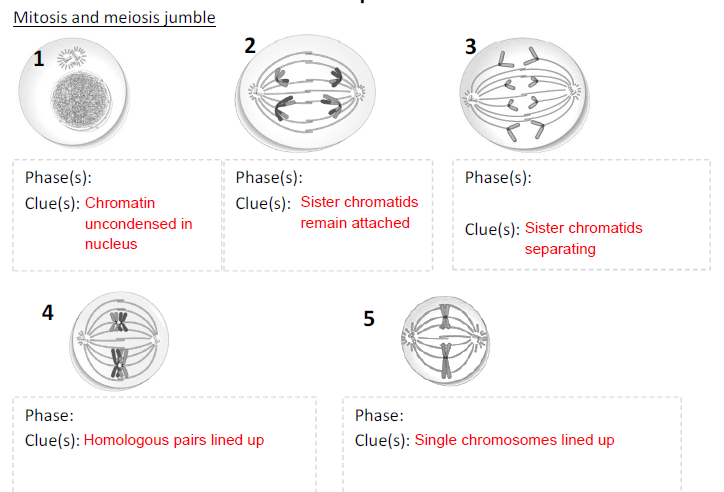
- AInterphase
- BAnaphase I
- CAnaphase or Anaphase II
- DMetaphase I
- EMetaphse or Metaphase II
55Label the following diagram; mix of both mitosis and meiosis.
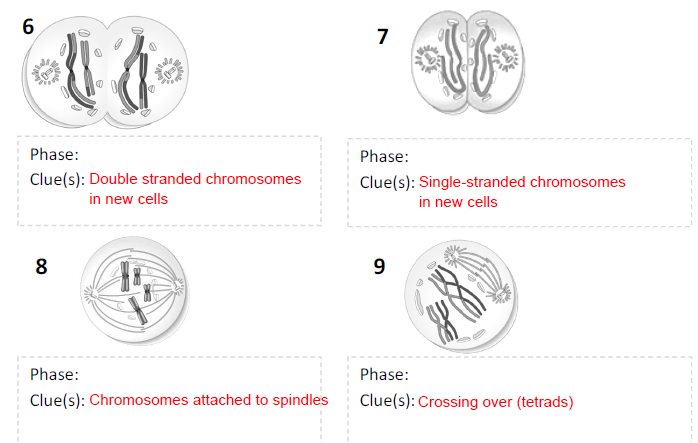
- ACytokinesis/Telophase I
- BCytokinesis/Telophase II
- CProphase or prophase II
- DProphase I
56Label the following diagram
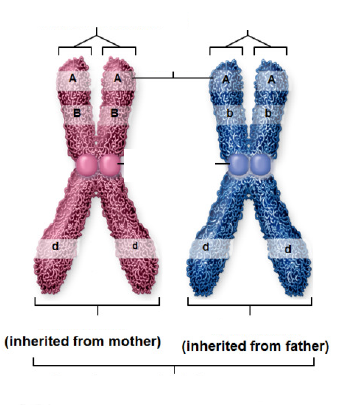
- ASister chromatids
- BSister chromatids.
- CAlleles
- DCentromere
- EChromosome
- FChromosome.
- GHomologous chromosomes
57Label the following diagram.
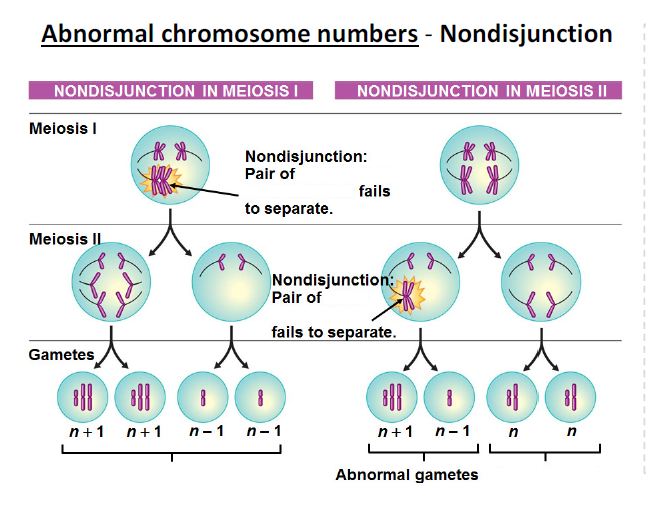
- AHomologous chromosome
- Bsister chromatid
- CAbnormal gametes
- DNormal gametes
58A gene is a combination of alleles on each chromosome in a homologous pair
- AVerdadero
- BFalso
59An allele is different forms of a specific gene.
- AVerdadero
- BFalso
60A phenotype is the expressed form of a gene.
- AVerdadero
- BFalso
61The term self-fertilization refers to:
- ASperm and eggs came from different plants
- BSperm and eggs came from the same plant
- CIs called a homozygote
- DIs called a heterozygote
62The term cross-fertilization refers to:
- ASperm and eggs came from the same plant
- BSperm and eggs came from different plants
- CIs a homozygote
- DIs a heterozygote
63[blank_start]Monohybrid cross[blank_end]: Mating between two organisms that only differ in one characteristic.
[blank_start]Dihybrid cross[blank_end]: Mating between two organisms that differ in more than one characteristic.
[blank_start]Test cross[blank_end]: An individual of unknown genotype is mated with a homozygous recessive individual.- AMonohybrid cross
- BDihybrid cross
- CTest cross
64[blank_start]Codominance[blank_end]; a heterozygote individual expresses two different alleles and is neither dominant nor recessive.
[blank_start]Incomplete dominance[blank_end]; a heterogote expresses an intermediate phenotype between dominant and recessive.- ACodominance
- BIncomplete dominance
65[blank_start]Multiple alles[blank_end]; a trait that is controlled by more than two different alleles.
[blank_start]Pleiotropic genes[blank_end]; have effects on multiple seemingly unrelated traits.
[blank_start]Polygenic traits[blank_end]; controlled by two or more sets of alleles.
[blank_start]Multifactorial trais[blank_end]; controlled by two or more sets of alleles as well as environmental factors.- AMultiple alleles
- BPleiotropic genes
- CPolygenetic traits
- DMultifactorial traits
- EPleiotropic genes
- FMultiple alleles
- GPolygenetic traits
- HMultifactorial traits
- IPolygenic traits
- JMultiple alleles
- KPleiotropic traits
- LMultifactorial traits
- MMultifactorial traits
- NMultiple alleles
- OPleiotropic genes
- PPolygenic traits
66Label the following diagram.
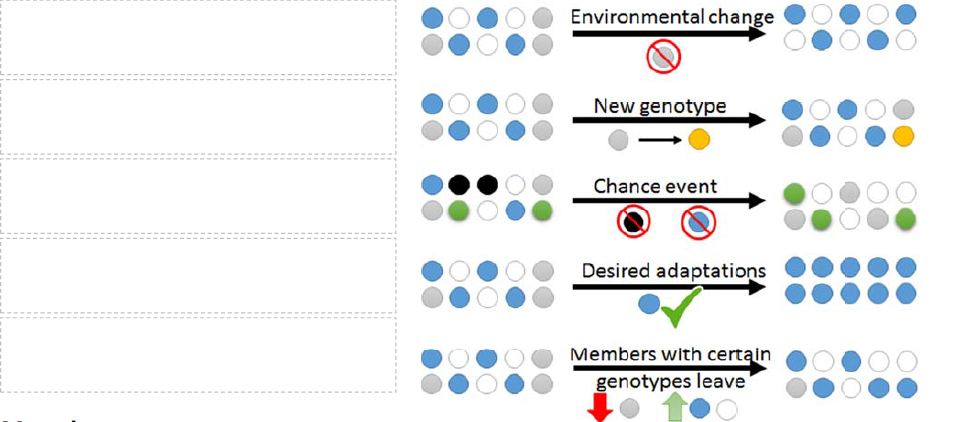
- ANatural selection
- BMutation
- CGenetic drift
- DNon-random mating
- EMigration
67[blank_start]Mutation[blank_end]; produces new alleles which may provide a selective advantage.
[blank_start]Natural selection[blank_end]; environmental factors provide differences in reproductive success.
[blank_start]Artificial selection[blank_end]; selective breeding for individuals who only have specific desirable features.
[blank_start]Sexual selection[blank_end]; selective breeding of individuals of one sex for certain characteristics in the other sex.- AMutation
- BNatural selection
- CArtificial selection
- DSexual selection
- ENatural selection
- FMutation
- GArtificial selection
- HSexual selection
- IArtificial selection
- JMutation
- KNatural selection
- LSexual selection
- MSexual selection
- NMutation
- ONatural selection
- PArtificial selection
68Cytokinesis I; contains [blank_start]23[blank_end] chromosomes (in each cell) and [blank_start]46[blank_end] DNA strands.
- A23
- B46
- C92
- D46
- E23
- F92
69Cytokinesis II; contains [blank_start]23[blank_end] chromosomes (in each cell) and [blank_start]23[blank_end] DNA strands.
- A23
- B46
- C92
- D23
- E46
- F92
70Label the following diagram.
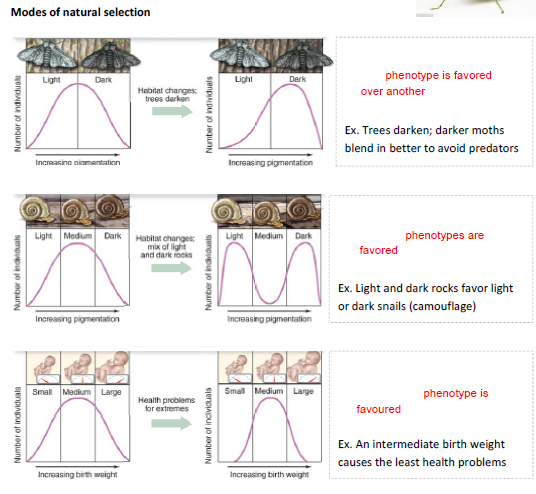
- ADirectional selection
- BDisruptive selection
- CStabilizing selection
- DOne
- EExtreme
- FIntermediate
71[blank_start]Founder effect[blank_end]; some members migrate to a new location while the original population remains.
[blank_start]Bottleneck effect[blank_end]; some members survive while original population is drastically reduced.- AFounder effect
- BBottleneck effect
72[blank_start]Mutation[blank_end]; change in the nucleotide sequence.
[blank_start]Frameshift[blank_end] mutation; changes the reading frame.
[blank_start]Point[blank_end] mutation; changes one codon and therefore one amino acid.- AMutation
- BPoint
- CFrameshift
73In pea plants, spherical seeds (S) are dominant to dented seeds (s). In a genetic cross of two plants that are both heterozygous for the seed shape trait, what percentage of the offspring should have spherical seeds.
- A100%
- B25%
- C50%
- D75%
74A phenotypic ratio of 3:1 in the offspring of a mating of two heterozygous organisms for spherical pea shape is expected because:
- Athe alleles segregate during meiosis
- Beach allele contains two mutations
- Cthe alleles are incompletely dominant
- Donly recessive traits are scored
75A genetic cross between two F1-hybrid pea plants for spherical seeds; results in what percentage of seeds expressing wrinkled (recessive) seed shape?
- A100%
- B75%
- C50%
- D25%
76When true-breeding tall stem pea plants are crossed with true breeding short stem pea plants. all of the [blank_start]F1-generation[blank_end] plants, and 75% of the [blank_start]F2-generation[blank_end] plants have tall stems.
- AF1-generation
- BF2-generation
- CG1-generation
- DG2-generation
- EF2-generation
- FF1-generation
- GG1-generation
- HG2-generation
77To identify the genotype of yellow-seeded pea plants as either homozygous dominant (YY) or heterozygous (Yy), you could do a test cross with plants of what genotype?
- Ayy
- BYY
- CYy
- DTest-cross
78A test cross is used to determine if the genotype of a plant with the dominant phenotype is homozygous or heterozygous. If the unknown is homozygous, all of the offspring of the test cross have the __________ phenotype. If the unknown is heterozygous, half of the offspring will have the __________ phenotype.
- Adominant, recessive
- Bdominant, incompletely dominant
- Crecessive, dominant
- Dcodominant, recessive
79In Mendel's experiments, if the gene for tall (T) plants was incompletely dominant over the gene for short (t) plants, what would be the result of crossing two Tt plants?
- A25% would be tall; 50% would be intermediate; 25% would be short
- BAll the offspring would be intermediate
- C50% would be tall; 25% would be intermediate; 25% would be short
- D25% would be tall; 25% would be intermediate; 50% would be short
80A woman with type A blood and a man with type B blood could potentially have offspring with which of the following blood types?
- AType A
- BType B
- CType AB
- DType O
- EAll options are possible
81What are the possible blood types of the offspring of a cross between individuals that are type AB and type O?
- AAB or O
- BA, B, or O
- CA or B
- DA, B, or AB
82A genetic cross of inbred snapdragons with red flowers with inbred snapdragons with white flowers resulted in F1-hybrid offspring that all had pink flowers. When the F1 plants were self-pollinated, the resulting F2-generation plants had a phenotypic ratio of 1 red: 2 pink: 1 white. The most likely explanation is:
- AThis is an example of multifactorial traits
- BThis is an example of polygenetic inheritance
- CThis is an example of incomplete dominance
- DThis is an example of codominance
Información
- Descripción
- DNA replication, Mitosis, Meiosis, Genetics, Evolution
- Autor
- Karime Chavolla
- Idioma
- English
- Visitas
- 85
- Etiquetas
- Valoración
- Aún sin valoraciones Valora este test