
Test
CBLG101 - Chapter 7 The Skeleton
Este test tiene tipos de pregunta que se abren en el reproductor de siempre.
Preguntas del test (42)
1What does the axial skeleton do?
- AForms longitudinal axis of body
- BSupports head, neck, and trunk
- CProtects brain, spinal cord, and thoracic organs
- DAll of the above
2What does the appendicular skeleton do?
- ASupports and protects
- BAllows mobility
3What is the skeletal system composed of?
- ABones
- BCartilages
- CJoints & ligaments
- DAll of the above
4How much body mass does the skeleton account for?
- A15%
- B20%
- C25%
- D30%
5What are the two major divisions of the skeleton?
- AAxial and appendicular
- BAnterior and posterior
- CDense and loose
- DHyaline and fibrocartilage
6Which of the following is true about the skeletal system or skeleton?
- AIt is composed of mostly bone
- BCartilage occurs in isolated areas
- CLigaments connect bones and reinforce joints
- DAll of the above
7The axial skeleton consists of how many bones?
- A20
- B50
- C80
- D100
8What are the major regions of the axial skeleton?
- ASkull
- BVertebral column
- CThoracic cage
- DAll of the above
9What is true of the skull?
- AIt's the most complex bony structure in the body.
- BIt's formed of cranial bones and facial bones.
- CMost of its bones are flat and locked together.
- DAll of the above
10Which of the following functions are associated with cranial bones?
- AEnclosing the heart in the thoracic cavity
- BSupporting the spinal cord in the vertebral canal
- CEnclosing the brain in the cranial cavity
- DProviding sites of attachment for leg muscles
11What is one of the functions of cranial bones?
- ASupporting the rib cage
- BProviding sites of attachment for arm muscles
- CProvide sites of attachment for head and neck muscles
- DForming the pelvis
12What term is used to describe joints in the skull?
- ASynovial joints
- BCartilaginous joints
- CSutures
- DLigamentous joints
13How would you describe the appearance of sutures in the skull?
- ASmooth and rounded
- BSerrated, with a saw-tooth appearance
- CFlat and linear
- DIrregular and bumpy
14What is NOT true about facial bones?
- AContain cavities for special sense organs for sight, taste, and smell
- BProvide openings for air and food passage
- CSecure teeth & anchor facial muscles used for facial expression
- DServe as attachment points for the spinal cord
15Label this image of the skull
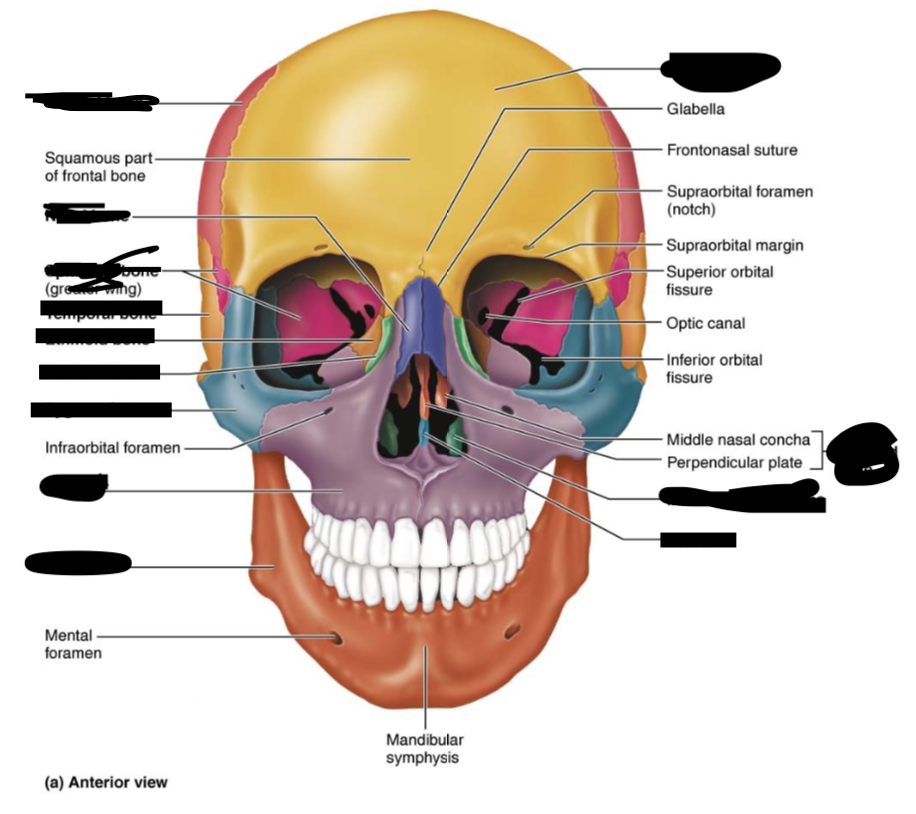
- AParietal bone
- BFrontal bone
- CNasal bone
- DSphenoid bone
- ETemporal bone
- FEthmoid bone
- GLacrimal bone
- HZygomatic bone
- IMaxilla
- JMandible
- KVomer
- LInferior nasal concha
- MAlso ethmoid bone
16Label this image of the skull
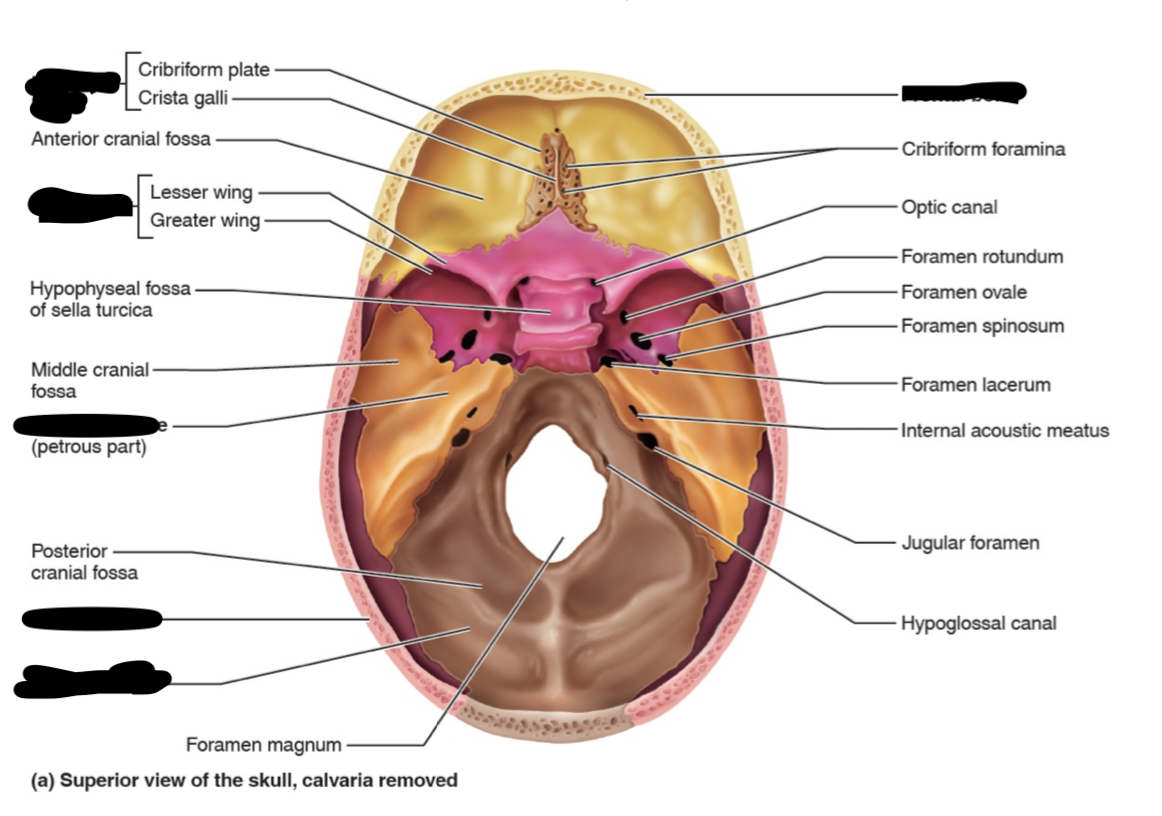
- AEthmoid bone
- BSphenoid
- CTemporal bone
- DParietal bone
- EFrontal bone
17Label this image of the skull
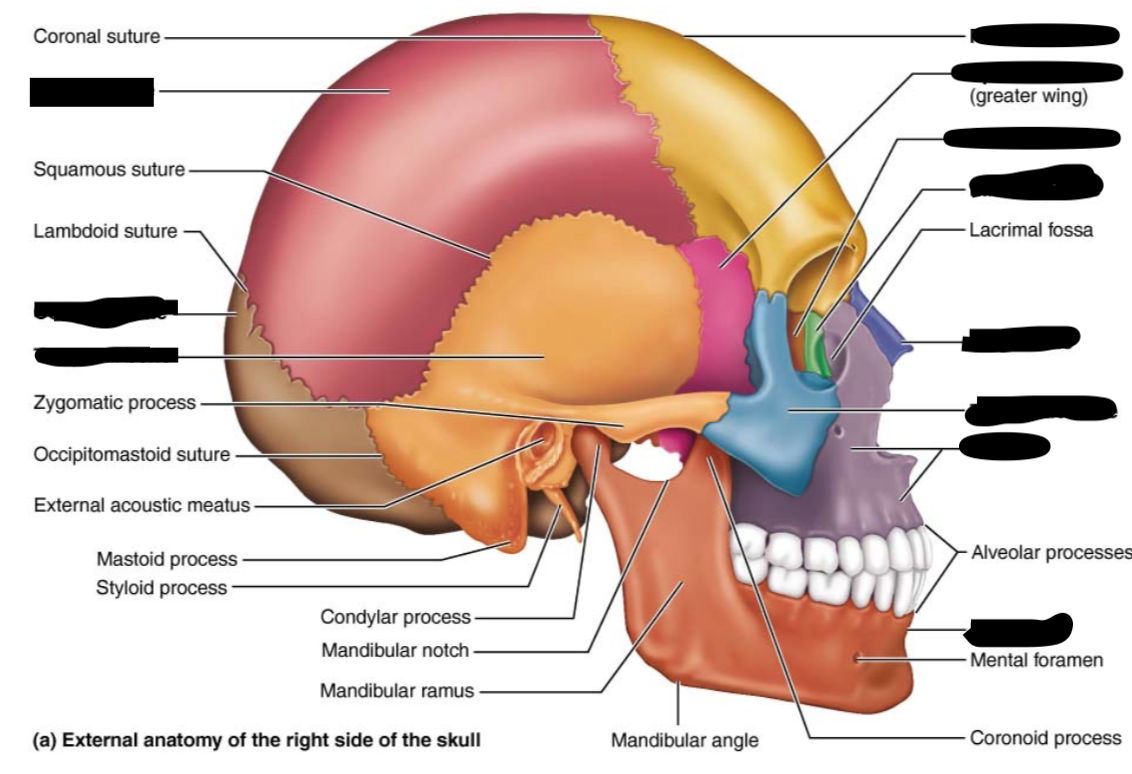
- AParietal bone
- BFrontal bone
- CSphenoid bone
- DNasal bone
- EOccipital bone
- FTemporal bone
- GMandible
- HMaxilla
- IZygomatic bone
- JEthmoid bone
- KLacrimal bone
18Which of the following represents the correct order of the five regions of the vertebral column from superior to inferior?
- ALumbar, Thoracic, Sacral, Cervical, Coccyx
- BThoracic, Lumbar, Cervical, Sacral, Coccyx
- CCervical, Thoracic, Lumbar, Sacral, Coccyx
- DSacral, Coccyx, Lumbar, Thoracic, Cervical
19These are the amount of vertebrae the 5 regions of the spinal column have. Cervical consists of [blank_start]7[blank_end] vertebrae. Thoracic consists of [blank_start]12[blank_end] vertebrae. Lumbar consists of [blank_start]5[blank_end] vertebrae. Sacrum is one bone formed from the fusion of [blank_start]typically 5[blank_end] vertebrae and articulates with the hip. Coccyx is also one bone formed from the fusion of [blank_start]4[blank_end] fused vertebrae.
- A7
- B12
- C5
- Dtypically 5
- E4
20What is true of the vertebral or spinal column?
- AExtends from skull to pelvis and has 4 main curves
- BFunctions to transmit weight of trunk to lower limbs, surround and protect spinal cord, provide attachment points for ribs and muscles
- CFlexible curved structure contains 26 irregular bones called vertebrae in five major regions
- DAll of the above
21Why does the spinal column have curvatures?
- ATo decrease the resilience and flexibility of the spine
- BTo provide a rigid support structure for the spine
- CTo help increase resilience and flexibility of the spine
- DTo limit movement and mobility in the spine
22Which of the following statements accurately describes the curvature of the cervical, lumbar, thoracic, and sacral regions of the spine?
- AThe cervical and lumbar curvatures are convex posteriorly, while the thoracic and sacral curvatures are concave posteriorly.
- BThe cervical and lumbar curvatures are concave posteriorly, while the thoracic and sacral curvatures are convex posteriorly.
- CAll regions of the spine have convex posterior curvatures.
- DAll regions of the spine have concave posterior curvatures.
23Describe the clinical homeostatic imbalance called scoliosis.
- Aabnormal lateral rotation of spine, most often in thoracic region, which may lead to breathing difficulties
- Babnormal dorsal thoracic curvature common in people with osteoporosis, tuberculosis of spine, rickets, or osteomalacia
- Caccentuated lumbar curvature that can result from disease but also pregnancy
- DNone of the above
24Describe the clinical homeostatic imbalance called kyphosis.
- Aabnormal lateral rotation of spine, most often in thoracic region, which may lead to breathing difficulties
- Babnormal dorsal thoracic curvature common in people with osteoporosis, tuberculosis of spine, rickets, or osteomalacia
- Caccentuated lumbar curvature that can result from disease but also pregnancy
- DNone of the above
25Describe the clinical homeostatic imbalance called lordosis.
- Aabnormal lateral rotation of spine, most often in thoracic region, which may lead to breathing difficulties
- Babnormal dorsal thoracic curvature common in people with osteoporosis, tuberculosis of spine, rickets, or osteomalacia
- Caccentuated lumbar curvature that can result from disease but also pregnancy
- DNone of the above
26What are some factors that can lead to abnormal spinal curvatures?
- ACongenital conditions
- BDiseases
- CPoor posture or unequal pull of muscles on the spine
- DAll of the above
27What is the thoracic cage composed of?
- AThoracic vertebrae posteriorly
- BSternum and costal cartilages anteriorly
- CRibs laterally
- DAll of the above
28What are the functions of the thoracic cage?
- AProtects vital organs
- BSupports shoulder girdles and upper limbs
- CProvides attachment sites for muscles of neck, back, chest, and shoulders
- DAll of the above
29Label this diagram of the thoracic cage.
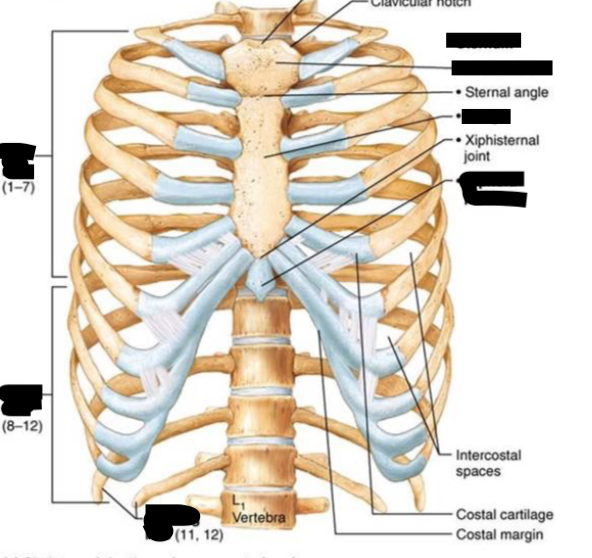
- ASternum
- BTrue ribs
- CFalse ribs
- DFloating ribs
- EManubrium
- FBody
- GXiphoid process
30Which of the following correctly describes the appendicular skeleton?
- AIt consists of bones that form the spinal column.
- BIt includes bones that make up the skull and face.
- CIt consists of bones of the limbs and their girdles.
- DIt comprises bones of the thoracic cage and pelvis.
31Which of the following statements is true?
- AIn the appendicular skeleton, the pectoral girdle attaches upper limbs to the body trunk and the pelvic girdle attaches lower limbs to the body trunk.
- BIn the appendicular skeleton, the pectoral girdle attaches lower limbs to the body trunk and the pelvic girdle attaches upper limbs to the body trunk.
- CIn the axial skeleton, the pectoral girdle attaches upper limbs to the body trunk and the pelvic girdle attaches lower limbs to the body trunk.
- DIn the axial skeleton, the pectoral girdle attaches lower limbs to the body trunk and the pelvic girdle attaches upper limbs to the body trunk.
32What bones make up the pectoral girdle?
- AClavicles and scapulae
- BHumerus and radius
- CFemur and patella
- DTibia and fibula
33What is another term for the pectoral girdle?
- APelvic girdle
- BShoulder girdle
- CHip girdle
- DLimb girdle
34What are the 3 categories of bones in the hands?
- ACarpals, Patellae, Tarsals
- BFemurs, Tibias, Fibulas
- CCarpals, Metacarpals, Phalanges
- DScapulae, Clavicles, Humeri
35Which of these descriptions of the bones of the hands is correct?
- APhalanges (finger bones), metacarpals (palm bones) and carpals (wrist bones)
- BPhalanges (palm bones), metacarpals (finger bones) and carpals (wrist bones)
- CPhalanges (wrist bones), metacarpals (finger bones) and carpals (palm bones)
- DPhalanges (wrist bones), metacarpals (palm bones) and carpals (finger bones)
36Which of the following correctly identifies the bones found in the upper limb?
- AArm: Radius and ulna; Forearm: Humerus; Hand: Carpals, Metacarpals, Phalanges
- BArm: Humerus; Forearm: Radius and ulna; Hand: Carpals, Metacarpals, Phalanges
- CArm: Humerus; Forearm: Carpals, Metacarpals, Phalanges; Hand: Radius and ulna
- DArm: Carpals, Metacarpals, Phalanges; Forearm: Radius and ulna; Hand: Humerus
37Which is the correct number of bones in the hands?
- A8 carpal bones in the wrist, 5 metacarpal bones in the palm and 14 phalanges in the fingers
- B5 carpal bones in the wrist, 8 metacarpal bones in the palm and 14 phalanges in the fingers
- C14 carpal bones in the wrist, 5 metacarpal bones in the palm and 8 phalanges in the fingers
- D8 carpal bones in the wrist, 14 metacarpal bones in the palm and 5 phalanges in the fingers
38Which of the following statements correctly identifies the ulna and the radius?
- AThe ulna articulates with the humerus at the elbow joint, while the radius articulates with the carpal bones of the wrist and the ulna at the radioulnar joints.
- BThe ulna is located on the lateral side of the forearm, while the radius is located on the medial side.
- CThe ulna is longer and thicker than the radius.
- DThe radius articulates with the humerus at the elbow joint, while the ulna articulates with the carpal bones of the wrist and the radius at the radioulnar joints.
39What is another term for the pelvic girdle?
- AShoulder girdle
- BRib cage
- CHip girdle
- DSkull cage
40Which bones form the pelvic girdle?
- AFemur and patella
- BScapula and clavicle
- CHumerus and ulna
- DTwo coxal bones and sacrum
41What three fused bones form the coxal bone?
- AIlium, ischium, and pubis
- BSacrum, coccyx, ilium
- CSacrum, ischium, pubis
- DIlium, coccyx, pubis
42What is true of the pelvic girdle?
- ASupports the pelvic organs
- BTransmits weight of upper body to lower limbs
- CHas less mobility but more stability than shoulder joint
- DAll of the above
Información
- Descripción
- Biology Test sobre CBLG101 - Chapter 7 The Skeleton, creado por Sarah S el 28/05/2024.
- Autor
- Sarah S
- Idioma
- English
- Visitas
- 34
- Historial
- Creado el 28 may 2024 · actualizado el 28 may 2024
- Etiquetas
- Valoración
- Aún sin valoraciones Valora este test