
Test
1z0-082
Crea una cuenta gratis para terminar este test
Guarda tu progreso y consulta tu resultado final.
¿Ya tienes cuenta? Inicia sesión
Preguntas del test (158)
1You execute this command:
CREATE BIGFILE TABLESPACE big_tbs
DATAFILE '/u01/oracle/data/big_f1.dbf'
SIZE 20G;
Sufficient storage is available in filesystem /u01.
Which two statements are true about the BIG_TBS tablespace?
(Choose two).- AAUTOEXTEND is possible for the datafile
- BIt must be bigger than the largest SMALLFILE tablespace
- CAdditional data files may not be added
- DIt will be a dictionary-managed tablespace by default
- EIt will always have a 32K blocksize
2Which statement is true about the INTERSECT operator used in compound queries?
- AMultiple INTERSECT operators are not possible in the same SQL statement
- BIt processes NULLs in the selected columns
- CINTERSECT is of lower precedence than UNION or UNION ALL
- DIt ignores NULLs
3Which three statements are true about advanced connection options supported by Oracle Net for connection to Oracle Database instances?
(Choose three).- AConnect Time Failover requires the use of Transparent Application Failover (TAF)
- BSource Routing requires the use of a name server
- CSource Routing enables the use of Connection Manager (CMAN) which enables network traffic to be routed through a firewall
- DLoad Balancing can balance the number of connections to dispatchers when using a Shared Server configuration
- ELoad Balancing requires the use of a name server
- FConnect Time Failover requires the connect string to have two or more listener addresses configured
4Which two statements are true about date/time functions in a session where NLS_DATE_FORMAT is set to DD-MON-YYYY HH24:MI:SS?
(Choose two).- ACURRENT_TIMESTAMP returns the same date and time as SYSDATE with additional details of fractional seconds
- BSYSDATE can be queried only from the DUAL table
- CCURRENT_DATE returns the current date and time as per the session time zone
- DSYSDATE can be used in expressions only if the default date format is DD-MON-RR
- ESYSDATE and CURRENT_DATE return the current date and time set for the operating system of the database server
- FCURRENT_TIMESTAMP returns the same date as CURRENT_DATE
5A database is configured to use automatic undo management with temporary undo enabled. An UPDATE is executed on a temporary table.
Where is the UNDO stored?- AIn the undo tablespace
- BIn the SYSAUX tablespace
- CIn the SGA
- DIn the PGA
- EIn the temporary tablespace
6You have been tasked to create a table for a banking application.
One of the columns must meet three requirements:
1. Be stored in a format supporting date arithmetic without using conversion functions
2. Store a loan period of up to 10 years
3. Be used for calculating interest for the number of days the loan remains unpaid
Which data type should you use?- AINTERVAL YEAR TO MONTH
- BINTERVAL DAY TO SECOND
- CTIMESTAMP WITH LOCAL TIMEZONE
- DTIMESTAMP
- ETIMESTAMP WITH TIMEZONE
7In the spfile of a single instance database, LOCAL_LISTENER is set to LISTENER_1.
The TNSNAMES.ORA file in $ORACLE_HOME/network/admin in the database home contains:
LISTENER_1 =
(ADDRESS =
(PROTOCOL = TCP)
(HOST = host1.abc.com)
(PORT = 5121)
)
Which statement is true?- ADynamic service registration cannot be used for this database instance
- BThe LREG process registers services dynamically with the LISTENER_1 listener
- CLISTENER_1 must also be defined in the LISTENER.ORA file to enable dynamic service registration
- DThere are two listeners named LISTENER and LISTENER_1 running simultaneously using port 1521 on the same host as the database instances
- EThe definition for LISTENER_1 requires a CONNECT_DATA section to enable dynamic service registration
8Which three statements are true concerning logical and physical database structures?
(Choose three).- AAll tablespaces may have one or more data files
- BThe extents of a segment must always reside in the same datafile
- CA smallfile tablespace might be bigger than a bigfile tablespace
- DA segment can span multiple data files in some tablespaces
- EA segment's blocks can be of different sizes
- FA segment might have only one extent
- GSegments can span multiple tablespaces
9Which two statements are true regarding a SAVEPOINT?
(Choose two).- ARolling back to a SAVEPOINT can undo a CREATE INDEX statement
- BRolling back to a SAVEPOINT can undo a TRUNCATE statement
- COnly one SAVEPOINT may be issued in a transaction
- DA SAVEPOINT does not issue a COMMIT
- ERolling back to a SAVEPOINT can undo a DELETE statement
10Which three functions are performed by dispatchers in a shared server configuration?
(Choose three).- AWriting inbound request to the common request queue from all shared server connections
- BChecking for outbound shared server responses on the common outbound response queue
- CReceiving inbound requests from processes using shared server connections
- DSending each connection input request to the appropriate shared server input queue
- EBroadcasting shared server session responses back to requesters on all connections
- FSending shared server session responses back to requesters on the appropriate connection
11Which two statements are true about the SET VERIFY ON command?
(Choose two).- AIt can be used only in SQL*Plus
- BIt displays values for variables used only in the WHERE clause of a query
- CIt can be used in SQL Developer and SQL*Plus
- DIt displays values for variables created by the DEFINE command
- EIt displays values for variables prefixed with &&
12Which three statements are true about a self join?
(Choose three).- AThe ON clause must be used
- BThe query must use two different aliases for the table
- CIt must be an equijoin
- DIt must be an inner join
- EThe ON clause can be used
- FIt can be an outer join
13You want to write a query that prompts for two column names and the WHERE condition each time it is executed in a session but only prompts for the table name the first time it is executed.
The variables used in your query are never undefined in your session.
Which query can be used?- ASELECT &&col1, &&col2 FROM &table WHERE &&condition = &&cond;
- BSELECT &col1, &col2 FROM &&table WHERE &condition;
- CSELECT &col1, &col2 FROM ג€&tableג€ WHERE &condition;
- DSELECT '&&col1', '&&col2' FROM &table WHERE '&&condition' = '&cond';
- ESELECT &&col1, &&col2 FROM &table WHERE &&condition;
14Examine the description of the CUSTOMERS table:
Name Null? Type
--------------------------- -------------- ------------
CUST_ID NOT NULL VARCHAR2(6)
FIRST_NAME VARCHAR2(50)
LAST_NAME NOT NULL VARCHAR2(50)
ADDRESS VARCHAR2(50)
CITY VARCHAR2(25)
You want to display details of all customers who reside in cities starting with the letter D followed by at least two characters.
Which query can be used?- ASELECT * FROM customers WHERE city LIKE 'D_%';
- BSELECT * FROM customers WHERE city = '%D_';
- CSELECT * FROM customers WHERE city LIKE 'D_';
- DSELECT * FROM customers WHERE city = 'D_%';
15Examine this command:
ALTER DATABASE
MOVE DATAFILE '/u01/sales1.dbf'
TO '/u01/sales01.dbf'
REUSE;
Which two statements are true?
(Choose two).- ADML may be performed on tables with one or more extents in this data file during the execution of this command.
- BThe tablespace containing SALES1.DBF must be altered READ ONLY before executing the command.
- CThe tablespace containing SALES1.DBF must be altered OFFLINE before executing the command.
- DIf Oracle Managed Files (OMF) is used, then the file is renamed but moved to DB_CREATE_FILE_DEST.
- EThe file is renamed and stored in the same location.
16Which three statements are true about dropping and unused columns in an Oracle database?
(Choose three).- AA primary key column referenced by another column as a foreign key can be dropped if using the CASCADE option.
- BAn UNUSED column's space is reclaimed automatically when the block containing that column is next queried.
- CAn UNUSED column's space is reclaimed automatically when the row containing that column is next queried.
- DPartition key columns cannot be dropped.
- EA DROP COLUMN command can be rolled back.
- FA column that is set to UNUSED still counts towards the limit of 1000 columns per table.
17Which two statements are true regarding Oracle database space management within blocks managed by Automatic Segment Space Management (ASSM)?
(Choose two).- APCTFREE defaults to 10% for all blocks in all segments for all compression methods.
- BASSM assigns blocks to one of four fullness categories based on what percentage of the block is allocated for rows.
- CUpdate operations always attempt to find blocks with free space appropriate to the length of the row being updated.
- DInsert operations always attempt to find blocks with free space appropriate to the length of the row being inserted.
- EA block will always be eligible for inserts if the row is short enough to fit into the block
18Evaluate these commands which execute successfully:
CREATE SEQUENCE ord_seq
INCREMENT BY 1
START WITH 1
MAXVALUE 100000
CYCLE
CACHE 5000;
CREATE TABLE ord _items(
ord_no NUMBER(4) DEFAULT ord_seq NEXTVAL NOT NULL,
item_no NUMBER(3),
qty NUMBER(3),
expiry_date DATE,
CONSTRAINT it _pk PRIMARY KEY (ord_no, item_no),
CONSTRAINT ord_fk FOREIGN KEY (ord_no) REFERENCES orders (ord _no));
Which two statements are true about the ORD_ITEMS table and the ORD_SEQ sequence?
(Choose two).- AIf sequence ORD_SEQ is dropped then the default value for column ORD_NO will be NULL for rows inserted into ORD_ITEMS.
- BAny user inserting rows into table ORD_ITEMS must have been granted access to sequence ORD_SEQ.
- CColumn ORD_NO gets the next number from sequence ORD_SEQ whenever a row is inserted into ORD_ITEMS and no explicit value is given for ORD_NO.
- DSequence ORD_SEQ cycles back to 1 after every 5000 numbers and can cycle 20 times.
- ESequence ORD_SEQ is guaranteed not to generate duplicate numbers
19Which three instance situations are possible with the Oracle Database server without multi-tenant?
(Choose three).- ATwo or more instances on separate servers all associated with one database.
- BOne instance on one server associated with one database.
- COne instance on one server associated with two or more databases on the same server.
- DOne instance on one server not associated with any database
- EOne instance on one server associated with two or more databases on separate servers.
20Which two statements are true about the ORDER BY clause when used with a SQL statement containing a SET operator such as UNION?
(Choose two).- AColumn positions must be used in the ORDER BY clause.
- BOnly column names from the first SELECT statement in the compound query are recognized.
- CThe first column in the first SELECT of the compound query with the UNION operator is used by default to sort output in the absence of an ORDER BY clause.
- DEach SELECT statement in the compound query must have its own ORDER BY clause.
- EEach SELECT statement in the compound query can have its own ORDER BY clause.
21Which four account management capabilities can be configured using Oracle profiles?
(Choose four).- AThe number of hours for which an account is locked after the configured number of login attempts has been reached.
- BThe number of days for which an account may be inactive before it is locked.
- CThe maximum amount of CPU time allowed for a user's sessions before their account is locked.
- DThe ability to prevent a password from ever being reused.
- EThe number of password changes required within a period of time before a password can be reused.
- FThe number of days for which an account is locked after the configured number of login attempts has been reached.
- GThe maximum number of sessions permitted for a user before the account is locked
22Which three statements are true about single-row functions?
(Choose three).- AThey can be used only in the WHERE clause of a SELECT statement.
- BThe argument can be a column name, variable, literal or an expression.
- CThe data type returned can be different from the data type of the argument.
- DThey can be nested to any level.
- EThey can accept only one argument.
- FThey return a single result row per table.
23You want to use table compression suitable for OLTP that will:
1. Compress rows for all DML statements on that table
2. Minimize the overheads associated with compression
Which compression option is best suited for this?- ACOLUMN STORE COMPRESS FOR QUERY LOW
- BROW STORE COMPRESS BASIC
- CCOLUMN STORE COMPRESS FOR ARCHIVE LOW
- DCOLUMN STORE COMPRESS FOR ARCHIVE HIGH
- EROW STORE COMPRESS ADVANCED
24Which two statements are true about space-saving features in an Oracle Database?
(Choose two).- APrivate Temporary Tables (PTTS) store metadata in memory only
- BAn index created with the UNUSABLE attribute has no segment
- CIf they exist for a session, Private Temporary Tables (PTTs) are always dropped at the next COMMIT OR ROLLBACK statement
- DAn index that is altered to be UNUSABLE will retain its segment
- EA table that is truncated will always have its segment removed
25Which two statements are true about the PMON background process?
(Choose two).- AIt registers database services with all local and remote listeners known to the database instance.
- BIt frees resources held by abnormally terminated processes.
- CIt records checkpoint information in the control file.
- DIt frees unused temporary segments.
- EIt kills sessions that exceed idle time.
26In which three situations does a new transaction always start?
(Choose three).- AWhen issuing a SELECT FOR UPDATE statement after a CREATE TABLE AS SELECT statement was issued in the same session.
- BWhen issuing a TRUNCATE statement after a SELECT statement was issued in the same session.
- CWhen issuing a CREATE TABLE statement after a SELECT statement was issued in the same session.
- DWhen issuing the first Data Manipulation Language (DML) statement after a COMMIT OR ROLLBACK statement was issued in the same session.
- EWhen issuing a CREATE INDEX statement after a CREATE TABLE statement completed successfully in the same session.
- FWhen issuing a DML statement after a DML statement failed in the same session.
27Examine the description of the SALES1 table:
Name Null Type
------------------------ ------------- ------------
SALES_ID NOT NULL NUMBER
STORE_ID NOT NULL NUMBER
ITEMS_ID NUMBER
QUANTITY NUMBER
SALES_DATE DATE
SALES2 is a table with the same description as SALES1.
Some sales data is duplicated in both tables.
You want to display the rows from the SALES1 table which are not present in the SALES2 table.
Which set operator generates the required output?- AINTERSECT
- BUNION ALL
- CUNION
- DSUBTRACT
- EMINUS
28Your database instance is started with a PFILE. Examine these parameters:
Name Type Value
------------------------------ --------------- ------
memory_max_target big integer 0
memory_target big integer 0
sga_max_size big integer 2G
sga_target big integer 2G
You want to increase the size of the buffer cache. Free memory is available to increase the size of the buffer cache.
You execute the command:
SQL> ALTER SYSTEM SET DB_CACHE_SIZE=1024M;
What is the outcome?- AThe value is changed only in the PFILE and takes effect at the next instance startup.
- BThe value is changed for the current instance and in the PFILE.
- CIt fails because the SCOPE clause is missing.
- DChange is applied to the current instance, but does not persist after instance restart
29Which three Oracle database space management features will work with both Dictionary and Locally managed tablespaces?
(Choose three).- AOracle Managed Files (OMF)
- BOnline table segment shrink
- COnline index segment shrink
- DAutomatic data file extension (AUTOEXTEND)
- ECapacity planning growth reports based on historical data in the Automatic Workload Repository (AWR)
30You execute this command:
[oracle@host01 ~]$ expdp system/oracle \
> FULL=Y \
> DUMPFILE=exp_db_full.dmp \
> PARALLEL=4 \
> LOGFILE=exp_dp_full.log \
> JOB_NAME=exp_db_full \
During the export operation, you detach from the job by using CTRL+C and then execute this command:
Export> STOP_JOB=immediate -
Are you sure you wish to stop the job ([yes]/no): yes
Which two statements are true about the job?
(Choose two).- AYou can no longer monitor it.
- BYou can reattach to it and monitor it.
- CIt is paused and can be resumed.
- DIt continues to run in the background.
- EIt terminates.
31In one of your databases, you create a user, HR, and then execute this command:
GRANT CREATE SESSION TO hr WITH ADMIN OPTION;
Which four actions can HR perform?
(Choose four).- ARevoke the CREATE SESSION privilege from other users.
- BRevoke the CREATE SESSION privilege from user HR.
- CLog in to the database instance.
- DGrant the CREATE SESSION privilege with ADMIN OPTION to other users.
- EExecute DDL statements in the HR schema.
- FExecute DML statements in the HR schema.
32Which two statements are true about the WHERE and HAVING clauses in a SELECT statement?
(Choose two).- AAggregating functions and columns used in HAVING clauses must be specified in the SELECT list of a query.
- BWHERE and HAVING clauses can be used in the same statement only if applied to different table columns.
- CThe HAVING clause can be used with aggregating functions in subqueries.
- DThe WHERE clause can be used to exclude rows before dividing them into groups.
- EThe WHERE clause can be used to exclude rows after dividing them into groups.
33Which two statements are true about UNDO and REDO?
(Choose two).- AThe generation of UNDO generates REDO.
- BDML modifies Oracle database objects and only generates UNDO.
- CThe generation of REDO generates UNDO.
- DDML modifies Oracle database objects and only generates REDO.
- EDML modifies Oracle database objects and generates UNDO and REDO.
34The SCOTT/TIGER user exists in two databases, BOSTON_DB and DALLAS_DB, in two different locations. Each database has a tnsnames.ora file defining DALLAS_DB as a service name.
Examine this command:
CREATE DATABASE LINK dblink1 CONNECT TO scott IDENTIFIED BY tiger USING 'dallas_db';
How do you execute the command so that only SCOTT in BOSTON_DB can access the SCOTT schema in DALLAS_DB?- Aas SCOTT in DALLAS_DB
- Bas SCOTT in BOSTON_DB
- Cas SCOTT in BOSTON_DB and SYS in DALLAS_DB
- Das SYS in both the databases
- Eas SCOTT in both the databases
35Which three statements are true about the DESCRIBE command?
(Choose three).- AIt displays the PRIMARY KEY constraint for any column or columns that have that constraint.
- BIt can be used from SQL Developer.
- CIt displays the NOT NULL constraint for any columns that have that constraint.
- DIt can be used to display the structure of an existing view.
- EIt displays all constraints that are defined for each column.
- FIt can be used only from SQL*Plus.
36Examine the description of the CUSTOMERS table:
Name Null? Type
-------------------------------------- ------------------- ------------
CUST_ID NOT NULL NUMBER
CUST_FIRST_NAME NOT NULL VARCHAR2(20)
CUST_LAST_NAME NOT NULL VARCHAR2(30)
CUST_INCOME_LEVEL VARCHAR2(30)
CUST_CREDIT_LIMIT NUMBER
For customers whose income level has a value, you want to display the first name and due amount as 5% of their credit limit. Customers whose due amount is null should not be displayed.
Which query should be used?- ASELECT cust_first_name, cust_credit_limit * .05 AS DUE_AMOUNT FROM customers WHERE cust_income_level IS NOT NULL AND due_amount IS NOT NULL;
- BSELECT cust_first_name, cust_credit_limit * .05 AS DUE_AMOUNT FROM customers WHERE cust_income_level != NULL AND cust_credit_level !=NULL;
- CSELECT cust_first_name, cust_credit_limit * .05 AS DUE_AMOUNT FROM customers WHERE cust_income_level <> NULL AND due_amount <> NULL;
- DSELECT cust_first_name, cust_credit_limit * .05 AS DUE_AMOUNT FROM customers WHERE cust_income_level != NULL AND due_amount != NULL;
- ESELECT cust_first_name, cust_credit_limit * .05 AS DUE_AMOUNT FROM customers WHERE cust_income_level IS NOT NULL AND cust_credit_limit IS NOT NULL;
37The INVOICE table has a QTY_SOLD column of data type NUMBER and an INVOICE_DATE column of data type DATE.
NLS_DATE_FORMAT is set to DD-MON-RR.
Which two are true about data type conversions involving these columns in query expressions?
(Choose two). ==> 3- ACONCAT (qty_sold, invoice_date) : requires explicit conversion
- Binvoice_date = '15-march-2019' : uses implicit conversion
- Cinvoie_date > '01-02-2019' : uses implicit conversion
- Dqty_sold BETWEEN '101' AND '110' : uses implicit conversion
- Eqty_sold = '0554982' uses implicit conversion
38Which three are types of segments in an Oracle Database?
(Choose three).- Aundo
- Bindex
- Cstored procedures
- Dsequences
- Etables
- Fclusters
39Which two statements are true about the results of using the INTERSECT operator in compound queries?
(Choose two).- AColumn names in each SELECT in the compound query can be different.
- BThe number of columns in each SELECT in the compound query can be different.
- CReversing the order of the intersected tables can sometimes affect the output.
- DINTERSECT returns rows common to both sides of the compound query.
- EINTERSECT ignores NULLs.
40Which two statements are true about single row functions?
(Choose two).- AMOD : returns the quotient of a division operation
- BFLOOR : returns the smallest integer greater than or equal to a specified number
- CTRUNC : can be used with NUMBER and DATE values
- DCONCAT : can be used to combine any number of values
- ECEIL : can be used for positive and negative numbers
41The EMPLOYEES table contains columns EMP_ID of data type NUMBER and HIRE_DATE of data type DATE.
You want to display the date of the first Monday after the completion of six months since hiring.
The NLS_TERRITORY parameter is set to AMERICA in the session and, therefore, Sunday is the first day on the week.
Which query can be used?- ASELECT emp_id, ADD_MONTHS(hire_date, 6), NEXT_DAY('MONDAY') FROM employees;
- BSELECT emp_id, NEXT_DAY(ADD_MONTHS(hire_date, 6), 'MONDAY') FROM employees;
- CSELECT emp_id, NEXT_DAY(MONTHS_BETWEEN(hire_date, SYSDATE), 6) FROM employees;
- DSELECT emp_id, NEXT_DAY(ADD_MONTHS(hire_date, 6), 1) FROM employees;
42The ORCL database has RESUMABLE__TIMEOUT = 7200 and DEFERRED_SEGMENT_CREATION = FALSE
User U1 has a 1 MB quota in tablespace DATA.
U1 executes this command:
SQL> CREATE TABLE t1 AS
(SELECT object_name, sharing, created FROM dba_objects);
U1 complains that the command is taking too long to execute.
In the alert log, the database administrator (DBA) finds this:
2017-03-06T12:15:17.183438+05:30 statement in resumable session 'User U1(136), Session 1, Instance 1' was suspended due to ORA-01536: space quota exceeded for tablespace 'DATA'
Which are three actions any one of which the DBA could take to resume the session?
(Choose three).- AAdd a data file to DATA.
- BDrop other U1 objects in DATA.
- CIncrease U1's quota sufficiently in DATA.
- DSet DEFERRED_SEGMENT_CREATION to TRUE.
- EGrant UNLIMITED TABLESPACE to U1.
- FSet AUTOEXTEND ON for data files in DATA.
43Which three statements are true about the Oracle Data Dictionary?
(Choose three).- AData dictionary views are created by joins of dictionary base tables and DBA-defined tables.
- BThe data dictionary is created and maintained by the database administrator.
- CViews with the same name but different prefixes, such as CDB, DBA, ALL and SER, reference the same base tables from the data dictionary.
- DBase tables can be queried directly.
- EIt is owned by the SYSTEM user.
- FUsernames of all users including database administrators are stored in the data dictionary
44In one of your databases, the user HR has the password HRMGR.
You want to connect to a database instance whose listener listens on port 1531 by using this statement:
CONNECT HR/HRMGR@orcl -
No name server is used.
Which statement is true about ORCL?- AIt must be the value of the SERVICE_NAMES parameter on the client side.
- BIt must resolve to a valid connect descriptor in the server's tnsnames.ora file
- CIt must resolve to a valid connect descriptor in the client's tnsnames.ora file
- DIt must be the name of the database to whose instance HR wishes to connect
- EIt must be the name of the server running the database to whose instance HR wishes to connect
45Which two statements are true about views used for viewing tablespace and datafile information?
(Choose two).- ATablespace free space can be viewed in V$TABLESPACE.
- BV$TABLESPACE displays information that is contained in the controlfile about tablespaces.
- CV$TABLESPACE displays information about tablespaces contained in the data dictionary.
- DTablespace free space can be viewed in DBA_TABLESPACES.
- EA datafile can be renamed when the database is in MOUNT state and the new file name is displayed when querying DBA_DATA_FILES after the database is opened.
46Examine the description of the PROMOTIONS table:
Name Null? Type
-----------------------------------------------------------------------
PROMO_ID NOT NULL NUMBER(6)
PROMO_NAME NOT NULL VARCHAR2(30)
PROMO_CATEGORY NOT NULL VARCHAR2(30)
PROMO_COST NOT NULL NUMBER(10,2)
You want to display the unique promotion costs in each promotion category.
Which two queries can be used?
(Choose two).- ASELECT promo_cost, promo_category FROM promotions ORDER BY by 1;
- BSELECT DISTINCT promo_cost || ' in ' || DISTINCT promo_category FROM promotions ORDER BY 1;
- CSELECT DISTINCT promo_category || ' has ' || promo_cost AS COSTS FROM promotions ORDER BY 1;
- DSELECT promo_category, DISTINCT promo_cost FROM promotions ORDER BY 2;
- ESELECT DISTINCT promo_category, promo_cost FROM promotions ORDER BY 1;
47In the ORCL database, UNDOTBS1 is the active undo tablespace with these properties:
1. A size of 100 MB
2. AUTOEXTEND is off
3. UNDO_RETENTION is set to 15 minutes
4. It has RETENTION GUARANTEE
UNDOTBS1 fills with uncommitted undo 10 minutes after the database opens.
What will happen when the next update is attempted by any transaction?- AIt succeeds and the generated undo is stored in SYSTEM.
- BIt fails and returns the error message ג€ORA-30036: unable to extend segment by 8 in undo tablespace 'UNDOTBS1'ג€.
- CIt succeeds and the least recently written undo block of UNDOTBS1 is overwritten by the generated undo.
- DIt succeeds and the generated undo is stored in SYSAUX.
- EIt succeeds and the least recently read undo block of UNDOTBS1 is overwritten by the generated undo.
48Which two statements are true about the rules of precedence for operators?
(Choose two).- AThe concatenation operator | | is always evaluated before addition and subtraction in an expression.
- BNULLS influence the precedence of operators in an expression.
- CThe + binary operator has the highest precedence in an expression in a SQL statement.
- DArithmetic operators with equal precedence are evaluated from left to right within an expression.
- EMultiple parentheses can be used to override the default precedence of operators in an expression.
49In one of your databases, user KING is:
1. Not a DBA user
2. An operating system (OS) user
Examine this command and its output:
SHOW PARAMETER OS_AUTHENT_PREFIX
NAME TYPE VALUE
--------------------------------------------------------
os_authent_prefix string
What must you do so that KING is authenticated by the OS when connecting to the database instance?- ASet OS_AUTHENT_PREFIX to OPS$
- BHave the OS administrator add KING to the OSDBA group
- CGrant DBA to KING
- DUnset REMOTE_LOGIN_PASSWORDFILE
- EAlter user KING to be IDENTIFIED EXTERNALLY
50View the Exhibits and examine the structure of the COSTS and PROMOTIONS tables.
You want to display PROD_IDS whose promotion cost is less than the highest cost PROD_ID in a promotion time interval.
Examine this SQL statement:
SELECT prod_id
FROM costs
WHERE promo_id IN
(SELECT promo_id
FROM promotions
WHERE promo_cost < ALL
(SELECT MAX(promo_cost)
FROM promotions
GROUP BY (promo_end_date - promo_begin_date)));
What will be the result?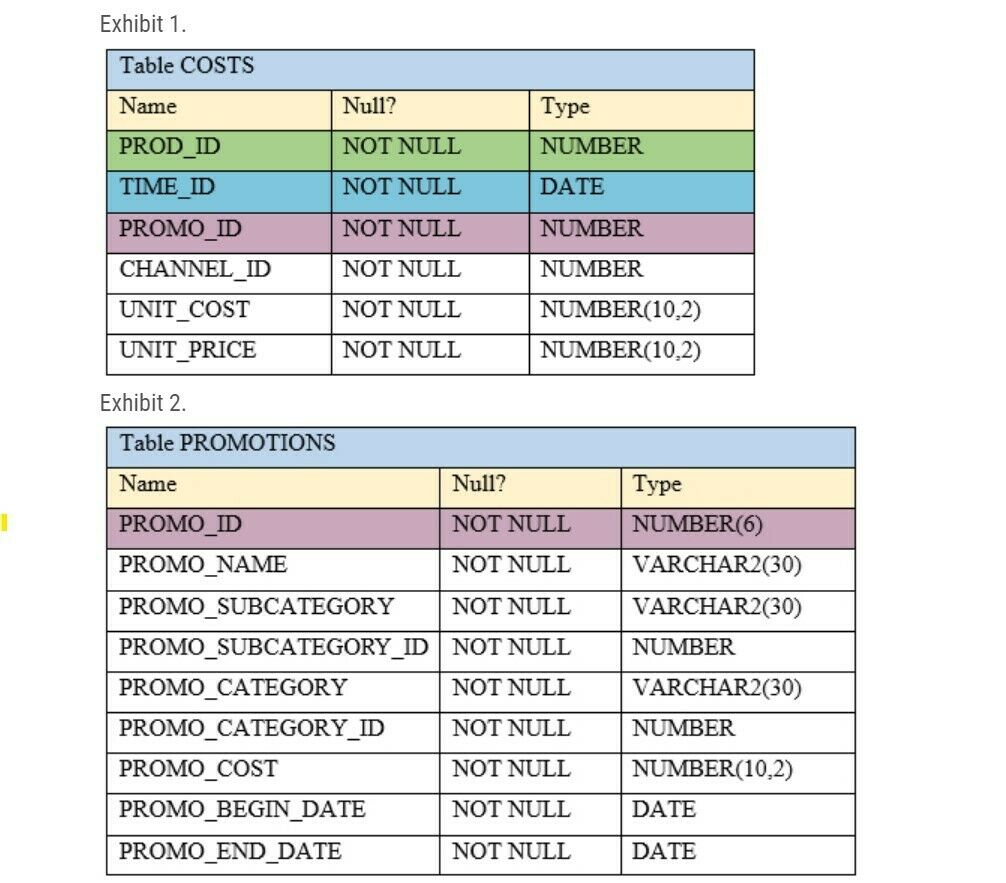
- AIt gives an error because the ALL keyword is not valid.
- BIt gives an error because the GROUP BY clause is not valid.
- CIt executes successfully but does not give the required result.
- DIt executes successfully and gives the required result.
51Which three statements are true about GLOBAL TEMPORARY TABLES?
(Choose three).- AA TRUNCATE command issued in a session causes all rows in a GLOBAL TEMPORARY TABLE for the issuing session to be deleted.
- BGLOBAL TEMPORARY TABLE rows inserted by a session are available to any other session whose user has been granted select on the table.
- CGLOBAL TEMPORARY TABLE space allocation occurs at session start.
- DAny GLOBAL TEMPORARY TABLE rows existing at session termination will be deleted.
- EA GLOBAL TEMPORARY TABLE'S definition is available to multiple sessions.
- FA DELETE command on a GLOBAL TEMPORARY TABLE cannot be rolled back.
52Which two statements are true about trace files produced by the Oracle Database server?
(Choose two).- AThey can be written by server processes.
- BTrace files are written to the Fast Recovery Area (FRA).
- CThey can be written by background processes.
- DAll trace files contain error information that require contacting Oracle Support.
- ETrace file names are based on the database name concatenated with a sequential number.
53You need to calculate the number of days from 1 January 2019 until today.
Dates are stored in the default format of DD-MON-RR.
Which two queries give the required output?
(Choose two).- ASELECT TO_CHAR(SYSDATE, 'DD-MON-YYYY') - '01-JAN-2019' FROM DUAL;
- BSELECT ROUND(SYSDATE - '01-JAN-2019') FROM DUAL;
- CSELECT ROUND(SYSDATE - TO_DATE('01/JANUARY/2019')) FROM DUAL;
- DSELECT TO_DATE(SYSDATE, 'DD/MONTH/YYYY') - '01/JANUARY/2019' FROM DUAL;
- ESELECT SYSDATE - TO_DATE('01-JANUARY-2019') FROM DUAL;
54Which two statements are true about the DUAL table?
(Choose two).- AIt can be accessed only by the SYS user.
- BIt consists of a single row and single column of VARCHAR2 data type.
- CIt can display multiple rows but only a single column.
- DIt can be used to display only constants or pseudo columns.
- EIt can be accessed by any user who has the SELECT privilege in any schema.
- FIt can display multiple rows and columns.
55Which four statements are true regarding primary and foreign key constraints and the effect they can have on table data?
(Choose four).- AA table can have only one primary key but multiple foreign keys.
- BA table can have only one primary key and one foreign key.
- CThe foreign key columns and parent table primary key columns must have the same names.
- DIt is possible for child rows that have a foreign key to remain in the child table at the time the parent row is deleted.
- EIt is possible for child rows that have a foreign key to be deleted automatically from the child table at the time the parent row is deleted.
- FOnly the primary key can be defined at the column and table level.
- GPrimary key and foreign key constraints can be defined at both the column and table level.
56Examine the description of the EMPLOYEES table:
Name Null? Type
----------------------------------------------------
EMP_ID NOT NULL NUMBER
EMP_NAME VARCHAR2(40)
DEP_ID NUMBER(2)
SALARY NUMBER(8,2)
JOIN_DATE DATE
Which query is valid?- ASELECT dept_id, AVG(MAX(salary)) FROM employees GROUP BY dept_id;
- BSELECT dept_id, join_date, SUM(salary) FROM employees GROUP BY dept_id;
- CSELECT dept_id, join_date, SUM(salary) FROM employees GROUP BY dept_id, join_date;
- DSELECT dept_id, MAX(AVG(salary)) FROM employees GROUP BY dept_id;
57What is true about non-equijoin statement performance?
(Choose two).- ATable aliases can improve performance.
- BThe BETWEEN condition always performs better than using the >= and <= conditions.
- CThe join syntax used makes no difference to performance.
- DThe BETWEEN condition always performs less well than using the >= and <= conditions.
- EThe Oracle join syntax performs better than the SQL:1999 compliant ANSI join syntax.
58In your data center, Oracle Managed Files (OMF) is used for all databases. All tablespaces are smallfile tablespaces.
SALES_Q1 is a permanent user-defined tablespace in the SALES database.
Examine this command which is about to be issued by a DBA logged in to the SALES database:
ALTER TABLESPACE sales_q1 ADD DATAFILE;
Which are two actions, either one of which you could take to ensure that the command executes successfully?
(Choose two).- AEnsure that DB_RECOVERY_FILE_DEST and DB_CREATE_FILE_DEST each specify with at least 50 Mb of available space.
- BSpecify a path in the DATAFILE clause of the command specifying a location with at least 100M of available space.
- CEnsure that DB_CREATE_FILE_DEST specifies a location with at least 100 Mb of available space.
- DAdd the AUTOEXTEND ON clause with NEXT set to 100M.
- EEnsure that DB_RECOVERY_FILE_DEST and DB_CREATE_FILE_DEST each specify locations with at least 50 Mb of available space.
59Examine this command and some partial output:
LSNRCTL> start LISTENER_1
Listening Endpoints Summary...
(DESCRIPTION=(ADDRESS=PROTOCOL=tcp) (HOST=host01.abc.com) (PORT=1562))
Services Summary...
Service "DB01.abc.com" has 1 instance(s).
Instance "DB01" status UNKNOWN, has 1 handler(s) for this service...
The command completed successfully
Why does the DB01.abc.com service show unknown status?- AThe service DB01.abc.com is dynamically registered.
- BThe LOCAL_LISTENER database parameter is not set to a service name that refers to LISTENER_1.
- CThe service DB01.abc.com is statically registered.
- DThe listener is not listening on the default port 1521.
- EThe SID_LIST_LISTENER section is not contained in the LISTENER.ORA file
60Which three statements are true about the tools used to configure Oracle Net Services?
(Choose three).- AThe Oracle Net Configuration Assistant is only used when running the Oracle installer.
- BOracle Net Manager can be used to centrally configure listeners on any database server target.
- CThe lsnrctl utility requires a listener.ora file to exist before it is started.
- DOracle Net Manager can be used to locally configure naming methods on a database server.
- EEnterprise Manager Cloud Control can be used to centrally configure listeners on any managed database server.
- FEnterprise Manager Cloud Control can be used to centrally configure net service names for any database server target
61Which two statements are true regarding the UNION and UNION ALL operators?
(Choose two).- ADuplicates are eliminated automatically by the UNION ALL operator.
- BThe number of columns selected in each SELECT statement must be identical.
- CThe names of columns selected in each SELECT statement must be identical.
- DThe output is sorted by the UNION ALL operator.
- ENULLS are not ignored during duplicate checking
62Which two statements are true about the Automatic Diagnostic Repository (ADR)?
(Choose two).- AThe ADR base defaults to $ORACLE_HOME/rdbms/admin if neither DIAGNOSTIC_DEST nor ORACLE_BASE is set.
- BThe ADR base defaults to $ORACLE_HOME/dbs if the DIAGNOSTIC_DEST parameter and the ORACLE_BASE environment variable are not set.
- CIt supports diagnostics for Automatic Storage Management (ASM).
- DIt supports diagnostics for Oracle Clusterware.
- EIt is held inside an Oracle database schema
63You want to apply the principle of Least Privilege in all your live databases.
One of your requirements is to revoke unnecessary privileges from all users who have them using Privilege Analysis.
Which three types of analyses can be done using the DBMS_PRIVILEGE_CAPTURE package?
(Choose three).- AAnalysis of all privileges used by all users including administrative users in the database.
- BAnalysis of all privileges used by all users but excluding administrative users in the database.
- CAnalysis of privileges that a user has on their own schema objects that they did not use.
- DAnalysis of privileges that a user has on their own schema objects that they did use.
- EAnalysis of privileges granted directly to a role that are then used by a user who has been granted that role.
- FAnalysis of privileges granted indirectly to a role that are then used by a user who has been granted that role.
64Which three statements are true about undo segments and the use of undo by transactions in an Oracle database instance?
(Choose three).- AAn undo segment may be used by multiple transactions simultaneously.
- BUndo segments can wrap around to the first extent when a transaction fills the last extend of the undo segment.
- CUndo segments have a minimum of three extents.
- DUndo segments can extend when a transaction fills the last extent of the undo segment.
- EA single transaction may use multiple undo segments simultaneously.
- FUndo segments must be stored in a BIGFILE tablespace.
- GUndo segments must be stored in a SMALLFILE tablespace
65Which two statements are true about Enterprise Manager Database Express?
(Choose two).- AIt is available only when the database is open.
- BIt can be used to perform database recovery.
- CThe same port number can be used for Database Express configurations for databases on different hosts.
- DIt can be used to switch a database into ARCHIVELOGMODE.
- EThe same port number can be used for multiple Database Express configurations for multiple databases on the same host
66Table EMPLOYEES contains columns including EMPLOYEE_ID, JOB_ID and SALARY.
Only the EMPLOYEE_ID column is indexed.
Rows exist for employees 100 and 200.
Examine this statement:
UPDATE employees
SET (job_id, salary) =
(SELECT job_id, salary
FROM employees
WHERE employee_id = 200)
WHERE employee_id = 100;
Which two statements are true?
(Choose two).- AEmployee 100 will have SALARY set to the same value as the SALARY of employee 200.
- BEmployee 200 will have JOB_ID set to the same value as the JOB_ID of employee 100.
- CEmployee 200 will have SALARY set to the same value as the SALARY of employee 100.
- DEmployee 100 will have JOB_ID set to the same value as the JOB_ID of employee 200.
- EEmployees 100 and 200 will have the same JOB_ID as before the update command.
- FEmployees 100 and 200 will have the same SALARY as before the update command.
67Which two are true about a SQL statement using SET operators such as UNION?
(Choose two).- AThe data type group of each column returned by the second query must match the data type of the corresponding column returned by the first query.
- BThe number, but not names, of columns must be identical for all SELECT statements in the query.
- CThe data type of each column returned by the second query must exactly match the data type of the corresponding column returned by the first query.
- DThe names and number of columns must be identical for all SELECT statements in the query.
- EThe data type of each column returned by the second query must be implicitly convertible to the data type of the corresponding column returned by the first query.
68Which three statements are true about time zones, date data types, and timestamp data types in an Oracle database?
(Choose three).- AThe CURRENT_TIMESTAMP function returns data without time zone information.
- BA TIMESTAMP WITH LOCAL TIMEZONE data type column is stored in the database using the time zone of the session that inserted the row.
- CA TIMESTAMP data type column contains information about year, month, and day.
- DThe DBTIMEZONE function can return an offset from Universal Coordinated Time (UTC).
- EThe SESSIONTIMEZONE function can return an offset from Universal Coordinated Time (UTC)
69Which three statements are true about inner and outer joins?
(Choose three).- AA full outer join returns matched and unmatched rows.
- BAn inner join returns matched rows.
- COuter joins can only be used between two tables per query.
- DA full outer join must use Oracle syntax.
- EOuter joins can be used when there are multiple join conditions on two tables.
- FA left or right outer join returns only unmatched rows
70Examine this description of the TRANSACTIONS table:
Name Null? Type
-------------------------------------------------------------------------------
TRANSACTION_ID NOT NULL VARCHAR2(6)
TRANSACTION_DATE DATE
AMOUNT NUMBER(10,2)
CUSTOMER_ID VARCHAR2(6)
Which two SQL statements execute successfully?
(Choose two).- ASELECT customer_id AS "CUSTOMER-ID", transaction_date AS DATE, amount + 100 "DUES" FROM transactions;
- BSELECT customer_id AS "CUSTOMER-ID", transaction_date AS "DATE", amount + 100 DUES FROM transactions;
- CSELECT customer_id AS CUSTOMER-ID, transaction_date AS TRANS_DATE, amount + 100 "DUES AMOUNT" FROM transactions;
- DSELECT customer_id CUSTID, transaction_date TRANS_DATE, amount + 100 DUES FROM transactions;
- ESELECT customer_id AS 'CUSTOMER-ID', transaction_date AS DATE, amount + 100 'DUES AMOUNT' FROM transactions;
71The CUSTOMERS table has a CUST_CREDIT_LIMIT column of data type NUMBER.
Which two queries execute successfully?
(Choose two).- ASELECT NVL(cust_credit_limit * .15, 'Not Available') FROM customers;
- BSELECT NVL2(cust_credit_limit * .15, 'Not Available') FROM customers;
- CSELECT NVL(TO_CHAR(cust_credit_limit * .15), 'Not Available') FROM customers;
- DSELECT TO_CHAR(NVL(cust_credit_limit * .15, 'Not Available')) FROM customers;
- ESELECT NVL2(cust_credit_limit, TO_CHAR(cust_credit_limit * .15), 'Not Available') FROM customers;
72Which statement is true about aggregate functions?
- AAggregate functions can be nested to any number of levels.
- BThe AVG function implicitly converts NULLS to zero.
- CAggregate functions can be used in any clause of a SELECT statement.
- DThe MAX and MIN functions can be used on columns with character data types.
73Your database instance was shut down normally and then started in NOMOUNT state. You then execute this command:
ALTER DATABASE MOUNT;
Which two actions are performed?
(Choose two).- AThe online redo logs are opened.
- BThe online data files are opened.
- CThe alert log records the execution details.
- DThe Oracle background processes are started.
- EThe initialization parameter file is read.
- FThe control file is read.
74Which two are true about shrinking a segment online?
(Choose two).- AIt is not possible to shrink either indexes or Index Organized Tables (IOTs).
- BIt always eliminates all migrated rows if any exist in the table.
- CTo shrink a table it must have a PRIMARY KEY constraint.
- DTo shrink a table it must have a UNIQUE KEY constraint.
- ETo shrink a table it must have row movement enabled
- FIt must be in a tablespace that uses Automatic Segment Space Management (ASSM)
75Examine these commands:
[oracle@host01 ~]$ sqlplus u1/oracle
SQL> SELECT * FROM emp;
ENO ENAME DN
--------------------------------
1 Alan 2
2 Ben 2
SQL> exit
[oracle@host01 ~] cat emp.dat
3,Culr,4
4,Bob,4
[oracle@host01 ~] sqlldr u01/oracle TABLE=emp
Which two statements are true about the sqlldr execution?
(Choose two).- AIt overwrites data in EMP with data in EMP.DAT
- BIt uses the database buffer cache to load data.
- CIt generates a log that contains control file entries, which can be used with normal SQL*Loader operations.
- DIt generates a sql script that it uses to load data from EMP.DAT to EMP
- EIt appends data from EMP.DAT to EMP
76A script abc.sql must be executed to perform a job.
A database user HR, who is defined in this database, executes this command:
$ sqlplus hr/hr@orcl @abc.sql
What will happen upon execution?- AThe command succeeds and HR will be connected to the orcl and abc.sql databases.
- BThe command succeeds and HR will be connected to the orcl database instance, and the abc.sql script will be executed.
- CThe command fails because the script must refer to the full path name.
- DThe command fails and reports an error because @ is used twice.
77Which three statements are true regarding indexes?
(Choose three).- AA UNIQUE index can be altered to be non-unique.
- BA SELECT statement can access one or more indices without accessing any tables.
- CA table belonging to one user can have an index that belongs to a different user.
- DAn update to a table can result in updates to any or all of the table's indexes.
- EWhen a table is dropped and is moved to the RECYCLE BIN, all indexes built on that table are permanently dropped.
- FAn update to a table can result in no updates to any of the table's indexes.
78Which three statements are true about Oracle synonyms?
(Choose three).- AA synonym cannot be created for a PL/SQL package.
- BA synonym can be available to all users.
- CA SEQUENCE can have a synonym.
- DA synonym created by one user can refer to an object belonging to another user.
- EAny user can drop a PUBLIC synonym
79View the Exhibit and examine the structure of the PRODUCTS table.
Which two tasks require subqueries?
(Choose two).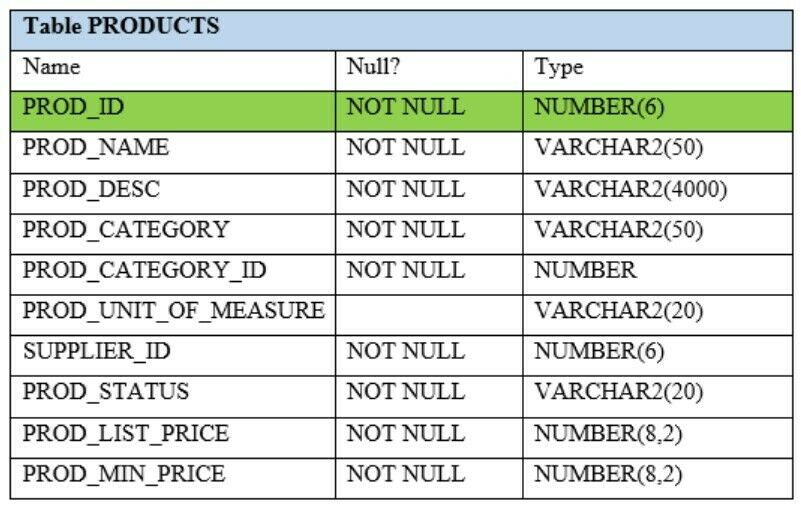
- ADisplay the number of products whose PROD_LIST_PRICE is more than the average PROD_LIST_PRICE.
- BDisplay suppliers whose PROD_LIST_PRICE is less than 1000.
- CDisplay products whose PROD_MIN_PRICE is more than the average PROD_LIST_PRICE of all products, and whose status is orderable.
- DDisplay the total number of products supplied by supplier 102 which have a product status of obsolete.
- EDisplay the minimum PROD_LIST_PRICE for each product status.
80The SALES_Q1 and USERS tablespaces exist in one of your databases and TEMP is a temporary tablespace.
Segment creation is not deferred.
You execute this command:
CREATE USER sales
IDENTIFIED BY sales_123
DEFAULT TABLESPACE sales_q1
TEMPORARY TABLESPACE temp
QUOTA 5M ON users;
Which three statements must be true so that the SALES user can create tables in SALES_Q1?
(Choose three).- AThe sales user must have a quota on the TEMP tablespace.
- BThe sales user must have a quota on the SALES_Q1 tablespace to hold the initial extends of all tables they plan to create in their schema.
- CThe sales user must have been granted the CREATE SESSION privilege.
- DThe sales user must have their quota on the users tablespace removed.
- EThe sales user must have a quota on the SALES_Q1 tablespace to hold all the rows to be inserted into any table in their schema.
- FThe sales user must have been granted the CREATE TABLE privilege.
81Which three statements are true about table data storage in an Oracle Database?
(Choose three).- AData block headers contain their own Data Block Address (DBA).
- BA table row piece can be chained across several database blocks.
- CMultiple row pieces from the same row may be stored in different database blocks.
- DMultiple row pieces from the same row may be stored in the same block.
- EData block free space is always contiguous in the middle of the block.
- FIndex block free space is always contiguous in the middle of the block
82Examine the description of the BOOKS table:
Name Null? Type
----------------------------------------------------------------------
TRANSACTION_ID NOT NULL VARCHAR2(6)
TRANSACTION_DATE DATE
AMOUNT NUMBER(10,2)
CUSTOMER_ID VARCHAR2(6)
The table has 100 rows.
Examine this sequence of statements issued in a new session:
INSERT INTO books VALUES ('ADV112', 'Adventures of Tom Sawyer', NULL, NULL);
SAVEPOINT a;
DELETE FROM books;
ROLLBACK TO SAVEPOINT a;
ROLLBACK;
Which two statements are true?
(Choose two).- AThe second ROLLBACK command does nothing.
- BThe second ROLLBACK command replays the delete.
- CThe first ROLLBACK command restores the 101 rows that were deleted, leaving the inserted row still to be committed.
- DThe second ROLLBACK command undoes the insert.
- EThe first ROLLBACK command restores the 101 rows that were deleted and commits the inserted row
83Which three statements are true about external tables in Oracle 18c and later releases?
(Choose three).- AExternal table files can be used for other external tables in a different database.
- BThe ORACLE_LOADER access driver can be used to unload data from a database into an external table.
- CThe ORACLE_DATAPUMP access driver can be used to unload data from a database into an external table.
- DThey cannot be partitioned.
- EThe ORACLE_DATAPUMP access driver can be used to load data into a database from an external table.
- FThey support UPDATEs but not INSERTs and DELETEs
84Which three statements are true about the Oracle join and ANSI join syntax?
(Choose three).- AThe Oracle join syntax supports creation of a Cartesian product of two tables.
- BThe Oracle join syntax performs better than the SQL:1999 compliant ANSI join syntax.
- CThe SQL:1999 compliant ANSI join syntax supports natural joins.
- DThe SQL:1999 compliant ANSI join syntax supports creation of a Cartesian product of two tables.
- EThe Oracle join syntax only supports right outer joins.
- FThe Oracle join syntax supports natural joins.
- GThe Oracle join syntax performs less well than the SQL:1999 compliant ANSI join syntax
85Which two tasks can you perform using DBCA for databases?
(Choose two).- AConfigure a nonstandard block size for a new database.
- BRegister a new database with an available Enterprise Manager Management server.
- CChange the standard block size of an existing database.
- DConfigure incremental backups for a new database.
- EEnable flashback database for an existing database.
86You execute this query:
SELECT TO_CHAR(NEXT_DAY(LAST_DAY(SYSDATE), 'MON'), 'dd "Monday for" fmMonth rrrr') FROM DUAL;
What is the result?- AIt executes successfully but does not return any result.
- BIt returns the date for the first Monday of the next month.
- CIt generates an error.
- DIt returns the date for the last Monday of the current month
87Examine this command:
CREATE UNDO TABLESPACE undotbs01 DATAFILE 'undotbs_01.dbf'
SIZE 100M AUTOEXTEND ON;
Which two actions must you take to ensure UNDOTBS01 is used as the default UNDO tablespace?
(Choose two).- AAdd the SEGMENT SPACE MANAGEMENT AUTO clause.
- BSet UNDO_TABLESPACE to UNDOTBS01.
- CAdd the NOLOGGING clause.
- DMake certain that the database operates in automatic undo management mode.
- EAdd the ONLINE clause
88Which three statements are true about views in an Oracle database?
(Choose three).- AViews can be updated without the need to re-grant privileges on the view.
- BTables in the defining query of a view must always exist in order to create the view.
- CThe WITH CHECK clause prevents certain rows from being displayed when querying the view.
- DData Manipulation Language (DML) can always be used on views.
- EInserting one or more rows using a view whose defining query contains a GROUP BY clause will cause an error.
- FDeleting one or more rows using a view whose defining query contains a GROUP BY clause will cause an error.
- GThe WITH CHECK clause prevents certain rows from being updated or inserted
89You execute this command:
CREATE SMALLFILE TABLESPACE sales DATAFILE '/u01/app/oracle/sales01.dbf
SIZE 5G SEGMENT SPACE MANAGEMENT AUTO;
Which two statements are true about the SALES tablespace?
(Choose two).- AIt must be smaller than the smallest BIGFILE tablespace.
- BFree space is managed using freelists.
- CAny data files added to the tablespace must have a size of 5 gigabytes.
- DIt uses the database default blocksize.
- EIt is a locally managed tablespace.
90In the SALES database, DEFERRED_SEGMENT_CREATION is TRUE.
Examine this command:
SQL> CREATE TABLE T1(c1 INT PRIMARY KEY, c2 CLOB);
Which segment or segments, if any, are created as a result of executing the command?- AT1, an index segment for the primary key, a LOB segment, and a lobindex segment.
- BNo segments are created
- CT1 only
- DT1 and an index segment created for the primary key only
- ET1, an index segment for the primary key, and a LOB segment only
91Which three activities are recorded in the database alert log?
(Choose three).- AData Definition Language (DDL) statements
- BNon-default database parameters
- CBlock corruption errors
- DDeadlock errors
- ESession logins and logouts
92Which two statements are true about Enterprise Manager (EM) Express?
- AYou can use a single instance of EM Express to manage multiple database running on the same server.
- BEM Express uses a separate repository database to store target database metadata.
- CBy default, EM express is available for a database after database creation using DBCA.
- DYou can shut down a database instance using EM Express.
- EYou cannot start up a database instance using EM Express.
93Examine this SQL statement:
SELECT cust_id, cust_last_name "Last Name"
FROM customers
WHERE country_id = 10
UNION
SELECT cust_id CUST_NO, cust_last_name
FROM customers
WHERE country_id = 30
Identify three ORDER BY clauses, any one of which can complete the query successfully.
(Choose three).- AORDER BY "Last Name"
- BORDER BY 2, 1
- CORDER BY 2, cust_id
- DORDER BY CUST_NO
- EORDER BY "CUST_NO"
94Which two statements are true about the configuration and use of UNDO_RETENTION with GURANTEED RETENTION?
(Choose two).- AUNDO_RETENTION specifies for how long Oracle attempts to keep expired and unexpired UNDO.
- BUNDO_RETENTION specifies how long all types of UNDO are retained.
- CUnexpired UNDO is always retained.
- DActive UNDO is always retained.
- EUNDO_RETENTION specifies for how long Oracle attempts to keep unexpired UNDO.
95Table ORDER_ITEMS contains columns ORDER_ID, UNIT_PRICE and QUANTITY, of data type NUMBER.
Examine these SQL statements:
Statement 1:
SELECT MAX(unit_price * quantity) 'Maximum Order' FROM order_items;
Statement 2:
SELECT MAX(unit_price * quantity) 'Maximum Order' FROM order_items GROUP BY order_id;
Which two statements are true?- AStatement 1 returns only one row of output.
- BStatement 2 returns only one row of output.
- CBoth statements will return NULL if either UNIT_PRICE or QUANTITY contains NULL.
- DBoth the statements give the same output.
- EStatement 2 may return multiple rows of output.
96Which three files are used by conventional path SQL*Loader when the TABLE option is not specified?
(Choose three).- ADump files
- BControl files
- CPassword files
- DBad files
- EInput files
97Which three statements are true about the naming methods and their features supported by Oracle database used to resolve connection information?
(Choose three).- ALocal Naming requires setting the TNS_ADMIN environment variable on the client side.
- BA client can connect to an Oracle database instance even if no client side network admin has been configured.
- CDirectory Naming can be used if Connect-Time Failover is required.
- DEasy Connect supports TCP/IP and SSL.
- ELocal naming can be used if Connect-Time Failover is required.
- FDirectory Naming requires setting the TNS_ADMIN environment variable on the client side.
98Which two statements are true about User Authentication in an Oracle Database?
(Choose two).- APassword authentication must be used for system-privileged administrative users.
- BPassword File authentication must be used for system-privileged administrative users.
- COperating System authentication may be used for system-privileged administrative users.
- DPassword File authentication is supported for any type of database user.
- EREMOTE_LOGIN_PASSWORDFILE must be set to exclusive to permit password changes for system-privileged administrative users.
99Which is the default column or columns for sorting output from compound queries using SET operators such as INTERSECT in a SQL statement?
- AThe first NUMBER column in the first SELECT of the compound query.
- BThe first NUMBER or VARCHAR2 column in the last SELECT of the compound query.
- CThe first column in the last SELECT of the compound query.
- DThe first column in the first SELECT of the compound query.
- EThe first VARCHAR2 column in the first SELECT of the compound query.
100Examine the description of the PRODUCT_STATUS table:
Name Null? Type
-----------------------------------------------------------
PROD_ID NOT NULL VARCHAR2(6)
STATUS NOT NULL DATE
The STATUS column contains the values 'IN STOCK' or 'OUT OF STOCK' for each row.
Which two queries will execute successfully?
(Choose two).- ASELECT prod_id "CURRENT AVAILABILITY" || q'('s not available)'
FROM product_status WHERE status = 'OUT OF STOCK'; - BSELECT prod_id q's not available"
FROM product_status WHERE status = 'OUT OF STOCK'; - CSELECT prod_id || q'('s not available)' 'CURRENT AVAILABILITY'
FROM product_status WHERE status = 'OUT OF STOCK'; - DSELECT prod_id || q'('s not available)'
FROM product_status WHERE status = 'OUT OF STOCK'; - ESELECT prod_id || q"'s not available"
FROM product_status WHERE status = 'OUT OF STOCK'; - FSELECT prod_id || q'('s not available)' "CURRENT AVAILABILITY"
FROM product_status WHERE status = 'OUT OF STOCK';
- ASELECT prod_id "CURRENT AVAILABILITY" || q'('s not available)'
101Which two statements are true about UNDO and UNDO tablespaces?
(Choose two).- AThere can be only one UNDO tablespace created in a database.
- BUNDO segments are owned by SYSTEM.
- CUNDO segments are owned by SYSBACKUP.
- DAn UNDO tablespace may be owned by only one instance.
- EAn instance will crash if the active undo tablespace is lost.
102You must create a tablespace of non-standard block size in a new file system and plan to use this command:
CREATE TABLESPACE ns_tbs
DATAFILE '/u02/oracle/data/nstbs_f01.dbf'
SIZE 100G
BLOCKSIZE 32K;
The standard block size is 8k but other non-standard block sizes will also be used.
Which two are requirements for this command to succeed?
(Choose two).- ADB_32K_CACHE_SIZE must be less than DB_CACHE_SIZE.
- BDB_32K_CACHE_SIZE must be set to a value that can be accommodated in the SGA.
- CDB_32K_CACHE_SIZE should be set to a value greater than DB_CACHE_SIZE.
- DThe /u02 file system must have at least 100g space for the datafile.
- EThe operating system must use a 32k block size.
- FDB_CACHE_SIZE must be set to a size that is smaller than DB_32K_CACHE_SIZE.
103Examine the description of the PRODUCTS table:
Name Null? Type
------------------------------------------------------------------------
PROD_ID NOT NULL NUMBER
PROD_NAME VARCHAR2(40)
COST NUMBER(8,2)
RELEASE_DATE DATE
Which query is valid?- ASELECT prod_id, release_date, SUM(cost) FROM products GROUP BY prod_id;
- BSELECT prod_id, release_date, SUM(cost) FROM products GROUP BY prod_id, release_date;
- CSELECT prod_id, AVG(MAX(cost)) FROM products GROUP BY prod_id;
- DSELECT prod_id, MAX(AVG(cost)) FROM products GROUP BY prod_id;
104Which two statements are true about the Oracle Data Dictionary?
(Choose two).- AAll data dictionary view join base tables to dynamic performance views.
- BData dictionary base tables can be queried directly.
- CIt is owned by the SYS user.
- DIt is owned by the SYSTEM user.
- EData dictionary views are always created with queries that join two or more base tables.
105Which two Oracle database space management features require the use of locally managed tablespaces?
(Choose two).- AAutomatic data file extension (AUTOEXTEND).
- BServer-generated tablespace space alerts.
- COnline segment shrink.
- DFree space management with bitmaps.
- EOracle Managed Files (OMF)
106Which three statements are true about connection strings and service names used to connect to an Oracle database instance?
(Choose three).- AA connection string must include the SID of a database instance.
- BA connection string including a service name must be defined in the tnsnames.ora file.
- CA single database instance can support connections for multiple service names.
- DA single connection string can refer to multiple database instances.
- EA service name is created by a listener.
- FDifferent connection strings in the same tnsnames.ora file can contain the same service name, host and port parameters.
107Which three statements are true about using SQL*Plus?
(Choose three).- AIt has both command-line and graphical user interfaces (GUI).
- BIt must be downloaded from the Oracle Technology Network (OTN).
- CIt can run Recovery Manager (RMAN) commands.
- DIt has its own commands that are separate from any SQL statements.
- EIt can run scripts entered at the SQL prompt.
- FIt can run scripts passed to it by a shell script.
108The orders table has a column ORDER_DATE of data type DATE.
The default display format for a date is DD-MON-RR.
Which two WHERE conditions demonstrate the correct usage of conversion functions?
(Choose two).- AWHERE order_date > TO_DATE(ADD_MONTHS(SYSDATE, 6), 'MON DD YYYY')
- BWHERE order_date > TO DATE('JUL 10 2018', 'MON DD YYYY')
- CWHERE TO_CHAR(order date, 'MON DD YYYY') = 'JAN 20 2019'
- DWHERE order_date > TO_CHAR(ADD_MONTHS(SYSDATE, 6), 'MON DD YYYY')
- EWHERE order_date IN (TO_DATE('Oct 21 2018', 'Mon DD YYYY'), TO_CHAR('Nov 21 2018', 'Mon DD YYYY'))
109Which three statements are true about the Automatic Diagnostic Repository (ADR)?
(Choose three).- AIt can be used for problem diagnosis of a database when that database's instance is down.
- BThe ADR base is specified in the DIAGNIOSTIC_DEST database parameter.
- CIt is held inside an Oracle database schema.
- DIt is a file-based repository held outside any database.
- EIt is only used for Oracle Database diagnostic information.
110Which two statements are true about a self join?
(Choose two).- AIt can be an inner join.
- BIt can be a left outer join.
- CIt must be an equijoin.
- DThe join key column must have an index.
- EIt must be a full outer join.
111Which statement is true about database links?
- APrivate database link creation requires the same user to exist in both the local and the remote databases.
- BA database link created in a database allows a connection from that database's instance to the target database's instance, but not vice versa.
- CA public database link can be used by a user connected to the local database instance to connect to any schema in the remote database instance.
- DA public database link can be created only by SYS.
- EA database link can be created only between two Oracle databases.
112Which two queries execute successfully?
(Choose two).- ASELECT NULLIF(NULL, 100) FROM DUAL;
- BSELECT NULLIF(100, 'A') FROM DUAL;
- CSELECT COALESCE(100, 'A') FROM DUAL;
- DSELECT COALESCE(100, NULL, 200) FROM DUAL;
- ESELECT NULLIF(100, 100) FROM DUAL;
113Which three statements are true about data block storage in an Oracle Database?
(Choose three).- AAn index block can contain row data.
- BA data block header is of a fixed length.
- CRow data is stored starting at the end of the block.
- DA table block must always contain row data.
- EA block header contains a row directory pointing to all rows in the block.
114Which two are benefits of external tables?
(Choose two).- AThey support DELETES which transparently deletes records in the file system as if they were table rows.
- BThey can be queried, transformed, and joined with other tables without having to load the data first.
- CThey support UPDATES which transparently updates records in the file system as if they were table rows.
- DThe results of a complex join or aggregating function or both can be unloaded to a file for transportation to another database.
- EThey can be queried while the database is in the MOUNT state like dynamic performance views.
115Examine the description of the MEMBERS table:
Name Null? Type
----------------------------------------------------
MEMBER_ID NOT NULL VARCHAR2(6)
FIRST_NAME VARCHAR2(50)
LAST_NAME NOT NULL VARCHAR2(50)
ADDRESS VARCHAR2(50)
CITY VARCHAR2(25)
Examine the partial query:
SELECT city, last_name LNAME FROM members ...;
You want to display all cities that contain the string an. The cities must be returned in ascending order, with the last names further sorted in descending order.
Which two clauses must you add to the query?
(Choose two).- AORDER BY 1, 2
- BWHERE city = '%AN%'
- CWHERE city LIKE '%AN%'
- DORDER BY last_name DESC, city ASC
- EWHERE city IN ('%AN%')
- FORDER BY 1, LNAME DESC
116Which three statements are true about sequences in a single instance Oracle database?
(Choose three).- ASequences can always have gaps.
- BTwo or more tables cannot have keys generated from the same sequence.
- CA sequence's unallocated cached values are lost if the instance shuts down.
- DA sequence can issue duplicate values.
- EA sequence can only be dropped by a DBA.
- FA sequence number that was allocated can be rolled back if a transaction fails.
117Your database instance is started with an SPFILE.
A PFILE is also available.
You execute this command:
ALTER SYSTEM SET DB_CACHE_SIZE=100K;
Where is the value changed?- AIn the SPFILE, PFILE, and memory
- BIn the SPFILE and in memory
- COnly in the SPFILE
- DOnly in memory
- EIn the SPFILE and PFILE
118You want to apply the principle of Least Privilege in all your live databases.
One of your requirements is to revoke unnecessary privileges from all users who have them using Privilege Analysis.
Which two are types of analyses can be done using the DBMS_PRIVILEGE_CAPTURE package?
(Choose two).- AAnalysis of privileges that a user has on other schema’s objects.
- BAnalysis of privileges that a user has on their own schema objects.
- CAnalysis of all privileges used by the sys user.
- DAnalysis of privileges granted indirectly to a role that are then used by a user who has been granted that role.
- EAnalysis of privileges granted directly to a role that are then used by a user who has been granted that role.
119Examine the description of the SALES table:
Name Null? Type
--------------------------------------------------------------
PRODUCT_ID NOT NULL NUMBER(10)
CUSTOMER_ID NOT NULL NUMBER(10)
TIME_ID NOT NULL DATE
CHANNEL_ID NOT NULL NUMBER(5)
PROMO_ID NOT NULL NUMBER(5)
QUANTITY_SOLD NOT NULL NUMBER(10,2)
PRICE NUMBER(10,2)
AMOUNT_SOLD NOT NULL NUMBER(10,2)
The SALES table has 55,000 rows.
Examine this statement:
CREATE TABLE sales1 (prod_id, cust_id, quantity_sold, price)
AS
SELECT product_id, customer_id, quantity_sold, price
FROM sales
WHERE 1 = 1;
Which two statements are true?
(Choose two).- ASALES1 is created with l row.
- BSALES1 is created with no rows.
- CSALES1 has primary KEY and UNIQUE constraints on any selected columns which had those constraints in the SALES table.
- DSALES1 has NOT NULL constraints on any selected columns which had those constraints in the SALES table.
- ESALES1 is created with 55,000 rows.
120Which three statements are true about performing Data Manipulation Language (DML) operations on a view with no INSTEAD OF triggers defined?
(Choose three).- AViews cannot be used to query rows from an underlying table if the table has a PRIMARY KEY and the PRIMARY KEY columns are not referenced in the defining query of the view.
- BThe WITH CHECK clause has no effect when deleting rows from the underlying table through the view.
- CDelete statements can always be done on a table through a view.
- DViews cannot be used to add or modify rows in an underlying table if the defining query of the view contains the DISTINCT keyword.
- EViews cannot be used to add rows to an underlying table if the table has columns with NOT NULL constraints lacking default values which are not referenced in the defining query of the view.
- FInsert statements can always be done on a table through a view.
121Which three statements are true about indexes and their administration in an Oracle database?
(Choose three).- AAn index can be created as part of a CREATE TABLE statement.
- BIf a query filters on an indexed column, then it will always be used during execution of the query.
- CA descending index is a type of function-based index.
- DA DROP INDEX statement always prevents updates to the table during the drop operation.
- EA UNIQUE and non-unique index can be created on the same table column.
- FAn INVINSIBLE INDEX is not maintained when Data Manipulation Language (DML) is performed on its underlying table.
122Which three actions are ways to apply the principle of least privilege?
(Choose three).- ASetting the O7_DICTIONARY_ACCESSIBILITY parameter to true.
- BSetting the REMOTE_OS_AUTHENT parameter to true.
- CRevoking execute privilege on UTL_SMTP, UTL_TCP, UTL_HTTP, and UTL_FILE from the SYSTEM user,
- DEnabling Unified Auditing.
- EUsing Access Control Lists (ACLs).
- FRevoking execute privilege on UTL_SMTP, UTL_TCP, UTL_HTTP, and UTL_FILE from the public user
123The STORES table has a column START_DATE of data type DATE, containing the date the row was inserted.
You only want to display details of rows where START_DATE is within the last 25 months.
Which WHERE clause can be used?- AWHERE ADD_MONTHS(start_date, 25) <= SYSDATE
- BWHERE MONTHS_BETWEEN(start_date, SYSDATE) <= 25
- CWHERE MONTHS_BETWEEN(SYSDATE, start_date) <=25
- DWHERE TO_NUMBER(start date - SYSDATE) <= 25
124Examine the description of the BOOKS_TRANSACTIONS table:
Name Null? Type
-------------------------------------------------------------------------
TRANSACTION_ID NOT NULL VARCHAR2(6)
TRANSACTION_TYPE VARCHAR2(3)
BORROWED_DATE DATE
BOOK_ID VARCHAR2(6)
MEMBER_ID VARCHAR2(6)
Examine this partial SQL statement:
SELECT * FROM books_transactions
Which two WHERE conditions give the same result?
(Choose two).- AWHERE borrowed_date = SYSDATE AND (transaction_type = 'RM' AND member_id = 'A101' OR member_id = 'A102');
- BWHERE borrowed_date = SYSDATE AND transaction_type = 'RM' OR member_id IN ('A101', 'A102');
- CWHERE borrowed_date = SYSDATE AND (transaction_type = 'RM' AND (member_id = 'A101' OR member_id = 'A102'));
- DWHERE borrowed_date = SYSDATE AND (transaction_type = 'RM' OR member_id IN ('A101', 'A102'));
- EWHERE (borrowed_date = SYSDATE AND transaction_type - 'RM') OR member_id IN ('A101', VA102');
125Which two statements are true about views?
(Choose two).- AThe WITH CHECK clause prevents certain rows from being updated or inserted in the underlying table through the view.
- BThe WITH CHECK clause prevents certain rows from being displayed when querying the view.
- CViews can be updated without the need to re-grant privileges on the view.
- DA view must only refer to tables in its defining query.
- EViews can be indexed.
126Which compression method is recommended for Direct-Path Insert operations?
- AROW STORE COMPRESS BASIC
- BROW STORE COMPRESS ADVANCED
- CCOLUMN STORE COMPRESS ADVANCED
- DCOLUMN STORE COMPRESS BASIC
127Which three statements are true about Deferred Segment Creation in Oracle databases?
(Choose three).- AIt is supported for Index Organized Tables (IOTs) contained in locally managed tablespaces.
- BIt is the default behavior for tables and indexes.
- CSessions may dynamically switch back and forth from DEFERRED to IMMEDIATE segment creation.
- DIndexes inherit the DEFERRED to IMMEDIATE segment creation attribute from their parent table
- EIt is supported for SYS-owned tables contained in locally managed tablespaces.
128Examine these statements executed in a single Oracle session:
CREATE TABLE product (pcode NUMBER(2), pname VARCHAR2(20));
INSERT INTO product VALUES(1,'pen');
INSERT INTO product VALUES(2,'pencil');
INSERT INTO product VALUES(3,'fountain pen');
SAVEPOINT a;
UPDATE product SET pcode = 10 WHERE pcode = 1;
COMMIT;
DELETE FROM product WHERE pcode = 2;
SAVEPOINT b;
UPDATE product SET pcode = 30 WHERE pcode = 3;
SAVEPOINT c;
DELETE FROM product WHERE pcode = 10;
ROLLBACK TO SAVEPOINT b;
COMMIT;
Which three statements are true?
(Choose three).- AThe code for pen is 10.
- BThere is no row containing fountain pen.
- CThere is no row containing pen.
- DThe code for fountain pen is 3.
- EThe code for pen is 1.
- FThere is no row containing pencil.
129Examine the description of the SALES1 table:
Name Null? Type
----------------------------------------------------
SALES_ID NOT NULL NUMBER
STORE_ID NOT NULL NUMBER
ITEMS_ID NUMBER
QUANTITY NUMBER
SALES_DATE DATE
SALES2 is a table with the same description as SALES1.
Some sales data is contained erroneously in both tables.
You must display rows from SALES1 and SALES2 and wish to see the duplicates too.
Which set operator generates the required output?- AUNION ALL
- BSUBTRACT
- CMINUS
- DUNION
- EINTERSECT
130In the promotions table, the PROMO_BEGIN_DATE column is of data type DATE and the default date format is DD-MON-RR.
Which two statements are true about expressions using PROMO_BEGIN_DATE contained in a query?
(Choose two).- ATO_NUMBER(PROMO_BEGIN_DATE) - 5 will return a number.
- BPROMO_BEGIN_DATE - SYSDATE will return an error.
- CPROMO_BEGIN_DATE - SYSDATE will return a number.
- DPROMO_BEGIN_DATE - 5 will return a date.
- ETO_DATE(PROMO_BEGIN_DATE * 5) will return a date.
131Which two statements are true regarding indexes?
(Choose two).- AA non-unique index can be altered to be unique.
- BAn update to a table can result in no updates to any of the table's indexes.
- CThe RECYCLE BIN never contains indexes.
- DAn update to a table can result in updates to any or all of the table's indexes.
- EA table belonging to one user cannot have an index that belongs to a different user.
132Which three statements are true regarding single row subqueries?
(Choose three).- AA SQL statement may have multiple single row subquery blocks.
- BThey can be used in the WHERE clause.
- CThey must be placed on the left side of the comparison operator or condition.
- DThey can be used in the HAVING clause.
- EThey must be placed on the right side of the comparison operator or condition.
- FThey must return a row to prevent errors in the SQL statement.
133Which two statements are true about Oracle synonyms?
(Choose two).- AAny user can create a public synonym.
- BA synonym has an object number.
- CA synonym can be created on an object in a package.
- DAll private synonym names must be unique in the database.
- EA synonym can have a synonym.
134Examine this command:
SQL> ALTER TABLE ORDERS SHRINK SPACE COMPACT
Which two statements are true?
(Choose two).- AThe SHRINK operation causes rows to be moved to empty space starting from the beginning of the ORDERS segment.
- BQueries and DML statements are allowed on ORDERS while the SHRINK is executing.
- CDependent indexes become UNUSABLE.
- DOnly queries are allowed on ORDERS while the shrink is executing.
- EThe high-water mark (HWM) of ORDERS is adjusted.
- FThe SHRINK operation causes rows to be moved to empty space starting toward the end of the ORDERS segment.
135The sales table has columns PROD_ID and QUANTITY_SOLD of data type number.
Which two queries execute successfully?
(Choose two).- ASELECT COUNT(prod_id) FROM sales WHERE quantity_sold > 55000 GROUP BY prod_id;
- BSELECT COUNT(prod_id) FROM sales GROUP BY prod_id WHERE quantity_sold > 55000;
- CSELECT prod_id FROM sales WHERE quantity_sold > 55000 AND COUNT(*) > 10 GROUP BY COUNT(*) > 10;
- DSELECT prod_id FROM sales WHERE quantity_sold > 55000 GROUP BY proa_id HAVING COUNT(*) > 10;
- ESELECT prcd_id FROM sales WHERE quantity_sold > 55000 AND COUNT (*) > 10 GROUP BY prod_id HAVING COUNT(*) > 10;
136Examine the description of the PRODUCT_DETAILS table:
Name Null? Type
-------------------------------------------------------------------------
PRODUCT_ID NOT NULL NUMBER(2)
PRODUCT_NAME NOT NULL VARCHAR2(25)
PRODUCT_PRICE NUMBER(8,2)
EXPIRY_DATE DATE
Which two statements are true?
(Choose two).- APRODUCT_ID can be assigned the PRIMARY KEY constraint.
- BEXPIRY_DATE cannot be used in arithmetic expressions.
- CPRODUCT_NAME cannot contain duplicate values.
- DEXPIRY_DATE contains the SYSDATE by default if no date is assigned to it.
- EPRODUCT_PRICE can be used in an arithmetic expression even if it has no value stored in it.
- FPRODUCT_PRICE contains the value zero by default if no value is assigned to it.
137Which two statements are true about INTERVAL data types?
(Choose two).- AINTERVAL DAY TO SECOND columns support fractions of seconds.
- BThe YEAR field in an INTERVAL YEAR TO MONTH column must be a positive value.
- CThe value in an INTERVAL DAY TO SECOND column can be copied into an INTERVAL YEAR TO MONTH column.
- DINTERVAL YEAR TO MONTH columns only support monthly intervals within a range of years.
- EINTERVAL YEAR TO MONTH columns only support monthly intervals within a single year.
- FINTERVAL YEAR TO MONTH support yearly intervals.
138Examine the description of the EMPLOYEES table:
Name Null? Type
----------------------------------------------------
EMP_ID NOT NULL NUMBER
EMP_NAME VARCHAR2(10)
DEPT_ID NUMBER(2)
SALARY NUMBER(8,2)
JOIN_DATE DATE
NLS_DATE_FORMAT is set to DD-MON-YY.
Which query requires explicit data type conversion?- ASELECT join_date FROM employees WHERE join_date > '10-02-2018';
- BSELECT join_date + '20' FROM employees;
- CSELECT salary + '120.50' FROM employees;
- DSELECT SUBSTR(join_date, 1, 2) - 10 FROM employees;
- ESELECT join_date || ' ' || salary FROM employees;
139You start your database instance in NOMOUNT state.
Which two actions are performed?
(Choose two).- ASYS can access the database.
- BThe consistency of the database is checked.
- CThe control files are opened.
- DAll required background processes are started.
- EMemory is allocated for the SGA.
140Which two statements are true about the PMON background process?
(Choose two).- AIt registers database services with all local and remote listeners known to the database instance.
- BIt frees unused temporary segments.
- CIt rolls back transactions when a process fails.
- DIt records checkpoint information in the control file.
- EIt frees resources held by abnormally terminated processes.
141Which two statements are true about the Oracle join and ANSI join syntax?
(Choose two).- AThe Oracle join syntax performs less well than the SQL:1999 compliant ANSI join syntax.
- BThe Oracle join syntax lacks the ability to do outer joins.
- CThe SQL:1999 compliant ANSI join syntax supports creation of a Cartesian product of two tables.
- DThe Oracle join syntax supports creation of a Cartesian product of two tables.
- EThe Oracle join syntax performs better than the SQL:1999 compliant ANSI join syntax.
142Which two statements are true about single row functions?
(Choose two).- ACEIL : can be used for positive and negative numbers.
- BMOD : returns the remainder of a division operation.
- CCONCAT : can be used to combine any number of values.
- DFLOOR : returns the smallest integer greater than or equal to a specified number.
- ETRUNC : can be used only with NUMBER data types.
143What is true about non-equijoin statement performance?
- AThe BETWEEN condition used with a non-equijoin always performs better than when using the >= and <= conditions.
- BThe BETWEEN condition used with a non-equijoin sometimes performs better than using the >= and <= conditions.
- CThe Oracle join syntax performs better than the SQL:1999 compliant ANSI join syntax.
- DThe Oracle join syntax performs less well than the SQL:1999 compliant ANSI join syntax.
- EThe join syntax used makes no difference to performance.
144Examine the description of the CUSTOMERS table:
Name Null? Type
----------------------------------------------------
CUST_ID NOT NULL VARCHAR2(2)
CUST_LAST_NAME VARCHAR2(30)
CITY VARCHAR2(10)
CUST_CREDIT_LIMIT NUMBER(6,2)
You need to display last names and credit limits of all customers whose last name starts with A or B in lower or upper case, and whose credit limit is below 1000.
Examine this partial query:
SELECT cust_last_name, cust_credit_limit FROM customers
Which two WHERE conditions give the required result?
(Choose two).- AWHERE (UPPER(cust_last_name) LIKE 'A%' OR UPPER(cust_last_name) LIKE 'B%')
AND ROUND(cust_credit_limit) < 1000; - BWHERE (INITCAP(cust_last_name) LIKE 'A%' OR INITCAP(cust_last_name) LIKE 'B%')
AND cust_credit_limit < 1000; - CWHERE UPPER(cust_last_name) IN ('A%', 'B%')
AND cust_credit_limit < 1000; - DWHERE (UPPER(cust_last_name) LIKE INITCAP('A') OR UPPER(cust_last_name) LIKE INITCAP('B'))
AND ROUND(cust_credit_limit) < ROUND(1000); - EWHERE UPPER(cust_last_name) BETWEEN UPPER('A%' AND 'B%')
AND ROUND(cust_credit_limit) < 1000;
- AWHERE (UPPER(cust_last_name) LIKE 'A%' OR UPPER(cust_last_name) LIKE 'B%')
145Which two statements are true about substitution variables?
(Choose two).- AA substitution variable can be used with any clause in a SELECT statement.
- BA substitution variable used to prompt for a column name must be enclosed in double quotation marks.
- CA substitution variable used to prompt for a column name must be enclosed in single quotation marks.
- DA substitution variable prefixed with & always prompts only once for a value in a session.
- EA substitution variable can be used only in a SELECT statement.
- FA substitution variable prefixed with && prompts only once for a value in a session unless it is set to undefined in the session.
146The CUSTOMERS table has a CUST_LAST_NAME column of data type VARCHAR2.
The table has two rows whose CUST_LAST_NAME values are Anderson and Ausson.
Which query produces output for CUST_LAST_NAME containing Oder for the first row and Aus for the second?- ASELECT REPLACE(SUBSTR(cust_last_name, -3), 'An', 'O') FROM customers;
- BSELECT REPLACE(TRIM(TRAILING 'son' FROM cust_last_name), 'An', 'O') FROM customers;
- CSELECT INITCAP(REPLACE(TRIM('son' FROM cust_last_name), 'An', 'O')) FROM customers;
- DSELECT REPLACE(REPLACE(cust_last_name, 'son', ''), 'An', 'O') FROM customers;
147Which two statements are true about GLOBAL TEMPORARY TABLES?
(Choose two).- AGLOBAL TEMPORARY TABLE space allocation occurs at session start.
- BGLOBAL TEMPORARY TABLE rows inserted by a session are available to any other session whose user has been granted select on the table.
- CA TRUNCATE command issued in a session causes all news in a GLOBAL TEMPORARY TABLE for the issuing session to be deleted.
- DA GLOBAL TEMPORARY TABLE 's definition is available to multiple sessions.
- EA DELETE command on a GLOBAL TEMPORARY TABLE cannot be rolled back.
148Which three statements are true about Resumable Space Allocation in Oracle databases?
(Choose three).- AA user's session may be suspended and resumed multiple times.
- BThe AFTER SUSPEND event trigger can itself be suspended due to space conditions.
- CAll sessions must have the same timeout value when waiting for resumable space allocations.
- DResumable space allocation is only possible with locally managed tablespaces.
- EA user's session may be suspended even if the user has the UNLTMTTED TABLESPACE system privilege.
- FResumable space allocation may be enabled for some sessions and not others.
149Examine the description of the PRODUCT_INFORMATION table:
Name Null? Type
--------------------------------------------------------------------
PROD_ID NOT NULL NUMBER(2)
PROD_NAME VARCHAR2(10)
LIST_PRICE NUMBER(6,2)
Which query retrieves the number of products with a null list price?- ASELECT COUNT(list_price) FROM product_information WHERE list_price IS NULL;
- BSELECT COUNT(NVL(list_price, 0)) FROM product_information WHERE list_price IS NULL;
- CSELECT COUNT(DISTINCT list price) FROM product_information WHERE list_price IS NULL;
- DSELECT COUNT(list_price) FROM product_information WHERE list_price = NULL;
150Examine the description of the CUSTOMERS table:
Name Null? Type
--------------------------------------------------------------------------------
CUSTINO NOT NULL NUMBER(3)
CUSTNAME NOT NULL VARCHAR2(25)
CUSTADDRESS VARCHAR2(35)
CUST_CREDIT_LIMIT NUMBER(5)
CUSTINO is the PRIMARY KEY
You must determine if any customers' details have been entered more than once using a different CUSTINO, by listing all duplicate names.
Which two methods can you use to get the required result?
(Choose two).- ASubquery
- BSelf join
- CLEFT OUTER JOIN with self join
- DRIGHT OUTER JOIN with self join
- EFULL OUTER JOIN with self join
151Which two statements are true about undo segments and the use of undo by transactions in an Oracle database instance?
(Choose two).- AUndo segments can be stored in the SYSAUX tablespace.
- BUndo segments can wrap around to the first extent when a transaction fills the last extend of the undo segment.
- CA single transaction may use multiple undo segments simultaneously.
- DUndo segments can extend when a transaction fills the last extent of the undo segment.
- EUndo segments can be stored in the SYSTEM tablespace.
152DATADIR1 and DATATDIR2 are database directory objects.
Examine this command:
[oracle@host01 ~] expdp system/oracle \
> FULL=y \
> DUMPFILE=datadir1:full$U.dmp,datadir2:full2$U.dmp
> FILESIZE=2G \
> PARALLEL=4 \
> LOGFILE=datadir1:/expfull.log \
> JOB_NAME=expfull
Which two statements are true about the expdp operation?
(Choose two).- AIt fails if the total size of the dump file is more than 2GB.
- BIt starts only when four worker processes are available.
- CIt creates a master table to store details of the export operation.
- DIt creates dump files for the entire database.
- EIt creates dump files only for objects in the SYSTEM schema.
153Which two statements are true about Enterprise Manager Database Express?
(Choose two).- AIt is available only when the database is open.
- BIt can be used to perform database recovery when the database is opened.
- CThe same port number can be used for Database Express configurations for databases on different hosts.
- DIt can be used to switch a database into ARCHIVELOGMODE.
- EThe same port number can be used for multiple Database Express configurations for multiple databases on the same host.
- FIt can be used to perform database recovery when the database is mounted
154Examine these SQL statements which execute successfully:
CREATE TABLE emp
(emg_no NUMBER (2) CONSTRAINT emp_emp_no_pk PRIMARY KEY,
ename VARCHAR2 (15),
salary NUMBER (8,2),
mgr_no NUMBER (2));
ALTER TABLE emp ADD CONSTRAINT emp_mgr_fk
FOREIGN KEY (mgr_no)
REFERENCES emp (emp_no)
ON DELETE SET NULL;
ALTER TABLE emp
DISABLE CONSTRAINT emp_emp_no_pk
CASCADE;
ALTER TABLE emp
ENABLE CONSTRAINT emp_emp_no_prk;
Which two statements are true after execution?
(Choose two).- AThe primary key constraint will be enabled and IMMEDIATE.
- BThe primary key constraint will be enabled and DEFERRED.
- CThe foreign key constraint will be enabled and DEFERRED.
- DThe foreign key constraint will be disabled.
- EThe foreign key constraint will be enabled and IMMEDIATE.
155Which two statements are true about the ORDER BY clause?
(Choose two).- AOnly columns that are specified in the SELECT list can be used in the ORDER BY clause.
- BNumeric values are displayed in descending order if they have decimal positions.
- CNULLS are not included in the sort operation.
- DColumn aliases can be used in the ORDER BY clause.
- EIn a character sort, the values are case-sensitive.
156Examine this query:
SELECT employee_id, first_name, salary
FROM employees
WHERE hire_date > '&1';
Which two methods should you use to prevent prompting for a hire date value when this query is executed?
(Choose two).- AStore the query in a script and pass the substitution value to the script when executing it.
- BExecute the SET verify off command before executing the query.
- CUse the undefine command before executing the query.
- DExecute the SET VERIFY ON command before executing the query.
- EReplace '&1' with '&&1' in the query.
- FUse the define command before executing the query.
157You issued this command:
DROP TABLE hr.employees;
Which three statements are true?
(Choose three).- AAll indexes defined on HR.EMPLOYEES are dropped.
- BSynonyms for HR.EMPLOYEES are dropped.
- CThe HR.EMPLOYEES table may be moved to the recycle bin.
- DSequences used to populate columns in the HR.EMPLOYEES table are dropped.
- EAll constraints defined on HR.EMPLOYEES are dropped.
- FViews referencing HR.EMPLOYEES are dropped.
158Examine the data in the CUST_NAME column of the CUSTOMERS table:
CUST_NAME
==========
Renske Ladwing
Jason Mallin
Samuel McCain
Allan McEwen
Irene Mikkilineni
Julia Nayer
You want to display the CUST_NAME values where the last name starts with Mc or MC.
Which two WHERE clauses give the required result?
(Choose two).- AWHERE UPPER (SUBSTR (cust_name, INSTR (cust_name, ' ') + 1)) LIKE UPPER ('MC%')
- BWHERE SUBSTR(cust_name, INSTR(cust_name, ' ') + 1 ) LIKE 'Mc%' OR 'MC%'
- CWHERE SUBSTR(cust_name, INSTR(cust_name, ' ') +1) LIKE 'Mc%'
- DWHERE INITCAP(SUBSTR(cust_name, INSTR(cust_name, ' ') +1)) LIKE 'Mc%'
- EWHERE INITCAP(SUBSTR(cust_name, INSTR(cust_name, ' ') +1)) IN (MC%', 'Mc%)
Información
- Descripción
- Database Administration
- Autor
- Henderson Viscarra
- Idioma
- English
- Visitas
- 712
- Etiquetas
- Valoración
- 5,0 de 5 · 2 valoraciones Valora este test