
Test
Language Development Worksheet
Crea una cuenta gratis para terminar este test
Guarda tu progreso y consulta tu resultado final.
¿Ya tienes cuenta? Inicia sesión
Preguntas del test (10)
1Approximately how many words can a toddler learn in a day?
- AAround 6 words
- BAround 9 words
- CAround 3 words
- DAround 12 words
2Approximately how many can a preschooler learn in a day?
- AAround 100 words
- BAround 50 words
- CAround 5 words
- DAround 10 words
3Infants prefer strangers who speak in the language that the infant is used to hearing. (So if an infant normally hears English being spoken, the infant will prefer English speaking strangers to strangers speaking another language.)
- AVerdadero
- BFalso
4Infants are unable to detect any difference between a native speaker and a foreign speaker. (For example, an infant would not be able to tell if a person has a foreign accent.)
- AVerdadero
- BFalso
5Infants can not distinguish emotions in the tone of different languages. (For example, an infant would not be able to recognize if a voice is speaking in a approving manner, no matter if it is in the infant's native language or a foreign language.)
- AVerdadero
- BFalso
6Suzie is a kindergarten student starting school for the first time. Her class is very diverse, with many children with foreign accents, and only a handful of native speakers. Suzie chooses to trust, and befriend the children who are native speakers (like she is). This demonstrates:
- AThe "Us" versus "Them" phenomenon in which children are naturally inclined to prefer groups that share similar language, separating those with foreign accents into a "stranger" category.
- BThe stereotypical bias that all people carry from a young age due to the latent social beliefs and prejudices unconsciously taught by children's caretakers.
- CThe ability for children to distinguish positive emotions in native speakers, but not in foreign accent.
- DNothing. Suzie choose some children to trust and befriend has nothing to do with language and is likely due to visual characteristic the students show.
7A four-day old infant is given a pacifier to suck on. Moments after being given the pacifier, an experimenter plays a recording of conversation in English. Initially, the infant reacts to this stimulus by sucking more rapidly on the pacifier, with interest, though, after a few minutes, the infant becomes disinterested by the stimulus. As soon as the infants shows disinterest, the experiment switches the recording to a conversation in French. Immediately, the infant begins to suck rapidly on its pacifier as it becomes interested in the new stimulus. This demonstrates:
- AThat infants are able to recognize differences in languages, distinguishing them as two separate and distinct stimuli.
- BThat infants become interested in languages that are familiar to them.
- CThat infants become interested in all types of speech, but recognizing speech as one entity, not yet able to separate different languages.
- DThat infants will get bored with sounds if played for a while, causing the need to switch recordings to allow a few seconds with no stimuli in order to attract the infant's interest once again.
8What does this chart indicate about infants? (The infants in this study were from English speaking nations. The title for this chart is "Diminishing Sensitivity to Foreign Language Contrasts as True Speech Begins")
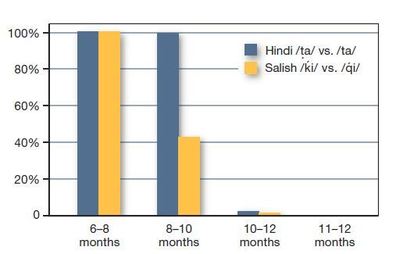
- AVery young infants are able to distinguish subtle differences between sounds in any language, but as the infant gets older, it begins to only notice subtle differences in sound in its native language, losing almost all ability to distinguish subtle differences in foreign language sounds.
- BThat infants totally lose the ability to understand multiple languages as they age.
- CThat young infants have the ability to distinguish languages from one another, but as the child ages, they gradually lose the ability to distinguish different languages. This makes every language other than their native language to sound like gibberish, and not even recognizable as words other people may understand.
- DThat young infants require intense amounts of speech therapy in order to properly speak and understand their native language.
9A mother is trying to teach her young child that his favorite toy is a Kraken. How should she indicate this the child?
- AWhenever she sees her child pick up the Kraken toy, she should say "Kraken" very loudly.
- BShe should repeat the word "Kraken" multiple times around her child.
- CShe should gaze at the Kraken toy, and perhaps gesture to it, while calling it a "Kraken".
- DShe should grab the child's hand and place it on the Kraken toy, while repeating the word "Kraken", while looking away from the child and from the toy.
10A bowl of confetti is placed in front of a young child. An experimenter asks the child, "Can you show me a seb?" to which the child points out the bowl. An experimenter then asks the child, "Can you show me sebbing?" to which the child begins to make a kneading, or throwing motion with their hands. Finally, the experimenter asks, "Can you show me some seb?" to which the child points to the pile of confetti. This demonstrates:
- AThe ability for young children to understand grammatical cues (i.e. count noun vs. verb vs. mass noun)
- BThe issues with teaching young children new words when they are not given social cues to guide their answers. (i.e. the child was unable to recognize seb as the same word)
- CThe ability for young children to understand a person's intent, but their inability to then explain or show a person's intent. (i.e. The child understood the experimenter wanted the child to show something, but could not verbalize the experimenter's desire or intent)
- DThe importance of body language in communicating ideas, and concepts.
Información
- Descripción
- Psychology
- Autor
- Rebekkah Gresh
- Idioma
- English
- Visitas
- 86
- Etiquetas
- Valoración
- Aún sin valoraciones Valora este test