
Test
Microbiology Lab Practical
Crea una cuenta gratis para terminar este test
Guarda tu progreso y consulta tu resultado final.
¿Ya tienes cuenta? Inicia sesión
Preguntas del test (127)
1What method of staining was used to create this slide?
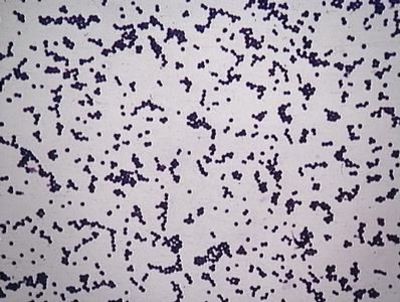
- AAcid-fast Stain
- BEndospore Stain
- CGram Stain
- DNegative Stain
2What kind of staining process was used to make this slide?
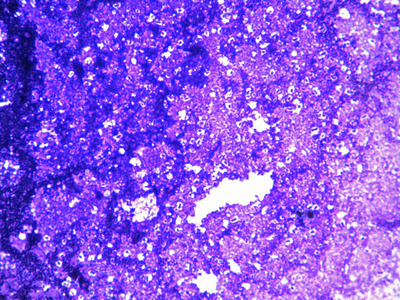
- ANegative Stain
- BEndospore Stain
- CGram Stain
- DAcid-fast Stain
3What kind of microbes are present on this slide?
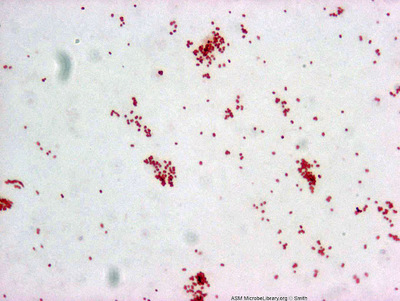
- AGram (-)
- BEndospores
- CNocardia
- DMycobacterium
4Where should your backpacks and purses be stored during the lab period?
- AOn the shelf under the lab bench.
- BOn the floor next to your seat.
- COn the lab bench.
5What items should you wear to protect yourself in the lab.
- ALab coat
- BSafety Glasses
- CGloves
- DClosed toe shoes
- EHair net
- FShoe covers
6When do you disinfect your lab table and where do you discard the used paper towels?
- ADisinfect on the way into the lab.
- BDisinfect on the way out of the lab.
- CPaper towels go in the regular trash.
- DPaper towels go in the autoclave trash.
- EDisinfect between each step of the lab process.
7You are dying of thirst (hunger, for smoke, chapped lips, bad breath) during the lab period. What do you do to alleviate your problem?
- ALeave
- BDisinfect your lab bench, take care of your need and then disinfect your lab bench, again.
- CGo to the corner of the lab room and take care of your need.
8You notice your lab partner has caught the lab manual on fire. What should you do?
- AAlert the professor
- BGet the fire extinguisher near the front door
- CGet the fire extinguisher from the back of the room
- DGet deionized water from the back of the room and pour it on the fire
9Your lab partner has managed to spill microorganisms all over the lab table. What should be done to clean up the spill?
- AAlert the professor
- BSpray disinfectant on the spill
- CSpray disinfectant on a paper towel and place on the spill
- DKeep spraying disinfectant on the paper towel
- EWait 10 minutes
- FWait 15 minutes
- GDispose in autoclave trash
- HDispose in regular trash
10A student broke an empty glass test tube. What should be done to clean up the glass and where should the pieces of glass be disposed of?
- AClean with dust pan and broom next to the fridge.
- BClean with dust pan and broom near the front door.
- CDispose of in the broken glass disposal box.
- DDispose of in the autoclave trash.
- EDispose of in the regular trash.
11The instructor tripped on a backpack on the floor knocking her safety goggles off and splashing HCl in her eyes. What should she do?
- AUse the eyewash located near the front door.
- BUse the eyewash located at the back of the room.
- CUse the eyewash next to the fridge.
- DUse the eyewash near back of the room.
12After surviving the lab period you remove your gloves by turning them inside out and then where do you toss them?
- AIn the autoclave trash
- BIn the regular trash
- CIn the used glove disposal bin
13Choose the two major types of microscopes that have been developed and the difference between them
- ACompound and Electron.
- BCompound uses light and Electron uses electrons.
- CCompound and Bright Field.
- DCompound uses electrons and Bright Field uses light.
- ECompound uses light and Bright Field uses electrons.
14Which microscopes are compound microscopes?
- APhase/Contrast Microscope
- BBright Field Microscope
- CDark Field Microscope
- DFluorescent Microscope
- EScanning Microscope
- FObjective Microscope
15The ability of the microscope to enlarge an object.
- AMagnification
- BResolving power.
- CRefractive index.
- DResolution.
16How clear your specimen will appear when viewed through the lenses.
- AResolution
- BRefractive index
- CResolving power
- DMagnification
17How well you lens is able to bend light.
- ARefractive index.
- BResolution
- CResolving power
- DMagnification
18What components influence the resolving power of a microscope?
- ANumerical aperture
- BWavelength of light
- CCondenser
- DDiopter ring
19Concentrates the light beam and directs light through the specimen.
- ACondenser
- BIris diaphragm
- CDiopter ring
- DRefractive index
20Regulates the intensity of the light entering the lens.
- AIris diaphragm
- BCondenser
- CDiopter ring
- DRheostat
21Focuses the individual eye piece to your eye.
- ADiopter ring
- BRheostat
- CDiaphragm ring
- DIris diaphragm
22Steps to achieve adequate lighting when the oil immersion objective is used to view a specimen.
- ACondenser raised to the highest position
- BIris and base diaphragm are open
- CRheostat is turned up
- DCondenser is lowered to the lowest position
23Components that influence the resolving power of a microscope.
- ANumerical aperture
- BWavelength of light
- CRheostat level
- DRefractive index
24The isolation of a single species of microbe.
- APure culture
- BColony
- CMedia
- DInoculum
- ETurbdity
25Cells from a single asexual parent that are identical.
- AColony
- BPure culture
- CMedia
- DInoculum
- ETurbidity
26Nutrient material suitable for the cultivation of microorganisms.
- AMedia
- BPure culture
- CColony
- DTurbdity
- EInoculum
27Transfer of a pure culture from a slant culture to a new sterile broth. The sampling of a bacterial culture.
- AInoculum
- BPure culture
- CColony
- DMedia
- ETurbidity
28Cloudiness in broth that indicates growth.
- ATurbidity
- BPure culture
- CMedia
- DColony
- EInoculum
29Steps involved in labeling a test tube.
- ALabel a piece of labeling tape with your name and the name of the bacteria and place on test tube.
- BUse a wax pencil and label the test tube with your name and the name of the bacteria.
- CUse a marker and label the test tube with your name and the name of the bacteria.
30What are the steps for labeling a Petri plate?
- ALabel the bottom of the media side using a wax pencil or marker with your name and the organism you are transferring.
- BLabel the lid using a wax pencil or marker with your name and the name of the organism you are transferring.
- CLabel a piece of labeling tape with your name and the name of the organism you are transferring and place it on the lid of the Petri plate.
31What are the steps for incubating a Petri plate?
- ASterilize inoculating loop in Bacticinerator. Lightly drag the tip of the loop from side to side or back and forth in order to spread the inoculum. Replace lid. Incubate lid side up.
- BSterilize inoculating loop in Bacticinerator. Lightly drag the tip of the loop from side to side or back and forth in order to spread the inoculum. Replace lid. Incubate lid side down.
32What is meant by the statement that microorganisms are ubiquitous?
- AMicroorganisms are everywhere
- BMicroorganisms are hard to identify
- CMicroorganisms are difficult to see without a microscope
- DMicroorganisms come in many forms
33Handling of bacteria in a manner so as to prevent contaminating laboratory media and to prevent infecting ourselves and our classmates.
- AAseptic technique
- BSterile transfer
- CInoculation technique
- DUbiquitous
34Why are "basic" dyes used in the Gram stain?
- ABacteria have an overall negative charge so stain with positive (basic) dyes. Opposites attract.
- BBacteria have an overall positive charge so stain with positive (basic) dyes. Likes attract likes.
35State two differences between a simple stain and a differential stain.
- ASimple stain uses one dye; all bacteria are the same color; shows size, shape and arrangement. Differential stain uses two dyes; different bacteria are stained contrasting colors; shows size, shape, arrangement and something else.
- BDifferential stain uses one dye; all bacteria are the same color; shows size, shape and arrangement. Simple stain uses two dyes; different bacteria are stained contrasting colors for simple identification; shows size, shape, arrangement and something else.
36A) Has a high lipid content and thin layer of tecoic acid underneath and stains pink.
B) Has a low lipid content and thick layer containing tecoic acids and stains purple.- AA) Gram negative bacteria
B) Gram positive bacteria - BA) Gram positive bacteria
B) Gram negative bacteria - CA) Gram stain
B) Acid-fast stain - DA) Acid-fast stain
B) Gram stain
- AA) Gram negative bacteria
37What us the importance of using only a pinpoint of inoculum for the smear preparation?
- AInsure proper staining
- BInsure proper decolorizing
- CThe slide is small
- DAllows you to prepare only one or two bacteria.
38What is the importance of allowing the smear to air dry?
- AInsure the cells stay intact and stain properly.
- BInsure the cells are dead and stain properly
- CInsure the cells wont move around during staining
39What is the importance of decolorizing smears one at a time?
- AIt is the most critical step and there is no hard and fast rule on how long to decolorize.
- BIt is the most critical step and don't want to drop the slides.
- CIt is the most critical step and need to time it exactly.
40List the gram stain reagents in order and state their function.
- A1) Crystal Violet - Primary stain
2) Iodine - Mordant, combines with the crystal violet in the cell.
3) Acetone or ethanol or combination of 75% ethanol/25% acetone - Decolorizer
4) Safranin - Counterstain or Secondary stain - B1) Crystal Violet - Primary stain
2) Safranin - Counterstain or Secondary stain
3) Iodine - Mordant, combines with the crystal violet in the cell.
4) Acetone or ethanol or combination of 75% ethanol/25% acetone - Decolorizer - C1) Crystal Violet - Primary stain
2) Acetone or ethanol or combination of 75% ethanol/25% acetone - Decolorizer
3) Iodine - Mordant, combines with the crystal violet in the cell.
4) Safranin - Counterstain or Secondary stain - D1) Crystal Violet - Primary Stain
2) Iodine - Mordant, combines with the crystal violet in the cell
3) Safranin - Counterstain or Secondary stain
4) Acetone or ethanol or combination of 75% ethanol/25% acetone - Decolorizer
- A1) Crystal Violet - Primary stain
41Why do gram negative cells lose the primary dye during decolorization?
- AThe high lipid content in gram negative cell walls causes them to dissolve in the ethanol allowing the crystal violet dye to leak out.
- BThe low lipid content in gram negative cell walls causes them to dissolve in the ethanol allowing the crystal violet dye to leak out.
42Why is the Acid-fast stain considered a "differential stain"?
- AIt distinguishes between two groups of organisms based on the lipid content in their cell walls.
- BIt uses two positively charged dyes.
- CIt uses one positively charged dye and one negatively charged dye.
- DIt tells size, shape, arrangement and something else.
- EIt tells size, shape and arrangement.
43What is the difference between the decolorizer used in the Gram stain and the decolorizer used in the Acid-fast stain?
- AAcid fast uses a solution of 3% HCl and 95% ethanol. Gram stain uses just ethanol.
- BAcid fast uses a solution of 95% HCl and 3% ethanol. Gram stain uses just ethanol.
44Lipids in the cell's waxy wall prevent the acid-alcohol from decolorizing the cell.
- AAcid-fast
- BGram
- CNegative
- DEndospore
45What is the difference between the Ziehl-Neelsen stain and the Kinyoun stain?
- AZiehl-Neelsen uses steam to penetrate the mycolic acid in cell walls.
Kinyoun uses concentrated dye, hard heat fixing and longer exposure time. - BKinyoun uses steam to penetrate the mycolic acid in cell walls.
Ziehl-Neelsen uses concentrated dye, hard heat fixing and longer exposure time. - CZiehl-Neelsen uses hard heat fixing to penetrate the mycolic acid in cell walls.
Kinyoun uses concentrated dye, steam and longer exposure time. - DKinyoun uses hard heat fixing to penetrate the mycolic acid in cell walls.
Ziehl-Neelsen uses concentrated dye, steam and longer exposure time.
- AZiehl-Neelsen uses steam to penetrate the mycolic acid in cell walls.
46Which are acid-fast organisms and what disease do they cause?
- AMycobacterium tuberculosis
Disease: Tuberculosis - BMycobacterium leprae
Disease: Leprosy or Hansen's disease - CNocardia asteroides
Disease: Nocardiosis - DCryptosporidium
Disease: Cryptosporidiosis - EMycosporidium
Disease: Mycardiosis - FNocardia tuberculosis
Disease: Tuberculosis
- AMycobacterium tuberculosis
47What are the reactants in the acid-fast stain, in order?
- A1) Carbolfuchsin
2) Acid-alcohol
3) Loeffler's methylene blue - B1) Loeffler's methylene blue
2) Acid-alcohol
3) Carbolfichsin - C1) Carbolfuschsin
2) Iodine
3) Acid-alcohol
4) Loeffler's methylene blue - D1) Loeffler's methylene blue
2) Iodine
3) Acid-alcohol
4) Carbolfuchsin
- A1) Carbolfuchsin
48Two methods used to force the dye into an endospore.
- ASteam for 3-5 minutes
- BHard heat fixing then letting the dye remain on the slide for an extended period of time.
- CHard heat fixing
- DSteam then letting the dye remain on teh slide for an extended period of time.
49What dyes are used in the Schaffer-Fulton spore stain?
- AMalachite green
- BGram's safranin
- CIodine
- DLoeffler's methylene blue
50In the "Christmas tree" stain, the endospores are colored _________________ and the vegetative cells are colored ____________________.
- AGreen
Red - BRed
Green
- AGreen
51Metabolically active, replicating cell.
- AVegetative cell
- BEndospore
- CGerminated cell
52The formation of endospores within a vegetative cell
- ASporogenesis
- BDecolorization
- CGermination
53When an endospore reverts to a vegetative state.
- AGermination
- BSporogenesis
- CGrowth
54Why are endospores considered "the most resistant life form known"?
- ACan remain dormant indefinitely
- BResistant to antibiotics and most disinfectants
- CResistant to radiation
- DResistant to boiling
- EResistant to drying
- FImpermeability of spore coat
55What are the medically important endospore-producing bacteria and their associated disease?
- ABacillus anthracis
Disease: anthrax - BClostridium botulinum
Disease: Botulism - CClostridium difficile
Disease: Toxic enterocolotis - DClostridium perfringens
Disease: Gas gangrene, food poisoning - EClostridium tetani
Disease: Tetnus, lockjaw - FClostridium anthracis
Disease: Anthrax
- ABacillus anthracis
56Which medically important genera of bacteria produce endospores?
- ABacillus
- BClostridium
- CStreptococcus
- DStaphylococcus
57A positive stain _____________________________ and a negative stain ______________________________.
- AStains what you want to see
Stains everything but the structure you want to see - BStains everything but the structure you want to see
Stains what you want to see - CStains gram (+) bacteria
Stains gram (-) bacteria - DStains gram (-) bacteria
Stains gram (+) bacteria
- AStains what you want to see
58Why are Nigrosin and India ink commonly used negative stains?
- AThey are negatively charged dyes and are repelled by the negative contents of the bacterial cell.
- BThey are positively charged dyes and are repelled by the positive contents of the bacterial cell.
- CThey are positively charged dyes and are attracted by the negative contents of the bacterial cell.
- DThey are negatively charged dyes and are attracted by the positive contents of the bacterial cell.
59What are the advantages of using a negative stain versus a positive stain?
- AAble to see a capsule
- BDo not heat fix so can see them as they are
- CCan be used for things that don't stain.
- DCan see if it produces endospores
- ECan see if it is gram (-) or gram (+)
60Sticky substance that is tightly bound, highly organized and generally round or oval.
- ACapsule
- BSlime layer
- CEndospore
61Sticky substance is loosely bound and somewhat irregularly shaped.
- ACapsule
- BSlime layer
- CEndospore
62How does a capsule contribute to the virulence of a bacteria?
- AHelps the bacteria avoid phagocytosis by white blood cells
- BHelps the bacteria attach to skin and mucous membranes
- CIs a source of nutrition for the bacteria when resources are scarce
- DContains the pathogenic part of the bacteria
63What are the difference(s) between the smear preparation for a Gram stain and a capsule stain?
- AA smear for a capsule stain is not heat fixed.
- BA spear from a capsule stain is not rinsed with deionized water it is rinsed with copper sulfate
- CA smear for a capsule stain uses steam
- DA smear for a Gram stain uses crystal violet and a capsule stain does not
64Using Anthony's stain, the background will be colored ____________________ and the capsule will be colored _________________________.
- ADark blue
Light blue to white - BLight blue to white
Dark blue
- ADark blue
65What are the damaging by-products of oxygen during cellular respiration?
- ASuperoxides
- BPeroxides
- CCarbon dioxide
- DCarbon monoxide
66What enzymes neutralize the damaging effects of the by-products of oxygen during cellular respiration?
- ACatalase
- BPeroxidase
- CSuperoxide dismutase
- DCarbonase
67Uses oxygen as the final member of the ETC and has enzymes to break down the toxic by-products of oxygen.
- AAerobe
- BAnerobe
68Does not use oxygen as the final member of the ETC and lacks the enzymes to breakdown the toxic by-products of oxygen.
- AAerobe
- BAnaerobe
69How does a candle jar achieve an atmosphere to grow microaerophilic and capnophilic organisms?
- AThe flame burns using up the oxygen and producing CO2
- BThe flame burns up the CO2 and produces oxygen.
70How does a Gas Pak jar achieve an anaerobic atmosphere?
- AThe pak contains chemicals that produce H+ and CO2. The H+ combines with the O2 in the jar to produce H2O.
- BThe pak contains chemicals that produce CO2 and destroy O2.
71Which type of organism grows equally well in all types of oxygen concentrations?
- AFacultative anaerobes
- BMicroaerophiles
- CCapnophiles
- DAerotolerant anaerobes
72How does thioglycolate broth grow anaerobic bacteria as well as aerobic bacteria?
- AThe agar prevents diffusion of O2
- BIt contains a reducing agent, sodium thioglycollate, that combines with O2 to produce water
- CIt contains a reducing agent, sodium thioglycollate, that combines with the agar to produce CO2 near the bottom
- DThe agar prevents diffusion of CO2
73Organisms that require around 20% atmospheric oxygen.
(Check the name of the organism and the media on which it will grow.)- AStrict aerobe
- BFacultative anaerobe
- COnly at the top of the thioglycollate broth.
- DCandle jar
- EGas pak
- FCapnophile
74Organisms that require between 5-15% atmospheric oxygen for growth
(Check the name of the organism and the media on which it will grow.)- AMicroaerophile
- BFacultative anaerobe
- CGrows in candle jar
- DGrows at the point where the oxygen level is diminishing in the thio broth.
- EGrows in the GasPak
75Organisms that require between 5-15% atmospheric oxygen and increased (10%) carbon dioxide.
(Check the name of the organism and the media on which it will grow.)- ACapnophile
- BMicroaerophile
- CGrows in candle jar
- DGrows in oxygen
- EGrows in a GasPak
76Organisms that will use a fermentative metabolic pathway in anaerobic conditions yet can convert to aerobic cellular respiration when atmospheric oxygen is present. They grow equally well in aerobic anaerobic environments.
- AFacultative anaerobe
- BMicroaerophile
- CGrows in oxygen
- DGrows in candle jar
- EGrows in GasPak
- FGrows throughout the entire thio broth slant
77Organism that can exist in the presence of oxygen, but does not use oxygen for metabolism.
- AAerotolerant anaerobe
- BMicroaerophile
- CAll over the thio broth slant but slightly less at the top
- DGrows in the GasPak
- ECapnophile
78Organisms that die in the presence of atmospheric oxygen because they lack the enzymes needed to breakdown the toxic by-products.
- AStrict anaerobe
- BGrows in GasPak
- CGrows in candle jar
- DGrows toward the bottom of the thio broth
- EGrows toward the top of the thio broth
79Which gene allows jellyfish to glow in the dark?
- AGreen fluorescent protein
- BFluorescent blue plasmid
- CGFP
- DFBP
80Bacteria cells able to take up the plasmid/DNA.
- ACompetent cells
- BCompetent genes
- CCompetent proteins
81What laboratory procedures are done to encourage cells to become competent?
- AMixing cells with calcium chloride during growth phase
- BExposing cells to extreme temperature changes during the proceduree
- CMixing cells with with heated calcium hydroxide
- DFreezing cells
82What is the relationship between a gene and a protein?
- AA gene is a piece of DNA that provides the instructions for making a protein
- BA protein is a piece of DNA that provides the instructions for making a gene
- CDNA is a piece of a protein that provides the instructions for making a gene
83Chromosomal DNA ___________________________________ and plasmids _________________________________________.
- ACarries genes needed for the hereditary characteristics essential for bacterial growth and reproduction.
Small pieces of circular DNA that have genes for one or more traits that may be beneficial but are not essential for bacterial survival. - BSmall pieces of circular DNA that have genes for one or more traits that may be beneficial but are not essential for bacterial survival.
Carries genes needed for the hereditary characteristics essential for bacterial growth and reproduction. - CCarries genes needed for the hereditary characteristics that may be beneficial but are not essential for bacterial growth and reproduction.
Small pieces of circular DNA that have genes for one or more traits that are essential for bacterial survival.
- ACarries genes needed for the hereditary characteristics essential for bacterial growth and reproduction.
84Which genes are contained in the pGLO plasmid?
- AGFP
- BBLA
- CAra-C
- DAra-B
85How is expression of the Green Fluorescent Protein gene regulated?
- AThe Ara-C gene controls expression of GFP via the sugar arabinose
- BThe Ara-B gene controls expression of GFP via the sugar arabinose
- CThe Ara-C gene controls expression of GFP via the sugar glucose
86Chemicals produced by microorganisms that in small quantities can inhibit the growth of other microorganisms
- AAntibiotic
- BMIC
- CE-test
87Determines the lowest concentration of an antibiotic that is able to inhibit the growth of a test organism.
- AAntibiotic
- BMIC
- CE-test
88A plastic coated strip that contains a gradient
- AAntibiotic
- BMIC
- CE-test
89What are the disadvantages of using a broad spectrum antibiotic?
- AContributes to escalating drug resistance
- BWipes out a person's normal flora resulting in superinfections
- COnly works on weak bacteria
90What does the antibiotic test result "sensitive" indicate about the test organism?
- AAn organism is susceptible to drug concentrations obtained in the body using normal therapeutic doses.
- BThe antibiotic is likely to be effective against the pathogen
- CThe antibiotic is not likely to work.
91What factors must be controlled in order to standardize the Kirby-Bauer test?
- AStability of the antibiotic
- BRate of diffusion of the antibiotic
- CpH of the culture medium
- DDepth of the culture medium
- EInoculum density
- FIncubation time
- GIncubation temperature
- HConcentration of antibiotic
92A?
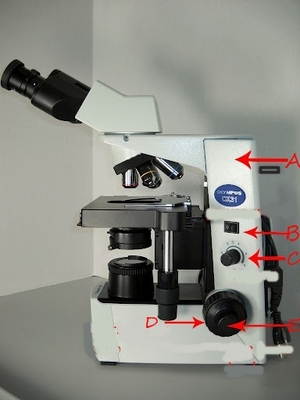
- AArm
- BRheostat
- CPower switch
- DCoarse focus knob
93B?
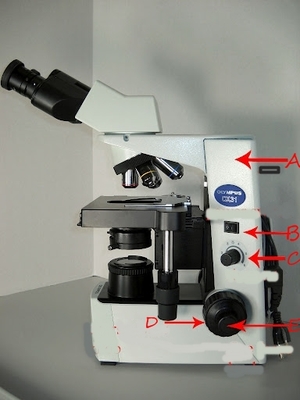
- ARheostat
- BPower switch
- CCoarse focus knob
- DArm
94C?
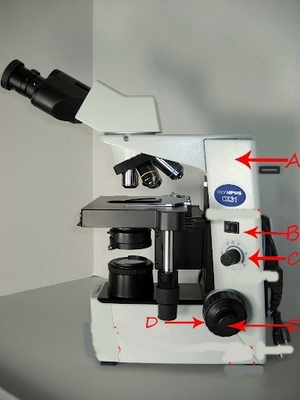
- ARheostat
- BPower switch
- CCoarse focus knob
- DFine focus knob
95D?
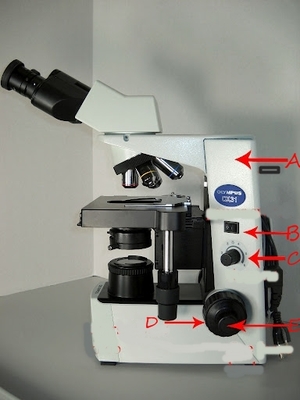
- ACoarse focus knob
- BFine focus knob
- CRHeostat
- DPower switch
96E?
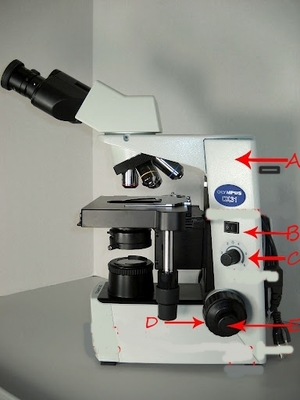
- AFine focus knob
- BCoarse focus knob
- CRheostat
- DPower switch
97A?
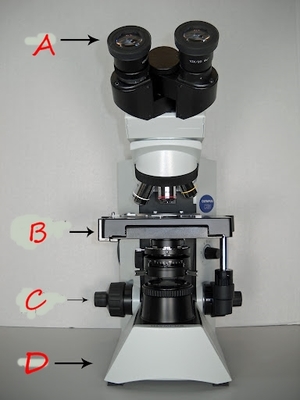
- AOcular
- BDiopter
- CDiaphragm ring
- DFine focus knob
98B?
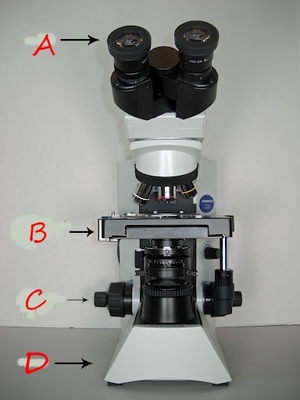
- AMechanical stage
- BBase
- CSlide stage
- DOcular stage
99C?
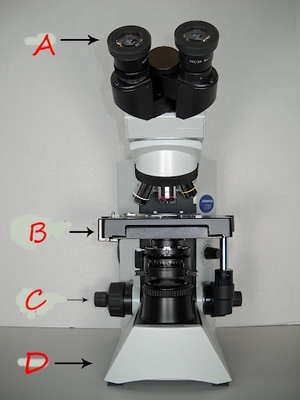
- AFine focus knob
- BCoarse focus knob
100D?
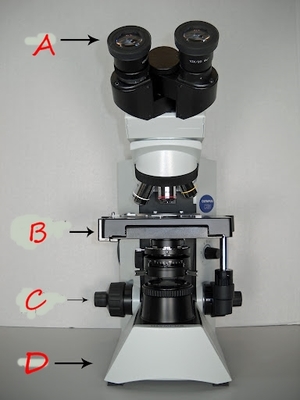
- ABase
- BMechanical stage
- CMechanical base
101A
B
C
D
E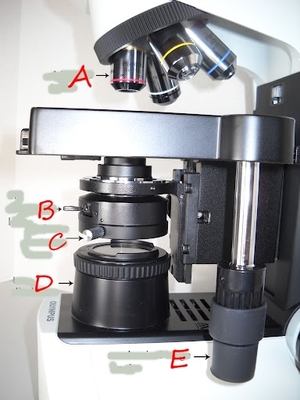
- AA - Objective lens
B - Iris diaphragm lever
C - Condenser centering screw
D - Base diaphragm
E - Mechanical stage knob - BA - Ocular lens
B - Iris diaphragm lever
C - Condenser centering screw
D - Base diaphragm
E - Mechanical stage knob - CA - Ocular lens
B - Condenser centering screw
C - Iris diaphragm lever
D - Base diaphragm
E - Mechanical stage knob - DA - Ocular lens
B - Iris diaphragm lever
C - Mechanical stage knob
D - Base diaphragm
E - Condenser centering screw
- AA - Objective lens
102A
B
C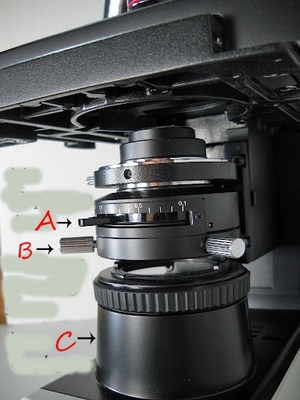
- AA - Iris diaphragm lever
B - Condenser centering screw
C - Base diaphragm - BA - Condenser centering screw
B - Iris diaphragm lever
C - Base diaphragm - CA - Iris diopter screw
B - Iris diaphragm lever
C - Base diaphragm - DA - Iris diopter lever
B - Condenser centering screw
C - Base diaphragm
- AA - Iris diaphragm lever
103A
B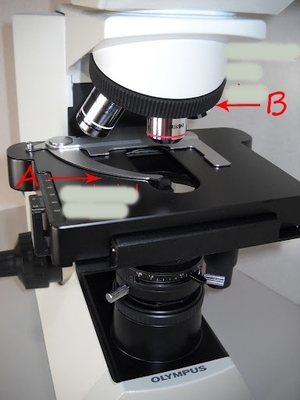
- AA - Revolving nose piece
B - Mechanical stage clip - BA - Objective ring
B - Mechanical stage clip - CA - Diopter ring
B - Mechanical stage clip
- AA - Revolving nose piece
104A
B
C- AA - Condenser knob
B - Condenser
C - Base diaphragm ring - BA - Condenser knob
B - Condenser ring
C - Base - CA - Condenser ring
B - Condenser
C - Base
- AA - Condenser knob
105In the thioglycollate test tube A, what kind of organism does the growth represent?
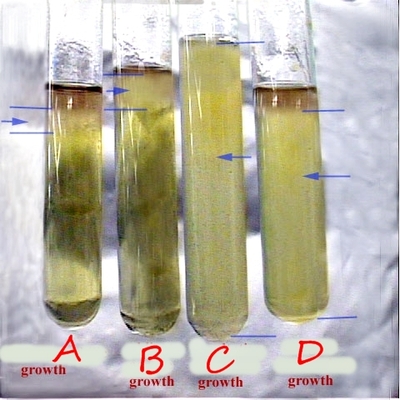
- AMicroaerophile
- BObligate/Strict aerobe
- CFacultative anaerobe
- DObigate/strict anaerbe
106In the thioglycollate test tube B, what kind of organism does the growth represent?
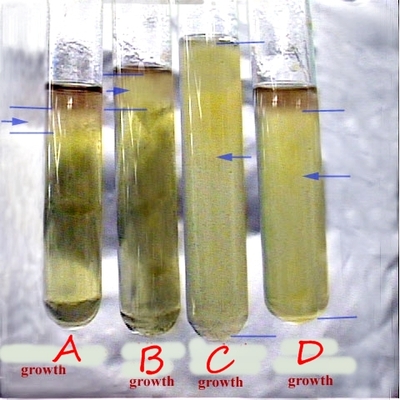
- AMicroaerophile
- BObligate/Strict aerobe
- CFacultative anaerobe
- DObligate anaerobe
107In the thioglycollate test tube C, what kind of organism does the growth represent?
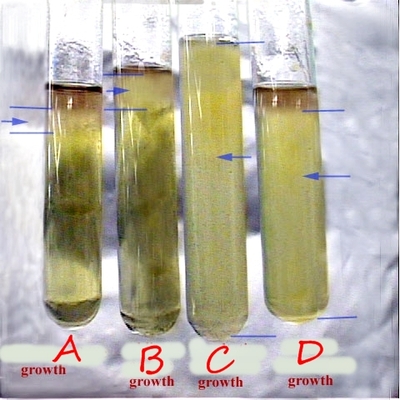
- AMicroaerophile
- BObligate/strict aerobe
- CFacultative anaerobe
- DObligate/strict anaerobe
108In the thioglycollate test tube D, what kind of organism does the growth represent?
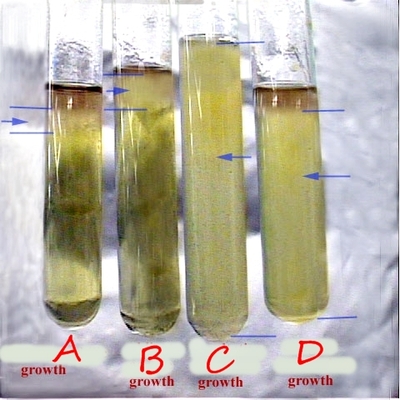
- AMicroaerophile
- BObligate/strict aerobe
- CFacultative anaerobe
- DObligate/strict anaerobe
109On a luria plate with Ampicillin, why is there no E. coli growth?
- ABecause E.coli are sensitive to Ampicillin
- BBecause E. coli are resistant to Ampicillin
- CBecause luria does not contain the nutrients necessary for growth.
110What protein allowed E. coli to grow on the plate with luria, Ampicillin and pGlo?
- ABeta lactamase
- BBLA
- CGFP
- DGreen fluorescent protein
111What gene allowed the E. coli to grow on the plate with luria, Ampicillin and pGlo?
- ABLA
- BBeta lactamase
- CGFP
- DGreen fluorescent protein
112What molecule allowed the E. coli to glow like a jellyfish?
- AArabinose
- BBeta lactamase
- CAra-C
- DGreen fluorescent protein
113What media is used for the antibiotic sensitivity test?
- AMueller hinton
- BKirby Bauer
- CLuria
114What is the result of the beta lactamase test pictured?
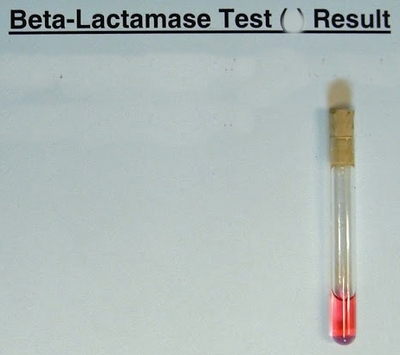
- AIt is pink and therefore, the test is negative and the microbe is sensitive to penicillin
- Bit is pink and therefore, the test is positive and the microbe is sensitive to penicillin
- Cit is pink and therefore, the test is positive and the microbe is resistant to penicillin
- DIt is pink and therefore, the test is negative and the microbe is resistant to penicillin
115Beta lactamase test
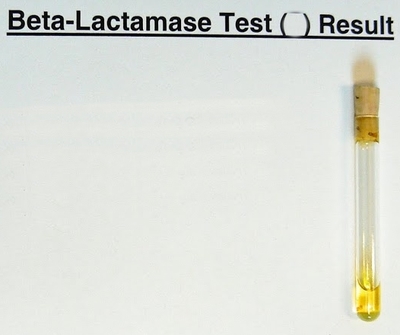
- AIt is yellow and therefore, the test is positive and the microbe is resistant to penicillin
- BIt is yellow and therefore, the test is negative and the microbe is resistant to penicillin
- CIt is yellow and therefore, the test is positive and the microbe is sensitive to penicillin
- DIt is yellow and therefore, the test is negative and the microbe is sensitive to penicillin
116Why us thioglycollate a semi-solid agar?
- AHas agar in it and contains a reducing agent that produces water
- BHas agar and a reducing agent that produces CO2
117Why are agar plates labeled on the bottom and inverted when incubated?
- ALabeled on the bottom in case you lose the lid and inverted during incubation to prevent condensation from dripping onto the agar surface
- BLabeled on the bottom in case you lose the lid and inverted so you can read the label
118Why hold the test tube with your little finger while taking your bacterial sample?
- ASo you do not contaminate the cap.
- BSo the cap doesn't roll away.
- CSo you can stretch your fingers.
119Describe the proteins encoded in the pGLO plasmid.
- AGreen fluorescent protein
- BBeta lactamase
- CAra-C represser protein
- DBeta green protein
120What is the principal of the beta lactamase test?
- ADoes the bacteria have the BLA gene and therefore produce beta lactamase
- BDoes the bacteria have the BLA protein and therefore produce the beta lactamase gene
121Explain the regulation mechanism of the Green Fluorescent Protein gene expression.
- AArabinose has to move the Ara-C represser protein out of the way so GFP can be transcribed and translated.
- BGFP takes up the arabinose so Ara-C can be transcribed and translated.
122Define reducing agent
- ASodium thioglycollate is a reducing agent and it reduces by binding O2 and converting it to water
- BSodium thioglycollate is a reducing agent that reduces by causing evaporation of the broth
123What are the criteria used to describe a bacterial colony>
- ASurface
- BElevation
- CWhole colony
- DEdge
- EColor
124Locations of items in the lab
- ANear the front door: Fire extinguisher, Eye wash, Shower, Gloves
- BBack of room: Fume hood
- CLab bench: Disinfectant, Autoclave bags, Paper towels
- DNear Sinks: Bleach, Dyes used for stains, Paper towels (above)
- EFume hood: Broken glass disposal box (underneath), Autoclave bags
- FFront podium: Phone
- GBack: Test tube racks, MSDS notebooks (back corner),
- HNext to fridge: Dustpan and broom
125Which items are disposed of in the autoclave trash?
- AUsed glass test tubes
- BUsed glass slides
- CBroken glass
- DUsed latex gloves
- EPaper towels used for bench disinfection
- FContaminated Petri plates
126Which items should be disposed of in the disinfectant basin?
- AUsed glass slides
- BUsed glass test tubes
- CContaminated Petri plates
- DBroken glass
127Which itens should be disposed of in the regular trash?
- ABroken glass
- BPaper towels used in bench disinfection
- CQtip swabs used to clean microscopes
- DUsed latex gloves
Información
- Descripción
- MCC Microbiology Lab Practical 2
- Autor
- Elle Ashe
- Idioma
- English
- Visitas
- 1.974
- Etiquetas
- Valoración
- Aún sin valoraciones Valora este test