
Test
ECG/EKG
Crea una cuenta gratis para terminar este test
Guarda tu progreso y consulta tu resultado final.
¿Ya tienes cuenta? Inicia sesión
Preguntas del test (15)
1The action potential propagates as a wave of depolarization through the conduction system myocardium. This wave is the electrical signal that triggers myocardial contraction.
- AVerdadero
- BFalso
2Which of the following is FALSE regarding electrocardiography?
- AIt provides information about cardiac size (hypertrophy) and the mean vector (direction) of ventricular or atrial activation (mean electrical axis-MEA)
- BIs indicated when the heart rate is too high, too slow, or the rhythm is inappropriately irregular
- CA wave of depolarization directed towards the positive electrode of a lead results in a positive deflection on the EKG
- DThe normal heart depolarizes from left to right, cranial to caudal, and dorsal to ventral
3Which of the following are correctly paired? Check all that apply.
- AAtrial depolarization- P wave
- BAtrial depolarization- QRS complex
- CAtrial depolarization- T wave
- DVentricular depolarization- QRS complex
- EVentricular depolarization- P wave
- FVentricular depolarization- T wave
- GVentricular repolarization- T wave
- HVentricular repolarization- QRS complex
- IVentricular repolarization- P wave
4MEA (mean electrical axis) is the dominant direction of atrial activation.
- AVerdadero
- BFalso
5What is the origin of a narrow QRS?
- ASupraventricular
- BThe ventricles
- CIntraventricular conduction delay
6Which of the following is FALSE regarding arrhythmias?
- ADevelop when the conduction system prevents initiation or propagation of the wave front
- BThey are clinically important because they can be responsible for clinical signs including syncope, low cardiac output, and sudden cardiac death
- CTachyarrhythmias develop with high vagal tone
- DBradyarrhythmias develop when disease of the conduction system slows the rate of depolarization or "blocks" conduction
7What type of arrhythmia does this image represent? Note: this is on 25 mm/sec paper.

- ASinus arrhythmia
- BSinus tachycardia
- CSinus bradycardia
- DSinus arrest
8What does this image demonstrate?
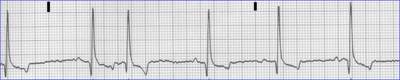
- ASupreventricular Tachycardia (SVT)
- BSupraventricular Tachyarrhythmia (SVTA)
- CSinus Tachycardia
- DAtrial fibrillation
9What does this image depict?
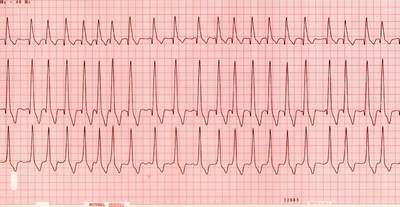
- AAtrial fibrillation
- BSupraventricular tachyarrhythmia
- CSupraventricular tachycardia
10What is this?
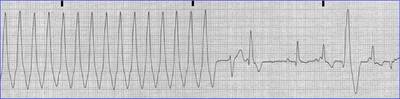
- AVentricular fibrillation
- BVentricular tachycardia
- CAtrial fibrillation
- DSinus arrhythmia
11How are AV blocks resolved?
- AThey aren't, the patient just lives with it
- BAdministration of atropine
- CExercise
- DThey resolve on their own
12Which of the following is CORRECT?
- A1st degree AV block: PR prolongation
2nd degree AV block: complete failure of AV conduction
3rd degree AV block: intermittent failure of AV conduction - B1st degree AV block: complete failure of AV conduction
2nd degree AV block: intermittent failure of AV conduction
3rd degree AV block: PR prolongation - C1st degree AV block: PR prolongation
2nd degree AV block: intermittent failure of AV conduction
3rd degree AV block: complete failure of AV conduciton - D1st degree AV block: complete failure of AV conduction
2nd degree AV block: PR prolongation
3rd degree AV block: intermittent failure of AV conduction
- A1st degree AV block: PR prolongation
13Which AV block is this?
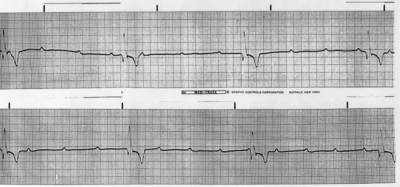
- A1st degree
- B2nd degree
- C3rd degree
14Which AV Block is this?
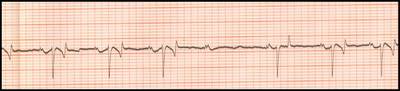
- A1st degree
- B2nd degree
- C3rd degree
15What is going on in this EKG?

- ASick sinus syndrome
- BHyperkalemic rhythm
- C1st degree AV block
- DAtrial fibrillation
Información
- Descripción
- Cardiorespiratory Test sobre ECG/EKG, creado por karahm el 02/03/2014.
- Autor
- karahm
- Idioma
- English
- Visitas
- 121
- Etiquetas
- Valoración
- Aún sin valoraciones Valora este test