
Test
Earth Science
Crea una cuenta gratis para terminar este test
Guarda tu progreso y consulta tu resultado final.
¿Ya tienes cuenta? Inicia sesión
Preguntas del test (27)
1What is the name of the theory that states Earth's crust is broken into many pieces that float around on the mantle (or sometimes stated as floating on the asthenosphere)?
- AThe Theory of Evolution & Natural Selection
- BThe Theory of Plate Tectonics
- CThe Theory of Subduction
- DThe Plate Boundaries Theory
2What process or processes would cause a big, tall mountain to become a much smaller mountain or hill over thousands or millions of years?
- ALava forming extrusive igneous rock.
- BSedimentation or deposition.
- CWeathering and erosion
- DSubduction
3Which of the following is the name of a break in rock that could rearrange rock layers so that they no longer line up in neat rows?
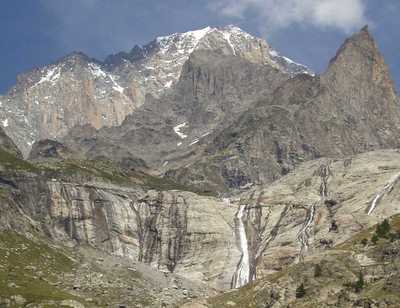
- AAn epicenter
- BA fault
- CFolding
- DSuperposition
4If you see rocks that look like they have been pushed together in ribbon-like layers, such as in the diagram below, what process would cause this change in the rock layers?
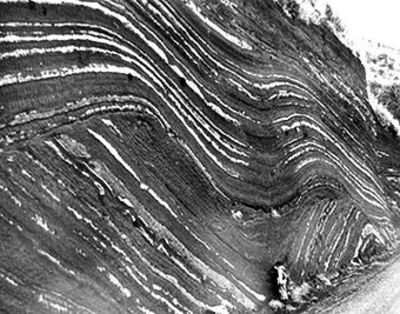
- AFolding
- BFaulting
- CWeathering
- DAn earthquake
5Which rock layer below most likely is the newest or youngest?
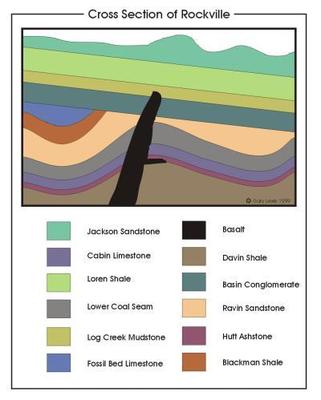
- AThe bottom layer made up of a rock called davin shale.
- BThe top layer made up of loren shale
- CThe intrusion of basalt
- DThe blackman shale layer
6Which of these rock layers would be most the most likely to be made up of sedimentary rock?
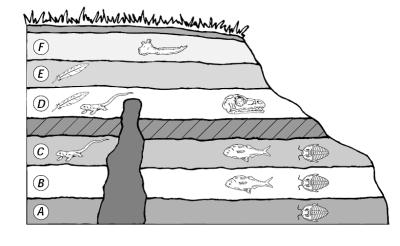
- ARock layer A
- BThe intrusion
- CRock layer F
- DAll of these would be equally likely to be made up of sedimentary rock
7Theory of Pangaea: In the early twentieth century, a scientist named Alfred Wegener noticed that, if you cut the continents out of a map, they would fit nicely together into one large super continent. He named this super continent, Pangaea. He predicted that Pangaea existed about 200 million years ago. Using that time period, he looked at what animals lived during that time and began to search for fossils on each continent. He was able to find fossils of the same kinds of animals on both continents where they would have been joined so his theory was supported. However, the best supporting evidence wasn’t found until the 1060’s. The idea of continental drift, where tectonic plates move around on Earth's mantle, explains how the continents have ended up in their current positions. Based on this information, which of the following is a true statement?
- AEarth's tectonic plates have very slowly moved over a long period of time. They used to be pushed together in one large continent, called Pangaea, but over time, the continents drifted apart to where they are today. They are not likely to move any further apart or closer together over the next few million years because the process has stopped. Fossil evidence proves the continents were once pushed together.
- BEarth's tectonic plates float around on the mantle because of convection currents. They used to be pushed together as one large continent, called Pangaea. Over millions of years, the continents have drifted apart to their current positions. One major piece of evidence to support this theory are the fossils found and the shapes of the continents that seem to fit like puzzle pieces. Over the next few million years, the continents will continue to drift apart in places and drift closer together in other places.
- CAlfred Wegener figured out that Earth's tectonic plates were moving around and called the idea continental drift. He realized this process happens very quickly, so over the next hundred years or so, North America will probably be touching China because of the convergent plate boundary around the Pacific Ocean.
- DContinental drift is the idea that explains how earth's continents have pushed together to their current positions, which is called Pangaea. Alfred Wegener was the person who proposed the idea that fossils change as the continents move around. By working with Charles Darwin, Alfred Wegener was able to figure out how Pangaea happened from convection currents by studying fossils.
8Lithosphere: The outer crust of the earth is known as the lithosphere and it is composed of the seven large plates and many smaller pieces. These are all known as tectonic plates. In Wegener’s theory, Pangaea broke apart and the pieces started moving over the earth’s surface and into their current locations. In fact, the plates are still moving and, if you could revisit the earth in a few million years from now, you would notice that the continents are not in exactly the same places they are today. Tectonic plates move because of convection currents within the mantle. As hot magma moves up, it starts to cool and sinks back toward the core where it heats back up, lowering the density and causing it to rise and cool again. What is the lithosphere?
- AAll of Earth's Land
- BAll of Earth's Water
- CAll of Earth's Living Things
- DAll of Earth's Air
9Water on Earth is always changing. Its repeating changes make a cycle. As water goes through its cycle, it can be a solid (ice), a liquid (water), or a gas (water vapor). Ice can change to become water or water vapor. Water can change to become ice or water vapor. Water vapor can change to become ice or water. What type of change is this when a substance changes from a solid to a liquid or a liquid to a gas?
- AChemical only.
- BPhysical only.
- CBoth chemical and physical
10What was the total distance this plane flew?
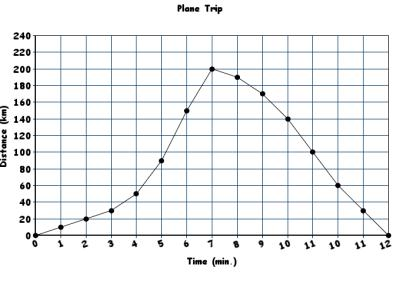
- A200 km
- B0 km
- C400 km
- DNone of these
11Look at the graph above. In this experiment, what was the dependent variable?
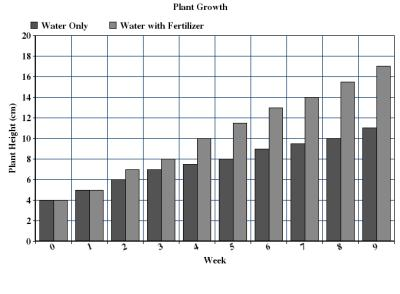
- AThe week the plant was checked
- BFertilizer given to plants
- CHow many plants grown
- DThe height of the plants
12According to this graph, which of the following would be the BEST conclusion to the experiment?
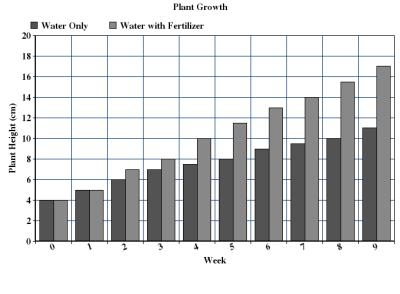
- APlants given fertilizer grew an average of 6 cm higher than those not given fertilizer; therefore, the fertilizer is clearly helpful to the growth of these plants.
- BPlants given water only grew an average of 6 cm higher than those not given fertilizer; therefore, the fertilizer is clearly not helpful to the growth of these plants.
- CBased on this graph, it is difficult or impossible to tell whether or not the fertilizer was helpful to the plants.
- DFertilizer is helpful to the growth of plants as you can see by this experiment.
13In many locations the hot molten magma from deep within the Earth rises up through the crust to reach the surface. This sometimes happens in the middle of plates. When a hot spot forms in the middle of a plate, it remains constant, as the plate continues to move over it. The result is that a trail of volcanoes is left behind, with older volcanoes moving away from the hot spot, and newer ones forming over top of the hot spot. What moves to form a hot spot volcano?
- AThe hot spot itself moves
- BThe convergent plate boundary forms the volcanoes as the ocean plate subducts
- CThe tectonic plate moves over the hot spot
- DNothing moves. Several hotspots form in a line to create a volcanic island arc
14What is the difference between a fault and a fold?
- AA fault is when rocks break, and a fold is when rocks bend.
- BA fault is caused by plates pulling apart, and a fold is caused by plates pushing together.
- CA fault occurs only in the middle of plates, and a fold occurs at plate boundaries.
- DNone of these describes the difference in a fault and a fold.
15Which processes are considered destructive?
- ADivergent plate boundaries and weathering.
- BWeathering and convergent plate boundaries.
- CBoth convergent plate boundaries and divergent plate boundaries.
- DTransform plate boundaries and faults.
16Which type of plate boundary forms folded mountains?
- AConvergent between an ocean plate and a continental plate.
- BConvergent between two continental plates.
- CDivergent
- DTransform
17What causes seafloor spreading?
- AEarthquakes break apart the ocean floor.
- BSediments accumulate (build up) at the area of spreading.
- CNew material is being added to the asthenosphere.
- DMolten material beneath Earth’s crust rises to the surface.
18What kind of plate boundary makes a subduction zone and often makes big earthquakes?
- ATransform
- BConvergent with an ocean plate and a continental plate
- CConvergent with two continental plates
- DDivergent
19What causes seafloor spreading?
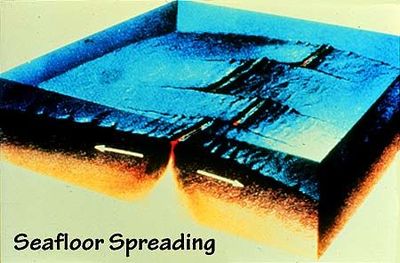
- AEarthquakes break apart the ocean floor.
- BSediments accumulate (build up) at the area of spreading.
- CNew material is being added to the asthenosphere.
- DMolten material beneath Earth’s crust rises to the surface.
20What kind of plate boundary makes a subduction zone and often makes big earthquakes?
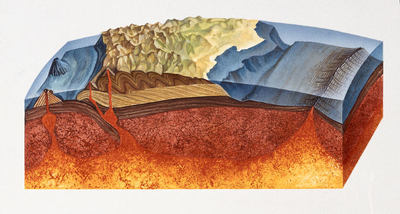
- ATransform
- BConvergent with an ocean plate and a continental plate
- CConvergent with two continental plates
- DDivergent
21The India Continetnal Plate is constantly pushing north up into the Eurasian Continental Plate. What kind of plate boundary is this, and what kind of landform is being created?
- AConvergent and volcanoes
- BDivergent and ridges
- CDivergent and volcanoes
- DConvergent and folded mountains
22What is the place beneath earth where rock breaks and sends out seismic waves in all directions from the point where the rock broke to cause earthquakes called?
- AThe epicenter
- BThe focus
- CThe seismocenter
- DThe aftershock
23Which type of plate boundary is considered a constructive Earth process as new igneous rocks are being formed?
- ADivergent
- BConvergent with two continental plates
- CConvergent with an ocean plate and a continental plate
- DTransform
24Which part of the water cycle happens when water RELEASES thermal energy?
- AEvaporation
- BCondensation
- CPercipitation
- DTranspiration
25Which of the following is the correct definition for density?
- ADensity is the amount of space something takes up.
- BDensity is the amount of matter in an object.
- CDensity is the amount of matter in a specific space.
- DDensity is the temperature of an object affecting its mass.
26What are the two main things that make a metamorphic rock?
- AConvection currents and intense heat.
- Bintense heat and pressure
- Ccooling and cementation
- Dfriction and wind
27This diagram shows many of the processes that change rocks from one form to another. Uplift is a term that refers to rocks being pushed up from faulting or folding of rock. Weathering breaks down rock. Extrusive igneous rock will form on the OUTSIDE of the volcano from cooled lava as it erupts. The intrusive igneous rock forms from cooled magma inside earth. What process provides the transportation of rock down the mountain?
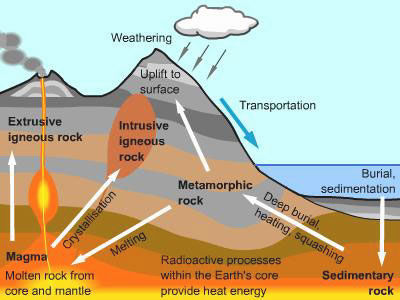
- Aerosion
- Bweathering
- Ctranspiration
- Dfaulting
Información
- Descripción
- High School Diploma Science Test sobre Earth Science, creado por Niat L el 09/03/2014.
- Autor
- Niat L
- Idioma
- English
- Visitas
- 419
- Etiquetas
- Valoración
- Aún sin valoraciones Valora este test