
Test
S377 Chapter 14
Este test tiene tipos de pregunta que se abren en el reproductor de siempre.
Preguntas del test (13)
1Cell death is an essential process in development and tissue homeostasis.
- AVerdadero
- BFalso
2Cells can die by different mechanisms. Regulated cell death can be of several types, including apoptosis, which involves the action of [blank_start]caspases[blank_end], and autophagic cell death, in which [blank_start]lysosomes[blank_end] are involved. Other forms of death have been described. [blank_start]Necrotic[blank_end] cell death is an unregulated response to severe physiological insults.
- Acaspases
- Blysosomes
- CNecrotic
3Dying cells can be identified not only by their appearance under the EM, but also by histochemical and biochemical methods that demonstrate [blank_start]DNA fragmentation[blank_end], membrane [blank_start]disruption[blank_end] and [blank_start]caspase[blank_end] activation.
- ADNA fragmentation
- Bdisruption
- Ccaspase
4[blank_start]Apoptosis[blank_end], or programmed cell death, involves [blank_start]proteins[blank_end] and signalling [blank_start]pathways[blank_end] that are evolutionarily [blank_start]conserved[blank_end] between animals from C. elegans to humans.
In mammals, many [blank_start]homologues[blank_end] of these proteins have been identified, and apoptosis is under complex and tight [blank_start]regulation[blank_end], which varies between different cell types.- AApoptosis
- Bproteins
- Cpathways
- Dconserved
- Ehomologues
- Fregulation
5[blank_start]Caspases[blank_end] exist as [blank_start]zymogens[blank_end], the procaspases, which can be activated by two main routes; an [blank_start]extrinsic[blank_end] pathway, which involves the activation of cell surface [blank_start]death receptors[blank_end], and [blank_start]intrinsic[blank_end] routes, most of which involve the [blank_start]mitochondria[blank_end].
- ACaspases
- Bzymogens
- Cextrinsic
- Ddeath receptors
- Eintrinsic
- Fmitochondria
6Other organelles, in particular the [blank_start]endoplasmic reticulum[blank_end], also play a role in the regulation of cell death via [blank_start]intrinsic[blank_end] pathways.
- Aendoplasmic reticulum
- Bintrinsic
7[blank_start]Caspases[blank_end] are a family of [blank_start]proteases[blank_end] that cleave substrates at aspartate residues.
There are two subfamilies of caspases, one involved predominantly in [blank_start]cell death[blank_end] and the other in cytokine processing.
Inactive caspases (i.e. [blank_start]procaspases[blank_end]) consist of a large and a small subunit and a [blank_start]prodomain[blank_end] of variable length.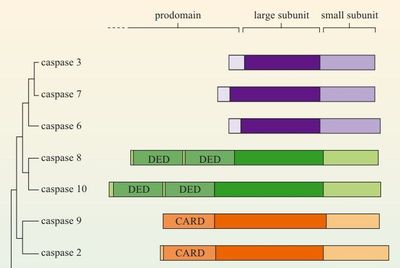
- ACaspases
- Bproteases
- Ccell death
- Dprocaspases
- Eprodomain
8Two types of caspase, [blank_start]initiator[blank_end] caspases and effector [blank_start]caspases[blank_end], are involved in cell death. Initiator caspases, when activated, go on to activate [blank_start]effector[blank_end] caspases, which in turn go on to cleave downstream [blank_start]cellular proteins[blank_end].
- Ainitiator
- Bcaspases
- Ceffector
- Dcellular proteins
9Initiator [blank_start]procaspases[blank_end] exist as monomers and possess a [blank_start]long[blank_end] prodomain, which include either [blank_start]CARD[blank_end] or DED domains. They are [blank_start]self-activated[blank_end], a process made possible by assembly into large multimolecular aggregates. This is called [blank_start]scaffold-mediated activation[blank_end] and involves interactions with homologous CARD or [blank_start]DED[blank_end] domains on other proteins.
- Aprocaspases
- Blong
- CCARD
- Dself-activated
- Escaffold-mediated activation
- FDED
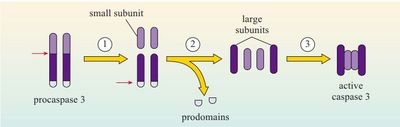
10[blank_start]Effector[blank_end] procaspases exist as [blank_start]dimers[blank_end]. They have a [blank_start]short prodomain[blank_end] and are activated upon cleavage by [blank_start]initiator[blank_end] caspases. Activation takes place by cleavage between the [blank_start]subunit domains[blank_end], and removal of the [blank_start]prodomain[blank_end]; activated effector caspases are [blank_start]tetramers[blank_end].
- AEffector
- Bshort prodomain
- Cinitiator
- Dsubunit domains
- Eprodomain
- Ftetramers
- Gdimers
11Certain activated caspases are inhibited by [blank_start]IAPs (Inhibitors of APoptosis)[blank_end], a family of proteins some of which are [blank_start]ubiquitin[blank_end] ligases. IAPs act by binding activated caspases, thereby inactivating them [blank_start]directly[blank_end], and also targeting them for [blank_start]degradation[blank_end] at the [blank_start]proteosome[blank_end]. (They may also act by a mechanism that involves their N-terminal amino acid.)
Caspases may be inhibited by [blank_start]synthetic[blank_end] peptides that have the same sequence of amino acids as that of the cleavage sites of their substrates.- AIAPs (Inhibitors of APoptosis)
- Bubiquitin
- Cdirectly
- Ddegradation
- Eproteosome
- Fsynthetic
12Label the diagram of the extrinsic pathway of apoptosis

- ADeath Domains (DD)
- Bligand binding brings DDs together
- CAdaptor proteins bind
- Ddeath-inducing signalling complex (DISC)
- Einitiator caspase binds
- Finitiator caspase activated
- Geffector caspase activated
- Hin some cells, cleaves Bid
- Itriggers intrinsic pathway
13The [blank_start]extrinsic[blank_end] apoptotic pathway involves activation of [blank_start]cell surface receptors[blank_end] by ligands that may be soluble or on the surface of other cells. The extrinsic pathway is involved in [blank_start]targeted killing[blank_end] and is essential, among other things, for [blank_start]lymphocyte[blank_end] development and regulation of lymphocyte numbers following an [blank_start]immune response[blank_end].
[blank_start]Death receptors[blank_end] (e.g. Fas) on the target cells [blank_start]cluster[blank_end] upon binding of ligand (e.g. Fas ligand). The intracellular part of each death receptor includes a [blank_start]death domain[blank_end] that is also present in [blank_start]adaptor proteins[blank_end], which are hence recruited to the activated receptor to form a complex known as the [blank_start]DISC[blank_end]. The adaptors also possess a [blank_start]death effector domain[blank_end], shared by some [blank_start]initiator procaspases[blank_end] (e.g. procaspase 8). Thus initiator procaspases are recruited to the DISC and this proximity allows their [blank_start]autoactivation[blank_end].
The activated initiator caspases may go on to directly cleave downstream [blank_start]effector caspases[blank_end] (e.g. procaspase 3) or Bid, which stimulates the [blank_start]intrinsic[blank_end] pathway.
Activation of the extrinsic pathway may be inhibited by [blank_start]decoy receptors[blank_end], or decoy adaptors/caspases, which lack [blank_start]functional domains[blank_end].- Aextrinsic
- Bcell surface receptors
- Ctargeted killing
- Dlymphocyte
- Eimmune response
- FDeath receptors
- Gcluster
- Hdeath domain
- Iadaptor proteins
- JDISC
- Kdeath effector domain
- Linitiator procaspases
- Mautoactivation
- Neffector caspases
- Ointrinsic
- Pdecoy receptors
- Qfunctional domains
Información
- Descripción
- Quiz based on summaries of chapter 14
- Autor
- Mikki M
- Idioma
- English
- Visitas
- 35
- Etiquetas
- Valoración
- Aún sin valoraciones Valora este test