
Test
Sympathetic (adrenergic) system
Este test tiene tipos de pregunta que se abren en el reproductor de siempre.
Preguntas del test (17)
1which are the major neurotransmitters in the adrenergic system?
- Aacetylcholine
- Bserotonin
- Cnorepinephrine
- Depinhephrine
- Eepinephrine
- Fdopamine
- Gother catecholamines and amines
2at the adrenergic neurones, an action potential causes depolarisation and an influx of calcium ions. THis triggers catecholamin release by exocytosis, followed by activation of postjunctional receptors. The mechanisms that may account for inactivation of catecholamines in the nervous system include [blank_start]neuronal[blank_end] uptake ([blank_start]sodium[blank_end] dependent in the cytoplasm and [blank_start]magnesium[blank_end] dependent in the granules), [blank_start]absorption[blank_end] in surrounding tissue, [blank_start]MAOs[blank_end] deaminating catecholamines and [blank_start]COMT[blank_end] inactivating catecholamines.
- Aneuronal
- Bsodium
- Cmagnesium
- Dabsorption
- EMAOs
- FCOMT
3just like the cholinergic system, effects of adrenergic sympathetic activation are mediated through a series of complex G-coupled protein receptors. The most common receptors and their distribution in the adrenergic system are as follows:
1. [blank_start]alpha 1[blank_end] - smooth muscles, blood vessels, CNS
2. [blank_start]Alpha 2[blank_end] - some organ systems, CNS pre-synaptic
3. [blank_start]beta 1[blank_end] - mainly heart
4. [blank_start]beta 2[blank_end] - some organ systems, lungs some large blood vessels
5. [blank_start]dopamine[blank_end] - brain, coronary, kidney and mesenteric.- Aalpha 1
- BAlpha 2
- Cbeta 1
- Dbeta 2
- Edopamine
4what physiological change is characteristic of a generalised sympathetic discharge and what receptors mediate this effect?
- Adiarrhoea via muscarinic receptors in intestines
- Burination via muscarinic receptors in the bladder spincter
- Cmiosis via alpha 1 receptors in the circular iris muscles
- Dmydriasis via alpha 1 receptors of the radial iris muscles.
5what is the effect of sympathomimetics on heart rate and force of cardiac contraction?
- Ainhibitory with a general decrease
- Bexcitatory with a general increase of rate and force
- Cheart rate increases but contractile force is decreased
- Dheart rate decreases but contractile force is increased
- Eheart rate and contractile force are not altered.
6beta 2 receptors are considered inhibitory and therefore useful for induction of smooth muscle relaxation. What grouop of autonomic system modifying drugs would you consider to be useful against allergen induced bronchoconstriction and heaves in a horse?
- Abeta- 2 adrenergic receptor antagonists eg: propranolol
- Bmuscarainic receptor agonists eg: carbachol
- Cbeta-2 adrenergic receptor agonists eg: albuterol
- Dhistamine-2 receptor antagonists eg: ranitidine
- Ealpha adrenergic receptor agonists eg: pheylephrine
7Your patient is a large breed, spayed female dog with incontinence due to urethral spinchter incompetence mainly controlled by alpha 1 receptors. What autonomic modifying drug may be appropriate for this problem?
- Aphenylpropanolamine, a noradernaline releasing agent
- Bdobutamine, a selective beta-1 receptor agonist
- Cpropranolol, a beta1/2 receptor antagonist
- Dphenoxybenzamine, an alpha-1 receptor antagonist
- Etetracycline, a broad spectrum antibiotic.
8stimualteion of alpha 1 receptors in the bladder neck and proximal urethra narrows the bladder outlet maintaining continence. THe inappropriate contraction of the bladder neck or muscular urethra during the voiding phase prevents normal urine outflow and is termed 'functional urethra obstruction' . Which of the following drugs would you prescribe for a dog with functional urethra obstruction?
- Apropranolol, a beta receptor antagonist
- Bterbutaline, a beta 2 selective agonist
- Cmetaraminol, an alpha 1 receptor agonist
- Dsalbutamol, a beta 2 selective agonist
- Ephenoxybenzamine, an alpha 1 receptor antagonist.
9you are presented with a dog showing signs of severe sympathetic discharge, cardiac arrhythmias and hypertrophic cardiomyopathy, what adrenergic drug would you administer to minimize these catecholamine-induced cardiac effects?
- Adobutamine, a selective beta 1 receptor agonist
- Bsalbutamol, a selective beta-2 receptor agonist
- Cphenoxybenzamine, an alpha 1 receptor antagonist
- Dphentolamin, a non-selective alpha receptor antagonist.
- Epropranolol, a beta-receptor antagonist
10adrenergic effects may be modified by specific receptor agonists or antagonists, which of the following compounds directly stimulates alpha receptors?
- Anoradrenaline
- Badrenaline
- Csalbutamol
- Disoproterenol
- Enoradrenaline and adrenaline
11adrenergic effects may be modified by specific receptor agonists or antagonists, which of the following compounds directly stimulates beta receptors?
- Anoradrenaline
- Badrenaline
- Csalbutamol
- Disoproterenol
- Enoradrenaline and adrenaline
12alpha 2 receptors are stimulated by catecholamines such as noradrenaline. In the CNS (brain and spinal cord), the inhibitory nature of these receptors plays a critical role in controlling vital physiological functions including wakefulness/sleep, skeletal muscle tone and pain. What represents two commonly used alpha 2 receptor agonists for induction of sedation, muscle relaxation and analgesia in veterinary medicine?
- Anoradrenaline and xylazin
- Bxylazine and medetomidine
- Csalbutamol and phenoxybenzamine
- Disoproterenol and dexmedtomidine
13For which of the following clinical conditions would you administer alpha/beta receptor agonists?
- Ainduce mydriasis in opthalmology
- Breduce myometrial contraction during premature labour
- Capplied topically to reduce nasal congestion
- Dto induce vomiting
- Eto induce anorexia
- Fprophylaxis against asthma
- Ga hemostatic agent to stop epistaxis
- Hused in combination with local anesthetics to prolong the duration of action
- Ihypotension associated with anaphylaxis
- Jmanagement of anaphylactic and allergic reactions
14the diagram represents part of the sympathetic nerve supply to the myocardium, the sinoatrial node, the atrioventricular node and the HIS purkinje system. What adrenergic receptor subtype is responsible for physiological changes at neuro-effector junction in the heart structures identified in the diagram?
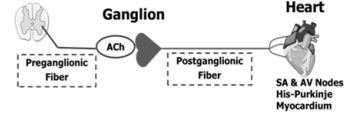
- Aserotonin receptors
- Bhistamine receptors
- Cbeta-1 adrenergic receptors
- Dmuscarinic receptor subtype
15the diagram is an illustration of physiological changes in heart rate and blood pressure following the administration of a sympathomimetic drug (dobutamine). what explains why dobutamine causes an increase in heart rate and cardiac contractility with minimal effect on blood pressure.
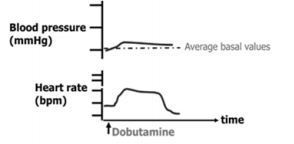
- Adobutamine blocks all the alpha-1 receptors
- Bdobutamine has potent muscarinic activity
- Cdobutamine directly stimulates nicotinic receptors
- Ddobutamine is a selective beta-1 agonist with some activity at beta-2 receptors that subserve vasodilation
- Edobutamine blocks both beta 1 and beta 2 receptors
16norepinephrine, epinephrine and isoproterenol were administered to a small cat. The tracings show measured heart rate, blood pressure, pulse rate, myocardial contractility and dopller assisted assessment of femoral and renal blood flow. Identify the adrenergic receptors (either alpha, beta 1 or beta 2)that may be involved in mediating the physiological effects at sites 1-13.
1. [blank_start]alpha[blank_end]
2. [blank_start]alpha[blank_end] and [blank_start]beta 2[blank_end]
3. [blank_start]beta 2[blank_end]
4. [blank_start]alpha[blank_end]
5. [blank_start]beta 2[blank_end]
6. [blank_start]beta 2[blank_end]
7. [blank_start]alpha[blank_end]
8. [blank_start]alpha[blank_end]
9. [blank_start]beta 1[blank_end] and [blank_start]beta 2[blank_end]
10-13. [blank_start]beta 1[blank_end].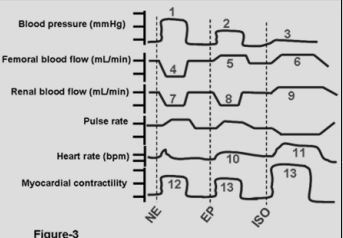
- Aalpha
- Balpha
- Cbeta 2
- Dbeta 2
- Ealpha
- Fbeta 2
- Gbeta 2
- Halpha
- Ialpha
- Jbeta 1
- Kbeta 2
- Lbeta 1
17Shown is a tracing of blood pressure easurement for an old cat that was given a therapeutic dose of epinephrine immediately after administering phenoxybenzamine. The penomenon where tehe blood pressure drops is known as '[blank_start]epinephrine reversal[blank_end]' in the presence of [blank_start]alpha -receptor[blank_end] blockers, epinephrine exergs an exaggerated [blank_start]beta-receptor[blank_end] activation including beta-2 receptors in the peripheral. The resultant effect is [blank_start]vasodilation[blank_end], decreased [blank_start]peripneral resistance and blood pressure[blank_end].
- Aepinephrine reversal
- Balpha -receptor
- Cbeta-receptor
- Dvasodilation
- Eperipneral resistance and blood pressure
Información
- Descripción
- Pharmacology (Autonomic Pharmacology) Quiz on Sympathetic (adrenergic) system , created by Kayleigh Alex on 17/10/2016.
- Autor
- Kayleigh Van
- Idioma
- English
- Visitas
- 64
- Etiquetas
- Valoración
- Aún sin valoraciones Valora este test