
Test
Nervous control of heart rate
Este test tiene tipos de pregunta que se abren en el reproductor de siempre.
Preguntas del test (5)
1Heart rate is controlled by the cardiovascular control centre located in the [blank_start]medulla oblongata[blank_end] region of the brain. Nerves forming part of the ANS ([blank_start]no control over[blank_end]) lead from the CCC to the heart. There are 2 nerves: a [blank_start]sympathetic[blank_end] nerve (accelerator) and the vagus nerve, which is a [blank_start]parasympathetic[blank_end] nerve (decelerator). Stimulation of the SAN by the by the sympathetic nerve causes [blank_start]an increase[blank_end] in heart rate, whereas impulses from the vagus nerve [blank_start]slow down[blank_end] the rate. The CCC detects accumulation of CO2 and lactate in the blood, reduction of oxygen, and increased temperature. Mechanical activity in muscles and joints is detected by sensory receptors in muscles, and impulses are sent to the CCC. [blank_start]Skeletal[blank_end] muscles contract and stretch receptors in the muscles and tendons are stimulated. They send impulses to the CCC. This in turn raises the heart rate via the sympathetic nerve. There is an increase in [blank_start]venous[blank_end] return, which leads to a rise in the stroke volume. The elevated heart rate and stroke volume together result in higher cardiac output, thus transporting oxygen and fuel to muscles more quickly.
- Amedulla oblongata
- Bhypothalamus
- Cno control over
- Dcontrol over
- Esympathetic
- Fparasympathetic
- Gparasympathetic
- Hsympathetic
- Ian increase
- Ja decrease
- Kslows down
- Lincreases
- MSkeletal
- NSmooth
- Ovenous
- Parterous
2Label the diagram:
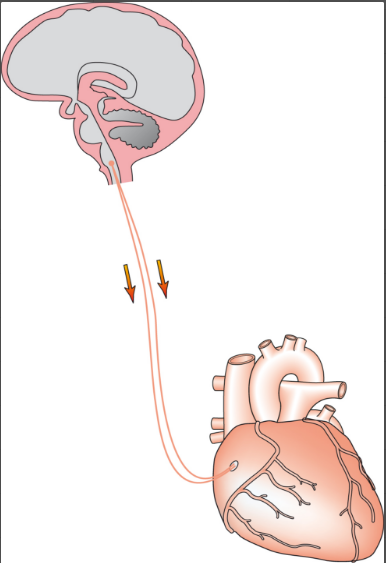
- Amedulla oblongata
- Bcardiovascular control centre
- Csympathetic nerve
- Dvagus nerve (parasympathetic)
- Esinoatrial node
3[blank_start]Blood pressure[blank_end] rises with higher cardiac output. To prevent it rising too far, [blank_start]pressure receptors[blank_end] in the aorta and in the carotid artery send nerve impulses back to the CCC. Inhibitory nerve impulses are then sent from here to the [blank_start]SAN[blank_end]. This prevents an excessive rise in blood pressure through [blank_start]negative feedback[blank_end], which prevents a further rise in heart rate.
- ABlood pressure
- Bpressure receptors
- CSAN
- Dnegative feedback
4With sympathetic stimulation, the intercostal muscles increase breathing rate, the heart increases heart rate and stroke volume, and the gut inhibits peristalsis (muscle contractions in the gut wall that move food through the gut).
- AVerdadero
- BFalso
5Fear, excitement and shock cause the release of the hormone [blank_start]adrenaline[blank_end] into the bloodstream from the [blank_start]adrenal glands[blank_end], located above the kidneys. Adrenaline has an effect on the heart rate similar to stimulation by the [blank_start]sympathetic[blank_end] nerve. It has a direct effect on the [blank_start]SAN[blank_end], increasing the heart rate to prepare the body for any likely physical demands. Adrenaline also causes [blank_start]dilation[blank_end] of the arterioles supplying skeletal muscles, and [blank_start]constriction[blank_end] of arterioles going to the digestive system and other non-essential organs; this maximises blood flow to the active muscles. Adrenaline causes an anticipatory increase in heart rate before the start of a race.
- Aadrenaline
- Badrenal glands
- Csympathetic
- DSAN
- Edilation
- Fconstriction
Información
- Descripción
- 5 questions
- Autor
- Ella Middlemiss
- Idioma
- English
- Visitas
- 47
- Etiquetas
- Valoración
- Aún sin valoraciones Valora este test